
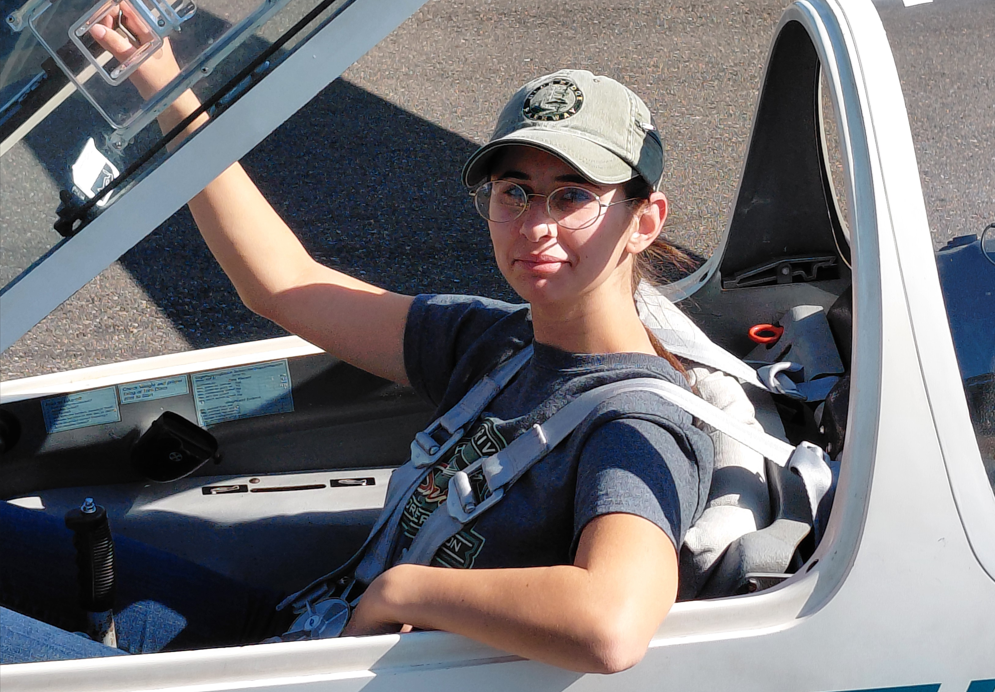
17-year-old Anastasia Mitsky is pretty serious when it comes to flying, but she laughs and smiles a good bit when talking about her amazing flight.
By Tom Peterson
The Dalles, Ore., Oct. 16, 2025 — Air flowing over the airframe of the ASK-21 glider sounded like winding-up wind as Anastasia Mitsky of The Dalles heard the beeping increase.
She was 4,000 feet above Odell and lifting higher on her second solo flight on Aug. 7. And her lift instrument was beginning to speak in high volume.
The 17-year-old was headed up — but she had no clue how far.
Her plane was climbing, and the rate of ascent was increasing, causing the beeping in her variometer to rise like her heart rate. She was using ridge lift off an area called the Dog Bowl to fly higher — wind pushed upward into the sky by the ridge.
“I hit a mountain wave,” she said. It’s a strong wind that came over Mount Hood, bounced into the ground, and rebounded into the air, creating lift for her glider. “I got into the sweet spot — high enough to hit that wave.”
Her plane pitched and went higher — higher than when it was released from the tow plane after taking off from the Hood River Airport.
Her adrenaline was flowing. “I did not expect I would do that,” she said.
“Soon I was riding a powerful lift line beneath a wide cloud street. The altimeter ticked past 5,000 feet, then 5,700, 6,200… and finally 7,400,” she said.
A cloud street is a long line of cumulus clouds formed by rising air currents, creating “highways” in the sky that let glider pilots travel miles in lift without circling.
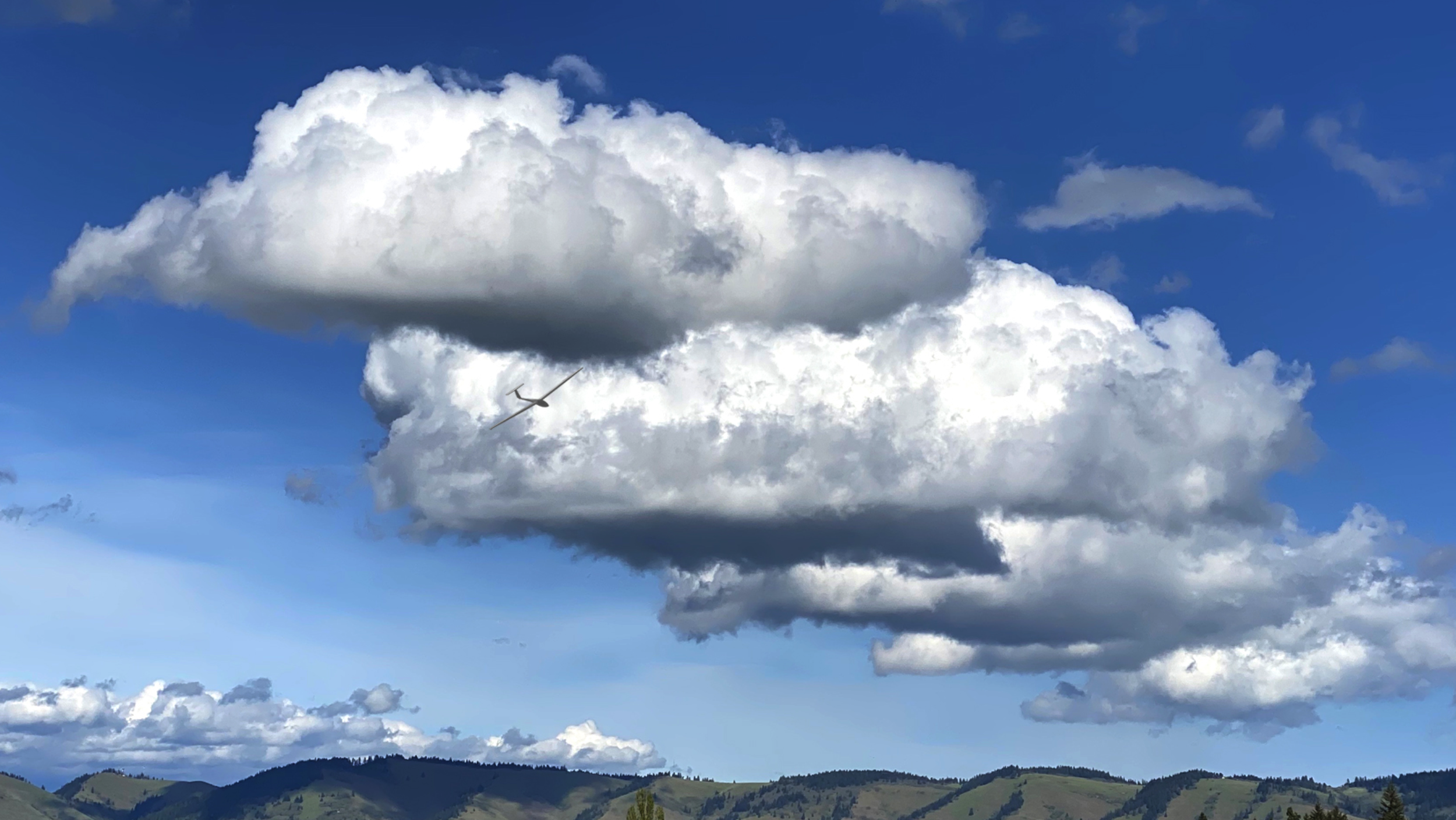
Cloud street above is a good example of how a glider can utilize lift on a series of cumulous clouds to carry them forward and upward. Photo courtesy Hood River Soaring.
“Mixed in with the growing anticipation of getting higher, I grew more and more cautious,” she continued. “I didn’t want to be pulled into the cloud base, yet I still wanted more altitude. That’s when I remembered a technique I’d seen Jonathan use on a flight: working lift along the side of the cloud while staying clear of its base. I shifted into position, and the vario (or lift indicator) kept singing without pulling me any closer to the white wall above.”
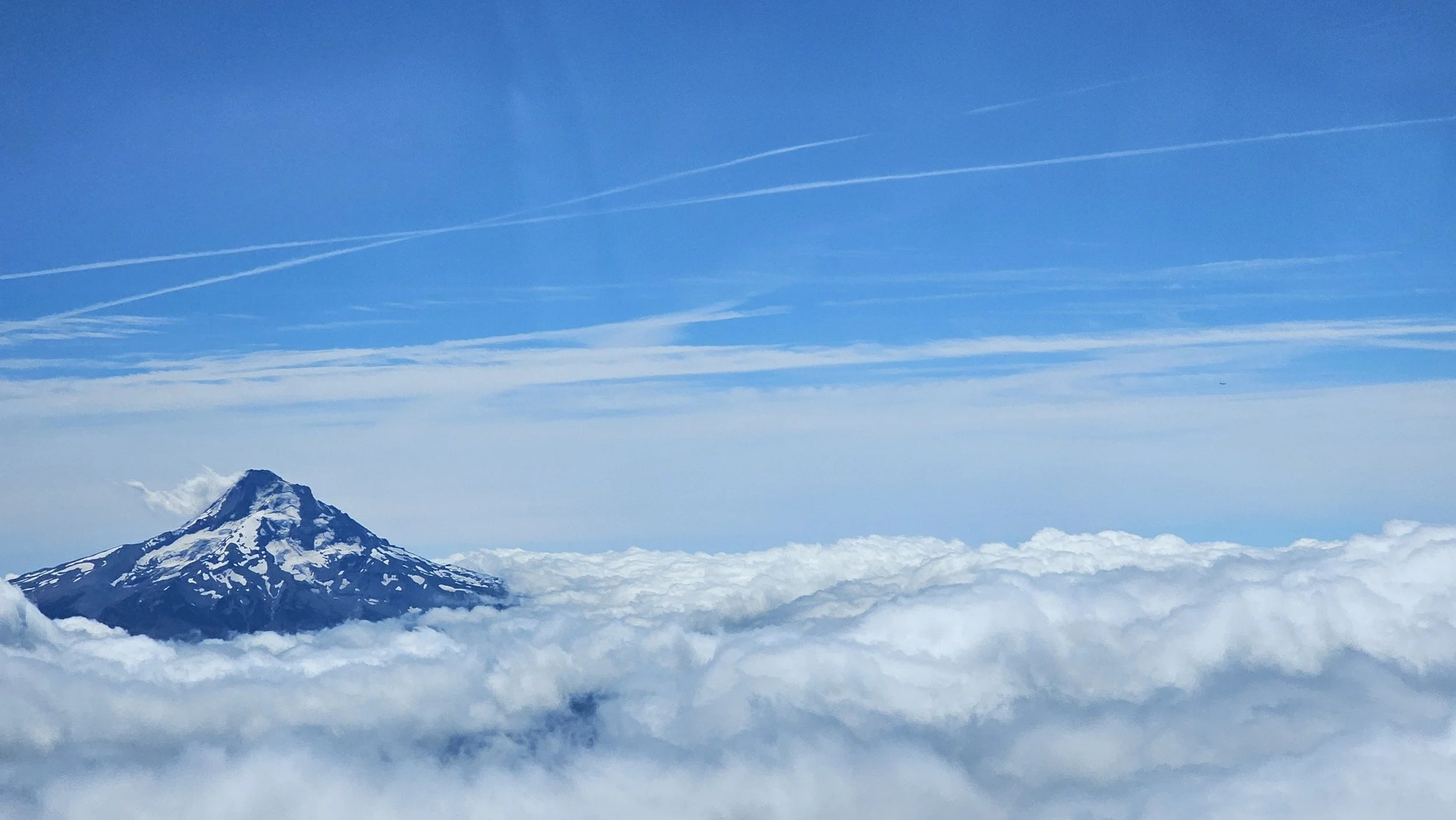
Mistky’s flight had her looking straight into Mt. Hood as her altitude was just below the top of the 11,249-foot tall Cascade peak. Epic.
“The next thing I knew I was already soaring over the sea of clouds with Mt. Hood in its prime beauty at 9,500 feet, with my peak altitude just shy of 9,800.”
That’s about two miles above sea level. Mitsky maintained her altitude and took in the incredible sights of Mount Hood and the airport below.
After about 15 minutes, it also became a bit unnerving — flying so high, so fast, all alone. “Maybe I should go back now,” she thought.
Her flight instructor, Brian Hart, who had trained Anastasia over the past several months to prepare her for this flight, radioed her from the ground every 10 minutes, checking her altitude.
“You still there?” he asked.
He kept it professional, she said, maintaining calm communication, but his heart was likely soaring like hers as his pupil made this rare and enviable flight — utilizing her skills to draft higher and higher as she managed to put her plane in the right place at the right time.
It took Anastasia 25 minutes to descend from the high altitude, and when she landed, she realized she had been aloft for an hour and 48 minutes.
“It was really, really memorable,” she said. “I will remember it for the rest of my life.”
“The sound, the feel of the controls, the feel of buffet and turning,” she said.
Is it a superpower?
“Yes. I never assumed it. But being alone above a sea of clouds… it is just something,” she said.
The fledgling flew above all others that day, even getting a radio call from a seasoned pilot asking where she caught her lifts.

Mitsky, right, shakes hands with her instructor Brian Hart at Left and FAA Designated Pilot Examiner Robin Reid on the left after her checkride in the ASK-21 glider at Hood River Soaring.
Reaching 9,800 feet on a third solo glider flight is well outside the standard expectations for a new solo student and requires exceptional weather conditions and advanced thermal-soaring skills that pilots typically develop with much more experience.
Anastasia had soared so high, so soon.
“I knew right then this was the kind of flight I’d be chasing again,” she said.