

Photo of the Adventist Health Columbia Gorge hospital on East 19th Street in The Dalles. Courtesy Adventist.
The Dalles, Ore., May 6, 2026 — Adventist Health Columbia Gorge’s push to become a federally designated Critical Access Hospital may appear at first glance to be an administrative change, but healthcare experts and policymakers increasingly view such moves as part of a broader fight for survival among rural hospitals across America.
Even many critics who believe the American healthcare system is financially broken remain wary of dramatic, rapid overhaul because hospitals are not abstract institutions — they are the places communities rely on for emergency rooms, trauma care, childbirth and life-saving treatment. When rural hospitals lose departments or close entirely, patients can face hours-long drives for critical care.
Lives hang in the balance.
That reality has left the country politically stuck between growing frustration over unsustainable healthcare costs and fear that aggressive reform could destabilize care before a replacement system exists. The result has been gradual restructuring instead: reimbursement changes, federal stabilization programs and hospitals repositioning themselves financially in hopes of surviving a system many leaders quietly acknowledge is under mounting strain.
It all comes down to paying for and retaining services.

Adventist Health Columbia Gorge Administrator Jayme Thompson
At Adventist in The Dalles, The Centers for Medicare and Medicaid Services recently approved the hospital’s application to become a Critical Access Hospital, marking a major milestone in the transition process. The designation, once finalized through an upcoming Joint Commission survey, would change how the hospital is reimbursed by Medicare and potentially strengthen the long-term financial stability of healthcare services in the Columbia Gorge.
“Gaining this status is foundational to ensuring we have a long future of providing much-needed care for our Columbia Gorge community,” Adventist Health Columbia Gorge Administrator Jayme Thompson said in a news release today, May 6.
The hospital’s language mirrors a growing national concern over the future of rural healthcare.
While the Critical Access Hospital program has existed since the late 1990s, healthcare analysts say increasing financial pressure on small rural hospitals has made the designation far more important in recent years. Under the designation, qualifying hospitals receive cost-based Medicare reimbursement instead of fixed prospective payment rates, a structure designed to help small rural facilities remain financially viable.
Adventist Health Columbia Gorge currently operates as a 25-bed hospital — the same scale the federal Critical Access model was originally designed to protect.
Nationally, nearly half of rural hospitals are operating at a financial loss, according to a March 2026 Reuters analysis examining the fragile economics of rural healthcare systems. Reuters reported that more than 100 rural hospitals have closed since 2005, while dozens more have eliminated inpatient services entirely as healthcare costs, labor shortages and reimbursement pressures intensified.
In Oregon, financial warning signs have also grown more visible.
Last year, Oregon Sens. Ron Wyden and Jeff Merkley joined Senate Democrats in releasing data from the Cecil G. Sheps Center for Health Services Research at the University of North Carolina warning that more than 300 rural hospitals nationwide were at disproportionate risk of closure, conversion or service reductions because of financial stress and proposed Medicaid cuts. The report specifically identified Oregon hospitals in Seaside, Madras, Hermiston and Silverton as financially vulnerable.

Merkley speaking at a town hall meeting in Parkdale in February.
The senators warned that cuts to Medicaid funding could increase uncompensated care while forcing some rural hospitals to reduce services, convert to emergency-only facilities or close entirely.
“As I hold town hall meetings in each of Oregon’s 36 counties, I frequently hear about struggles folks have in accessing health care in their communities,” Merkley said in the June 2025 release. “More than 300 rural hospitals will be at risk of shutting down — in Oregon and across the country.”
Wyden similarly warned that rural hospitals were already “walking on an economic tightrope.”
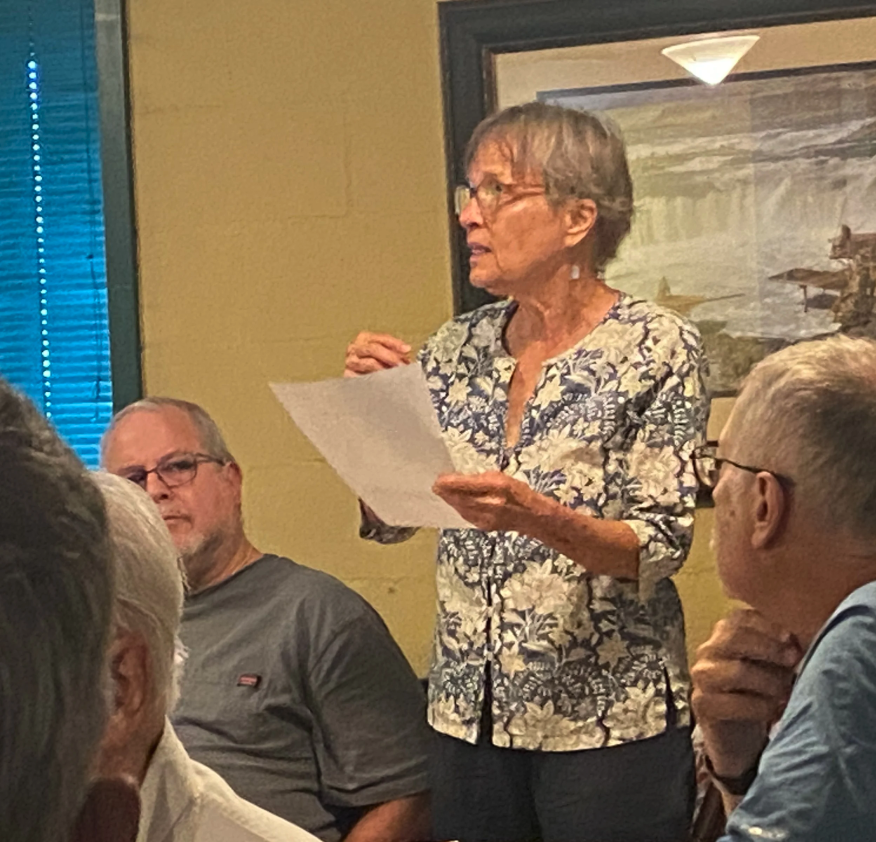
Linda Kentro
Those concerns surfaced locally last August during a Rotary Club meeting in The Dalles when audience member Linda Kentro asked Cliff Bentz about reports of hospitals considering cuts to emergency and maternity services.
“Already Seaside, Baker City, Madras and Hermiston hospitals are looking at closing departments,” Kentro said. “Delay in services costs lives.”
Bentz responded by acknowledging the seriousness of the issue.
“This is an existential issue to my hospitals,” Bentz said, adding that he was gathering financial data from hospitals across Eastern Oregon to monitor the effects of federal healthcare funding changes.

U.S. Rep Cliff Bentz responds to a question at The Dalles Rotary Club meeting on Aug. 20th, 2025 at Spooky’s Restaurant.
The growing concern comes amid national debate surrounding federal Medicaid spending reductions included in President Donald Trump’s “One Big Beautiful Bill Act,” which paired nearly $1 trillion in projected Medicaid spending reductions over a decade with a separate $50 billion Rural Health Transformation Program intended to help stabilize rural healthcare systems.
Supporters of the legislation argue the rural healthcare fund represents one of the largest federal investments ever directed toward rural medical systems. Critics, however, argue the stabilization funding may not fully offset projected Medicaid losses for small hospitals that rely heavily on government insurance programs.
Healthcare industry groups have also warned that Medicare reimbursement rates increasingly fail to cover the true cost of care. The American Hospital Association reported Medicare reimbursed hospitals roughly 82 cents for every dollar spent caring for Medicare patients in recent years, creating particular strain for small rural facilities with aging patient populations and fewer privately insured patients.
The financial pressure intensified after the COVID-19 pandemic, when labor shortages and rising contract nurse costs dramatically increased operating expenses for hospitals nationwide.
For many rural hospitals, Critical Access Hospital designation has increasingly become less about expansion and more about sustainability.
“In anticipation of a quick turnaround on the finalization of Critical Access Hospital approval, Adventist Health Columbia Gorge leaders and staff have prepared policy, record, and procedure changes to ensure a seamless transition for patients,” Adventist Health said in the May 6 press release.