
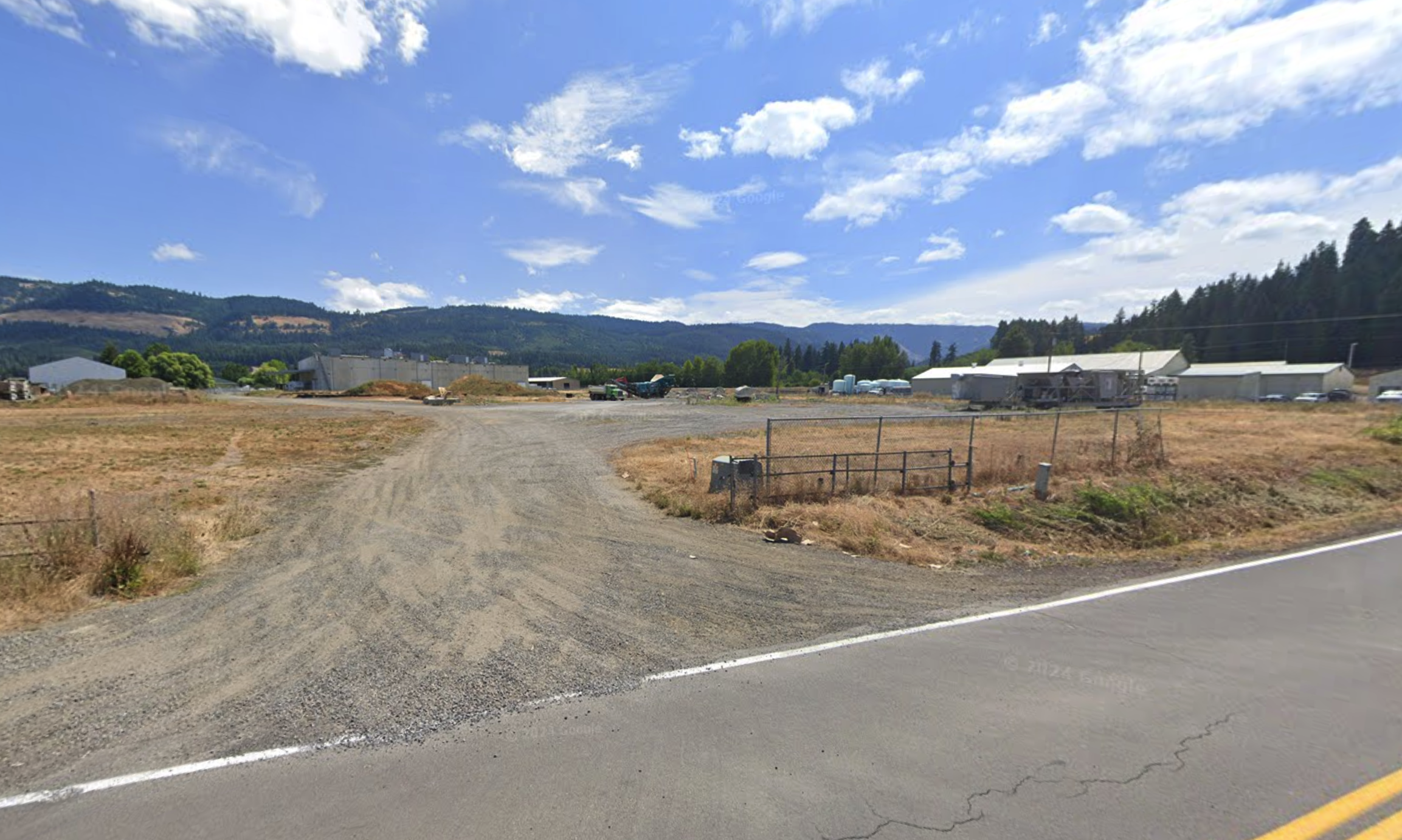
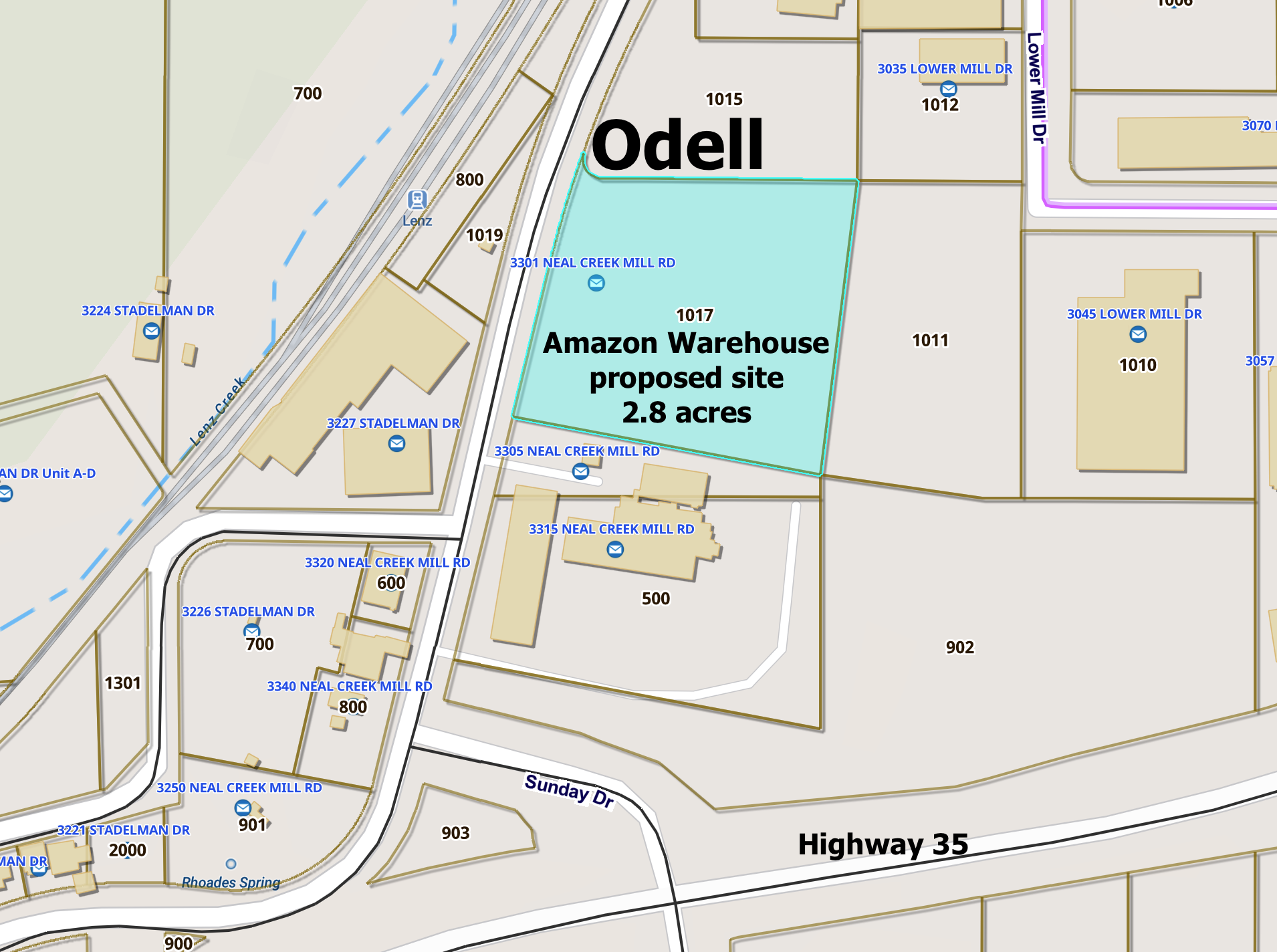
Proposed site for Amazon Warehouse in Odell on Neil Creek Mill Road.
The Dalles, Ore., June 5, 2026 — The debate over Amazon's proposed warehouse and distribution center near Odell may ultimately come down to a fundamental question of process: Did the company fail to meet county traffic standards, or did the standards themselves change during the review process?
The Hood River County Planning Commission voted 5-2 on May 27 to sustain an appeal filed by Thrive Hood River and deny Amazon's proposed 48,960-square-foot last-mile distribution facility on the former Lower Hanel Mill property along Highway 35. The decision came despite a recommendation for approval from county planning staff and reviews by the Oregon Department of Transportation that did not identify traffic deficiencies requiring denial.
Thrive Hood River is a local nonprofit land-use advocacy organization that has been involved in several development and planning issues throughout the Hood River Valley. The group describes its mission as promoting responsible land-use decisions and protecting the area's agricultural lands, natural resources and quality of life. Thrive filed the appeal challenging Hood River County's approval of the Amazon proposal.
Commissioners Jon Kelter Gehrig, Jamie Loomis, Kira Guisto, Jay Lyman and Josh Kitts voted in favor of the motion to deny the application. Commissioner Ryland Moore and Planning Commission Chair Erick von Lubken voted against the motion, supporting the county staff recommendation that would have allowed the project to proceed.
At the center of the dispute is not whether the facility would generate additional traffic. All parties acknowledge it would.
According to traffic analyses submitted with the application, the facility is expected to generate an average of 548 daily vehicle trips, including semitrailers, delivery vans, box trucks and passenger vehicles. Traffic volumes could increase by as much as 33% to 50% during the holiday shipping season and other peak delivery periods.

Instead, the disagreement appears to revolve around how traffic impacts should be measured and what evidence is required to demonstrate compliance with county code.
County staff concluded Amazon satisfied applicable land-use standards after reviewing a traffic impact study that examined four intersections near the proposed facility. The study evaluated roadway capacity, turning movements and traffic conditions at locations expected to be most directly affected by the development.

Commissioner Jon Kelter Gehrig
Planning Commission members who voted to deny the project questioned whether that analysis was broad enough to capture real-world conditions along the Highway 35 corridor.
During deliberations, Commissioner Jon Kelter Gehrig argued that traffic impacts should not be viewed solely through the lens of the site's immediate access points. He contended that vehicle trips generated by the warehouse would affect a broader transportation network already used by agricultural operations, tourists and winter recreation visitors.
Commissioner Jay Lyman also expressed concerns that traffic counts were collected during a single day in September and did not include harvest-season or ski-season conditions that can significantly increase traffic volumes in the area.
The distinction may seem technical, but it goes to the heart of the appeal.

Commissioner Jay Lyman
County staff and transportation engineers approached the review using what many planners consider a traditional traffic engineering model: evaluate the intersections directly affected by a project and determine whether those locations can safely accommodate additional traffic.
The Planning Commission majority appeared to adopt a broader view, questioning whether the project's impacts could be fully understood without examining seasonal traffic patterns and conditions beyond the four intersections included in the study.
That difference in interpretation may become a central issue if the matter advances to the Hood River County Board of Commissioners.
The applicable county standard requires applicants to demonstrate that site access will not create dangerous intersections or traffic congestion. What remains less clear is whether that standard requires analysis of only the intersections directly affected by a project or whether it also encompasses broader corridor-wide impacts.
County planning staff maintained that the traffic study satisfied applicable review requirements and noted that ODOT reviewed the analysis during the application process. According to staff reports, the study evaluated the roadway capacity, turning movements and operating conditions associated with the facility's access points.
Attorneys representing Amazon indicated during the hearing that the company was willing to provide additional traffic analysis if requested. However, the Planning Commission majority ultimately voted to sustain the appeal rather than leave the record open for further study.
The written findings supporting the denial have not yet been released. Those findings are expected to clarify the commission's legal basis for concluding the application did not satisfy county standards.
For observers on both sides of the debate, the upcoming findings may prove more important than the vote itself.
The decision raises broader questions about how industrial projects are evaluated in Hood River County and whether future applicants will be expected to address traffic impacts beyond the immediate areas traditionally examined in traffic impact studies.
Amazon has not publicly announced whether it intends to appeal the Planning Commission's decision. If it does, the case will move to the Hood River County Board of Commissioners, which will have the final local say on whether the project proceeds.
Until then, the dispute remains less about traffic itself than about how traffic impacts should be measured — and whether the standards used to evaluate the project remained consistent throughout the review process.
Deeper Analysis
Beyond the fate of Amazon's proposed warehouse, the Planning Commission's decision could have broader implications for how major development projects are reviewed in Hood River County.
At issue is whether the county's traffic standards should be interpreted narrowly, focusing on intersections directly affected by a project, or more broadly, considering impacts across an entire transportation corridor. County staff, ODOT and Amazon's consultants relied on a traffic analysis that examined the intersections expected to experience the most direct effects from the proposed facility. The Planning Commission majority, however, appeared to question whether that approach adequately captured seasonal traffic conditions and broader impacts along Highway 35.
Supporters of that broader view argue it provides a more complete picture of how development affects a community and transportation network. Critics contend it could create uncertainty for applicants who invest significant resources preparing studies based on standards and scopes of review accepted by county staff and state transportation agencies.
Oregon land-use decisions have addressed similar questions before. In one case involving a proposed hotel development in Wheeler, the Oregon Land Use Board of Appeals upheld a denial after concluding the applicant had failed to adequately demonstrate that the project would not create traffic congestion on nearby streets. The decision underscored a long-standing principle in Oregon land-use law: Applicants carry the burden of proving compliance with approval criteria, and local governments are not necessarily required to produce competing evidence if they determine that burden has not been met.
At the same time, Oregon courts and LUBA have generally afforded local governments substantial deference when interpreting their own ordinances, provided those interpretations are consistent with the language, purpose and intent of the code. When disputes arise, appeals often hinge on whether a local government's interpretation is supported by findings and evidence contained in the record.
That may ultimately become the central question in the Amazon case.
The dispute is not simply whether the warehouse would generate additional traffic. Rather, it raises questions about whether the Planning Commission applied a broader interpretation of traffic impacts than the one relied upon by county staff, ODOT and the applicant during the review process.
The outcome could help define how Hood River County evaluates future industrial and commercial projects. If the Planning Commission's interpretation stands, future applicants may be expected to demonstrate not only that nearby intersections can safely accommodate project traffic, but also that broader corridor-wide transportation impacts have been adequately analyzed and addressed.