
City of Maupin Faces Fines for Wastewater Treatment Violations
By: Michael Williams
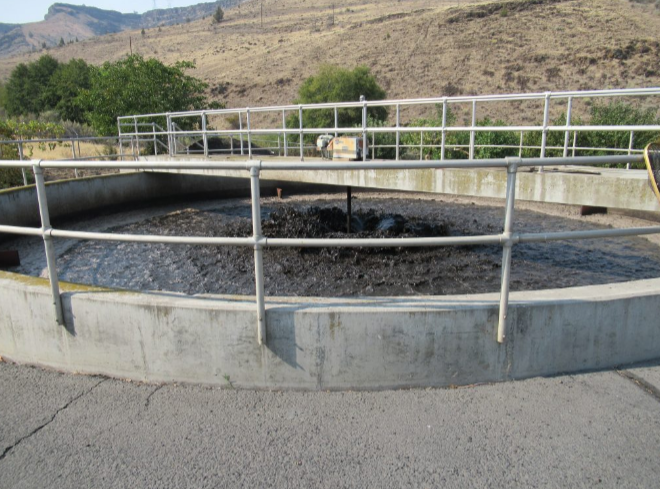
Maupin, Ore., July 8, 2026 — The City of Maupin in north-central Oregon faces an enforcement action from the Oregon Department of Environmental Quality regarding monitoring violations at its wastewater treatment facility operations. The civil penalties of $10,292 were issued for violations related to influent and effluent monitoring, as well as a failure to submit multiple reports by their required deadlines.
The city holds a wastewater disposal permit issued by DEQ, which requires standardized rules for how wastewater is tested, the frequency of testing, and how operations at wastewater treatment facilities are reported. As part of maintaining a valid permit, facilities must test their influent (untreated wastewater) for various analytes, as well as their effluent (treated wastewater) for those same analytes. The purpose of such testing is to keep groundwater clean, prevent contamination of the Deschutes River where the effluent is discharged, and to ensure public health standards are being met.
The drinking water for the city of Maupin comes from Dufur Springs, which is recharged by snowmelt and precipitation in the higher Cascade Range, and treated wastewater is discharged directly into the Deschutes River.
According to the city’s Wastewater Facilities Master Plan of 2022, the city has been struggling for years to meet wastewater permitting requirements due to an outdated facility; the plan reads, “critical equipment and components have surpassed their expected useful life, are showing significant signs of deterioration, and have become obsolete. The existing treatment plant is becoming increasingly more difficult to operate, maintain, and continue meeting NPDES Permit limitations.”
However, the city recently committed over $10 million toward modernizing its aging wastewater facilities, including a new secondary treatment plant and advanced disinfection upgrades. Loans for the improvements came from the Safe Drinking Water Revolving Loan Fund administered by the EPA and funds from the USDA.
Although the city requires some much-needed improvements to its wastewater facilities, the city manager of Maupin, Nick Smith, said that the violations had nothing to do with the operational capacity of the facility. In an email, Smith stated:
“It is important to note that these compliance issues were not the result of a decline in treatment plant performance or a reduction in operational monitoring. The facility continued to be operated and monitored largely as it had been for many years prior to the permit renewal…Since the inspection, we have implemented significant improvements to our compliance tracking, documentation, reporting procedures, and operational oversight to help ensure these issues do not occur again.
One of the primary compliance failures cited by the enforcement action was Maupin’s incorrect frequency of testing of influent and effluent. The following violations were cited by DEQ:
Influent and effluent must be monitored for total suspended solids (TSS) twice per week, but from April 2022 to August 2024 the city monitored TSS only twice per month
Influent and effluent must be monitored for pH three times per week, but from April 2022 to November 2023 the city monitored pH only twice per week
Effluent must be monitored for E. Coli twice per week, but during April 2022 the city monitored E. Coli only once per week
The city also failed to submit important reports to DEQ by deadlines for the years between 2022 and 2024; these reports included: annual infiltration and inflow reports, annual biosolids management reports, and an industrial user survey report. The city stated that they have since brought all reporting requirements up to date.
The measurements of pH are of particular concern to environmentalists who monitor the health of the Deschutes River. The Deschutes River Alliance, a nonprofit that monitors water quality on the river, has raised concerns about water samples being repeatedly out of compliance at their independent Maupin monitoring station. In particular, the organization reported in May this year that the monitoring station at Maupin had pH levels above the maximum state standard level for the past 37 of 37 days.
And it has been an ongoing problem for the Deschutes River in north-central Oregon. In a 2025 report, DRA stated “high pH can disrupt physiological processes in aquatic organisms, increasing stress and making fish more susceptible to disease and mortality. Data from Maupin showed near-continuous pH violations, with 210 of 212 days (99%) exceeding the standard. This persistent issue points to systemic factors influencing water chemistry at this location.”
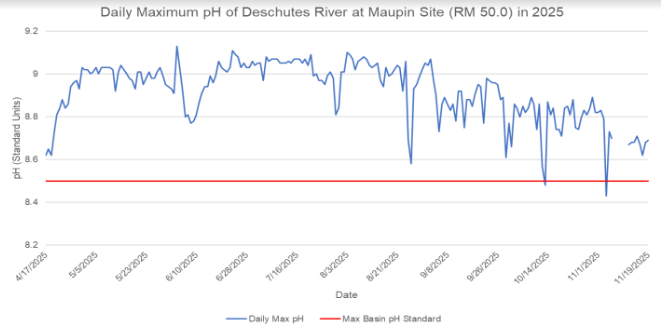
pH levels at the Maupin monitoring site along the Deschutes River in 2025. 210 out of 212 days were recorded in violation of the state pH standard. Courtesy Deschutes River Alliance.
It’s unclear whether there is a causal link between the DEQ violations at the Maupin wastewater treatment facility and the consistent pH violations at DRA’s monitoring station, but a shortage of data from monitoring practices at the treatment facility could make assessing the health of the river more difficult and point-source tracking less accurate.
A violation in the monitoring practices of E. coli was also concerning. E. coli is a bacterium found in the intestines of people and animals. Consumption of water containing E. Coli can lead to significant health problems, including severe stomach pain and vomiting.
An official within the Maupin city government communicated that they are eager to correct their mistakes and prevent future violations from happening again. In an email to this publication, Smith reiterated his commitment to bringing the treatment facility into compliance.
“To the residents of Maupin and downstream users of the Deschutes River, I would emphasize that protecting water quality remains one of the City’s highest priorities. While we fell short in certain monitoring and reporting obligations, we have worked diligently to correct those deficiencies and strengthen our compliance systems. We remain committed to operating our wastewater treatment facility responsibly and protecting the water resources entrusted to us.”
About the author.
Michael is a Portland-based journalist covering environmental and cultural stories, exploring the intersection of people, place, and sustainability. His reporting frequently covers investigative work that goes beyond simple coverage to provide in-depth reporting on the people of Oregon and the health of their environment.


Support Local News!
Available for Everyone; Funded by Readers.