
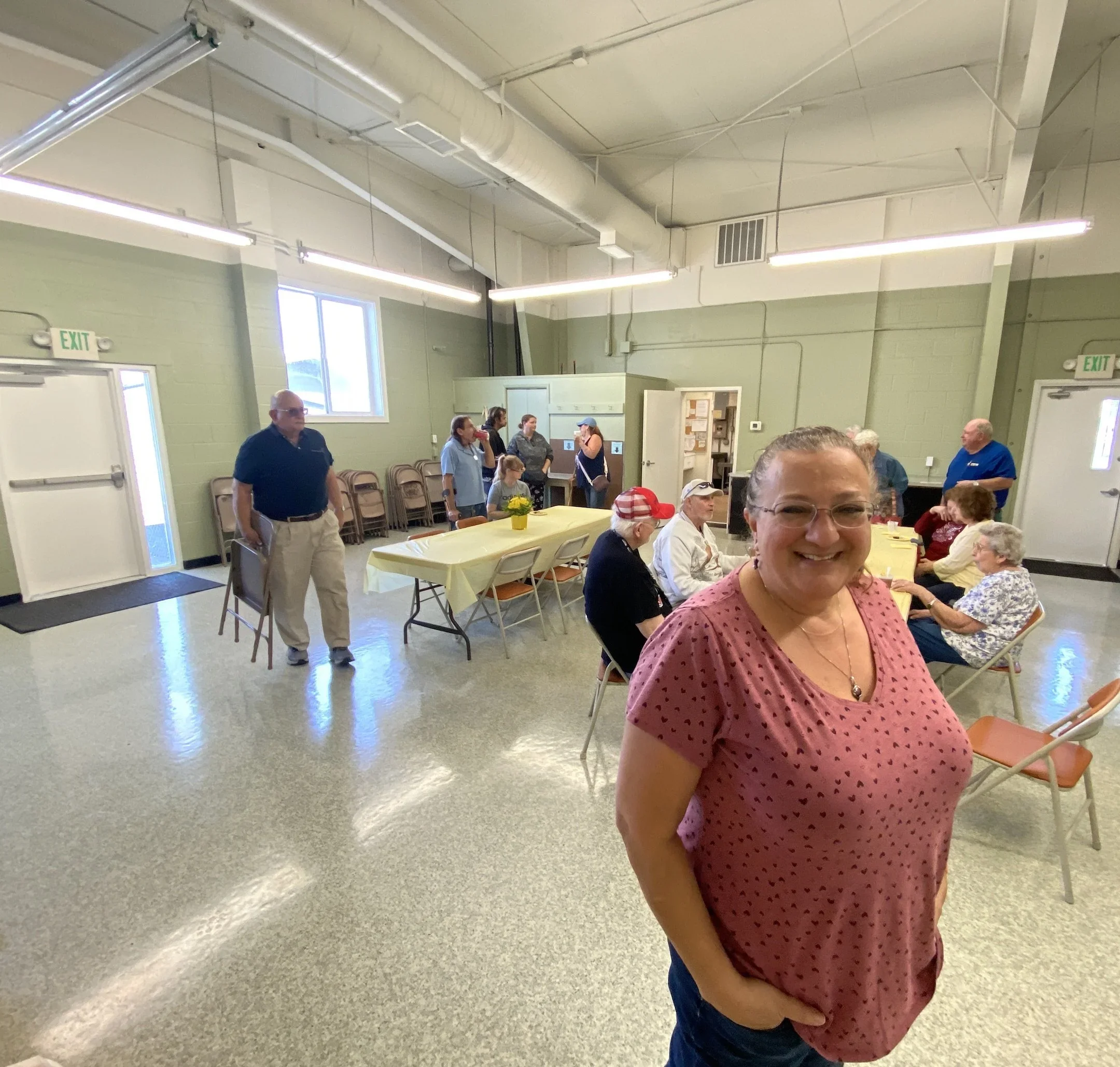
File Photo - St. Vincent de Paul Board Chair Kathryn Gilligan was all smiles in May 2024 while showing off the nonprofits newly painted and deep-cleaned shelter at 315 W. Third Street. The day-use facility reopened, despite the city’s lawsuit for public nuisance. While it restarted offering shelter, laundry and showers several days a week, food was no longer offered or served at the site. The City of The Dalles dropped it’s suit against the St. Vincent de Paul in March 2025.
By Tom Peterson
The Dalles, Ore., Oct. 13, 2025 — The Dalles City Council will consider a new law Monday that broadens how the city defines and enforces public nuisances, potentially reshaping how certain behaviors and properties are handled.
The debate comes amid a broader city crackdown on nuisance conditions linked to homelessness, neighborhood complaints and a ban on sidewalk food distribution. The deep dive into public nuisances also comes after the city sued the St. Vincent de Paul community meals site on Third Street after police logged hundreds of complaints of public nuisance near the building. The site was temporarily closed after the city sued St. Vincent for public nuisance, and meals began being delivered at off-site locations, such as First Street.
Officials say the new law is aimed at protecting neighborhoods and keeping public spaces accessible, while some community advocates worry about consequences for those who rely on meal programs.

In 2020, neighbors living near Pentland Street documented the houseless impact in their neighborhood siting littering, fires, public urination and defecation. Pentland abuts the St. Vincent de Paul day center. This man is laying on the corner of Pentland and Third streets.
The proposal expands nuisance rules to cover a wider range of activities. Houselessness-related conduct such as spreading belongings on sidewalks, or leaving behind litter could be construed as a public nuisance.
The law defines a public nuisance not only as activity on the property itself, but also as qualifying incidents that occur within 300 feet of the property, including when patrons or invitees create disturbances affecting nearby residents, businesses, or public rights-of-way.
At its heart, the law defines a “pattern of behavior” as three or more qualifying public nuisance incidents within a six-month period tied either to visitors to a property or to property-condition violations.
The law gives the City Attorney Jonathan Kara authority to seek emergency closure through Wasco County Circuit Court. If a property is found to be a public nuisance, the court can order activities to stop for at least six months, or close and secure the property for six to 18 months. If the property owner fails to comply, the court may authorize the city to physically secure the site.
Kara argues that the new framework “tightens up” the city’s nuisance law, giving staff and police clearer authority to act after The Dalles Police logged hundreds of nuisance complaints tied to operations at St. Vincent de Paul. He said the change closes loopholes that previously made enforcement slow and inconsistent.
Kara also described the ordinance as an equitable way of addressing repeat offenses, since it sets a clear threshold for violations and applies equally to businesses, nonprofits, rental properties, and private residences. By focusing on a documented pattern of behavior, he said the law balances neighborhood protections with giving property owners notice and opportunity to correct problems before harsher penalties apply.
Under the new provisions, nuisances could include the accumulation of garbage or unsanitary conditions, obstruction of sidewalks or rights-of-way, disorderly conduct or fights, excessive noise, drug or alcohol offenses occurring on site, and any conduct that endangers public safety or health.
It also establishes civil penalties of up to $500 per day for continuing violations, capped at $50,000 per case unless a court finds willful noncompliance.
Other items on Monday’s agenda include a joint funding agreement for the Columbia Gorge Regional Airport hangar expansion, a sludge removal contract at the Wicks Water Treatment Plant, and surplus of police equipment.
The meeting begins at 5:30 p.m. at City Hall Council Chambers and will be live-streamed on the city’s website. Click here to livestream the meeting.