David Vs. Goliath: Dufur’s Josiah Dean Challenges 13-Term Rep. Greg Smith for house seat 57
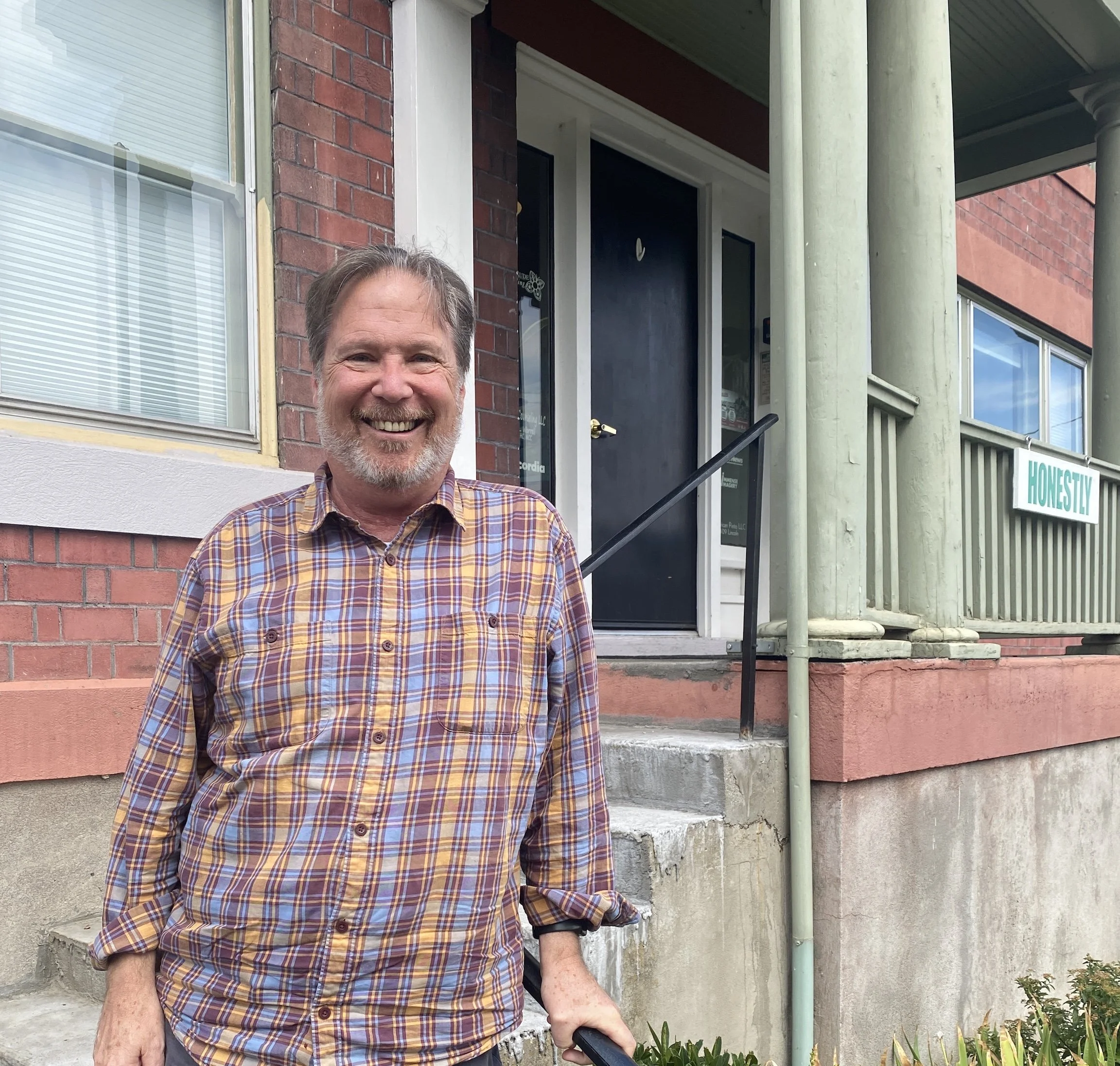
Josiah Dean, former owner of the Balch Hotel in Dufur and current Small Business Development Advisor is taking aim at Greg Smith, noting a significant number of nonaffiliated voters he believes have become disenfranchised with the 13-term House Rep for Oregon’s 57th District.
By Tom Peterson
Dufur, Ore., Sept. 3, 2026 — Josiah Dean knows he’s got an uphill race.
The 63-year-old Dufur resident and Pacific Green Party candidate is challenging Republican state Rep. Greg Smith for Oregon House District 57 — a sprawling rural district that reaches from The east edge of The Dalles to Milton Freewater.
It’s a district that Smith has owned for more than two decades, winning greater than 66 percent of the vote in every general election since he took office in 2001.
Dean, meanwhile, said on Thursday that he entered the race late, doesn't have a large campaign war chest and belongs to a minor political party in a district that has reliably elected Republicans.
But… Dean is serious when he says he has a shot at taking Smith’s seat. The Republican which has been embroiled in ethical complaints had a tight primary race in May and Dean points out that the largest number of voters in the district aren't registered with either major party.
If he can swing the independent voters, he says he can win.
“I do think I have a shot,” Dean said. “Some days more than others.”
He wants to hold Smith accountable and give voters another choice.
Dean and Smith are the only two candidates in the Nov. 3 general election.
District 57 stretches across a huge swath of north-central and northeastern Oregon, encompassing all of Gilliam, Morrow, Sherman and Wheeler counties and portions of Wasco, Umatilla, Jefferson, Marion and Clackamas counties.
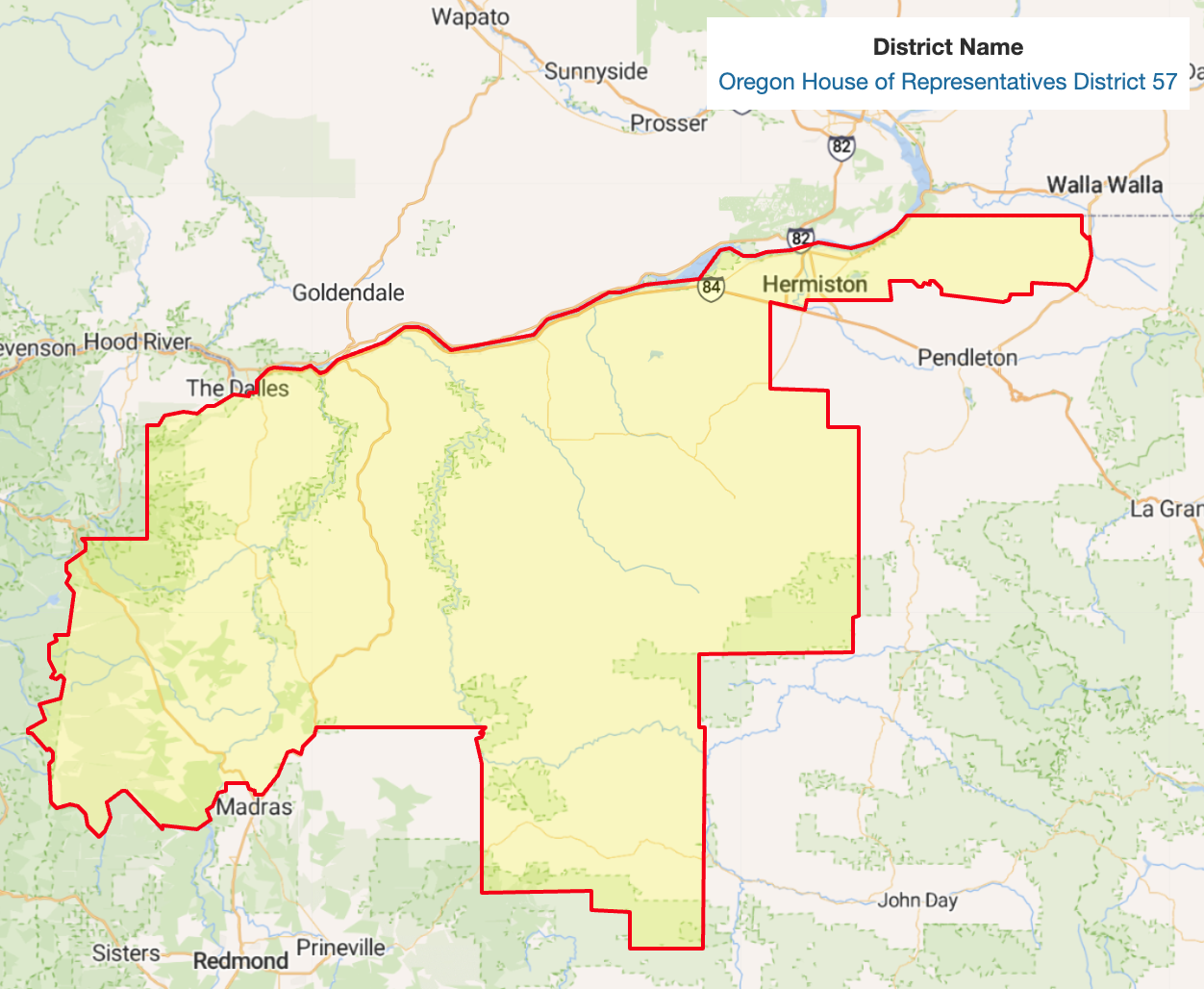
House District 57 in Oregon has about 70,000 people with about 43,000 registered voters.
Its communities range from the more populous Hermiston, Pop. 20,000, and Umatilla, pop 8,200, surrounded by major agricultural, food-processing, distribution and data-center development, to wheat and cattle country and towns of only a few hundred people such as Ione, Condon, Spray, Echo.
For Dean, those small communities — and whether they can remain viable places to live, work and raise families — are at the center of his campaign.
From historic hotels to rural Oregon
Dean moved to Dufur, population 632, in 2015 when he and his then-wife purchased the historic Balch Hotel.
The move followed a career in hospitality that took Dean to some of the West's historic national park lodges. He came to Oregon to manage the Oregon Caves Chateau and previously worked at properties including Paradise Inn at Mount Rainier and the former Giant Forest Lodge in Sequoia National Park.
Running historic hotels, Dean said, had been a passion for much of his working life. Buying the Balch gave him the opportunity to operate a small business himself.
Dean served on the Dufur City Council and now works as an advisor at Oregon’s Small Business Development Center in The Dalles, experience that strongly shapes his ideas about rural economic development.
His provides outreach into Sherman, Gilliam and Wheeler counties, where he helps prospective entrepreneurs understand finances, operations, marketing and the realities of turning an idea into a sustainable business.
Dean is also preparing a youth entrepreneurship program in Arlington that will take high school students through the process of developing a business idea, building a financial and marketing plan and eventually pitching it to successful entrepreneurs.
Dean said small towns don't necessarily need someone from outside to arrive with the next enormous development.
They need people with ideas — and the tools to turn those ideas into viable businesses.
“Dufur needs people with a passion,” Dean said.
That could mean tourism, manufacturing, food, retail, crafts or services. The larger goal, he said, is giving people an opportunity to build something in their hometown rather than assuming success requires moving somewhere else.
“Those are all things that we can build in these small communities,” Dean said. “Keep the folks from moving to the big city that have these dreams, make it so that they can create their dream in their own town.”
A 13-term incumbent shows vulnerability
Dean's decision to run came after years of interest in politics and his more recent involvement with the Pacific Green Party.
He recalled debating politics with a conservative former college roommate for more than 40 years. But for most of his working life, politics remained something he followed rather than pursued.
That began changing after Dean sold the Balch Hotel and became more involved with the Green Party. When he learned Democrats weren't fielding a candidate against Smith, he began considering the race.
“What if I did?” Dean recalled thinking.
The Pacific Green Party ultimately nominated him.
What transformed the idea into a serious campaign, Dean said, was Smith's showing in the May Republican primary.
Smith survived a challenge from former Morrow County Commissioner Jim E. Doherty, winning 4,123 votes to Doherty's 3,352 — a margin of 771 votes, according to the Oregon Secretary of State's official May 19 Primary Election Abstract of Votes.
The results also exposed geographic weaknesses for the 13-term incumbent.
Doherty defeated Smith in three counties in the district: Wasco County, 538-488; Sherman County, 316-132; and Gilliam County, 233-193.
Smith's strongest margins came farther east. He carried Umatilla County 2,033-1,436 and Morrow County 1,007-585. Smith also won Wheeler County 192-153, while Doherty carried the Jefferson County portion of the district 91-78.
Overall, Smith received about 55.2% of the two-candidate Republican vote to Doherty's 44.8%.
Those numbers caught Dean's attention.
“At first I was like, ‘Oh, I'll just do it — token campaign,’” Dean said. But after examining Smith's record and the primary results, he began thinking differently.
“Maybe vulnerable,” Dean said.
Dean also sees an opportunity among 20,000 voters who had no role in deciding the Republican primary — particularly unaffiliated and third-party voters.
Smith enters general election under scrutiny
The close primary isn't the only reason Dean believes the longtime incumbent is vulnerable.
Smith, Oregon's longest-serving current state representative, has faced significant ethics and legal scrutiny.
In August, the Oregon Government Ethics Commission approved a $12,000 civil penalty against Smith after finding he improperly used his position as executive director of the Columbia Development Authority in connection with salary increases and paid vacation time. Smith agreed to the penalty.
Smith is separately a defendant in an Oregon Department of Justice civil lawsuit concerning the sale of Windwave Communications, a broadband company previously owned by a Morrow County nonprofit.
The state alleges public officials and other community leaders used information obtained through their positions to acquire the broadband company at a favorable price before its value increased amid Amazon's rapid data-center expansion. Smith has denied wrongdoing. A judge in Union County ruled earlier this year that the state's lawsuit could proceed.
Dean said Smith's record helped convince him that simply putting another name on the ballot wasn't enough.
“He's not representing the district,” Dean said. “He's representing himself and the corporations.”
Data centers: Not whether, but under what terms
Dean's criticism of large corporations does not translate into opposition to industrial development.
His argument is that economic development should leave a rural community better off than it was before the development arrived.
That puts data centers squarely in the middle of his campaign.
Morrow and Umatilla counties have become major data-center hubs, and Dean said the industry illustrates both the promise and potential cost of economic-development incentives.
“I'm not 100% anti-data center,” Dean said.
Instead, he wants Oregon to reconsider how incentives such as enterprise zones are structured and attach stronger conditions to tax breaks given to major corporations.
One condition should be jobs.
Dean questioned the practice of touting thousands of construction jobs generated while a facility is being built when the number of permanent employees can be substantially smaller.
If a company receives substantial tax incentives based on job creation, Dean said, government should determine whether those promised jobs actually materialize and whether they are permanent, living-wage positions.
“You've got to — you can't just say, ‘I'm going to create these jobs,’” Dean said. “There has to be conditions for those jobs.”
Dean acknowledged that construction workers provide an economic boost while they are in a community. Hotels, restaurants, stores and other businesses can benefit from months or years of construction activity.
But the long-term calculation should be different, he said.
“Are they actually helping the community?” Dean asked.
His proposed standard is relatively straightforward: Does the development provide a net benefit to the community?
Water brings the argument home
That question takes on added importance in Morrow and Umatilla counties, where residents have spent years confronting nitrate-contaminated groundwater.
Agriculture, food processing and wastewater disposal have all figured in the decadeslong Lower Umatilla Basin groundwater problem.
Data centers have now become part of that debate.
In March, Amazon agreed to pay $20.5 million to settle claims that wastewater associated with its data-center operations contributed to nitrate groundwater contamination affecting residents in Morrow County. Amazon has denied contributing to the nitrate crisis, and the settlement was awaiting court approval as of June.
For Dean, the lesson is that Oregon should anticipate the impacts of major developments rather than waiting until problems emerge.
Data centers use water for cooling, and Dean said regulators should consider not only the amount of water being consumed but what happens to wastewater, along with impacts on electrical infrastructure, groundwater, noise and surrounding communities.
“We need to be forward thinking on that as opposed to responding to the problem,” Dean said.
Dean doesn't argue that District 57 should shut the door on data centers.
He argues that the door shouldn't be wide open either.
“We're way off to the other end where everything's unregulated,” Dean said. “We need to find at least a middle ground, if not more, to protect the communities.”
Agriculture remains the backbone
Dean's economic argument extends beyond technology.
Agriculture remains fundamental to District 57, from wheat and cattle operations across its rural counties to irrigated agriculture and massive food-processing operations around Boardman and Hermiston.
Dean said small farmers are being squeezed by the rising costs of fertilizer, diesel and equipment while having relatively little control over commodity prices.
He also worries about the continuing consolidation of agricultural land and operations as smaller farms disappear and larger companies acquire them.
Economies of scale may make financial sense, Dean said, but the loss of family farms has consequences extending beyond the farm gate.
Those families populate rural schools. They coach teams, serve on city councils and nonprofit boards, volunteer for fire departments, shop at local stores and help keep small towns functioning.
“I think we need to focus on helping small communities and keeping that culture alive,” Dean said.
For Dean, that means economic development should be judged not simply by how many dollars are invested but by whether it leaves a community stronger.
Solar without sacrificing the farm
Dean's Green Party affiliation naturally brings renewable energy into the campaign.
But he doesn't believe expanding solar generation should necessarily mean taking productive agricultural land out of production.
Dean points to agrivoltaics, which integrates solar generation with farming or livestock production.
Solar panels can be elevated or spaced farther apart to allow livestock to graze underneath and, in some applications, permit agricultural equipment to continue operating between the panels. Dean said the shade can also reduce evaporation and help retain soil moisture.
His broader argument is that Oregon doesn't have to choose between agriculture, renewable energy and industrial development.
“We need industry, we need the timber industry, we need the agriculture industry, we need the solar industry,” Dean said. “But they need to do it in a responsible way.”
That could mean regulations requiring certain practices or incentives rewarding developers that preserve agricultural production.
Dean also said private property rights have to remain part of the discussion. If a landowner can no longer make farming pencil out and wants to lease property for solar generation, Dean said government shouldn't reject the project simply because other people dislike how solar panels look.
The question should be whether the project demonstrably harms neighboring properties or the broader community.
Decisions, he said, should be based on evidence rather than fear or emotion.
Wildfire and the people who respond first
Wildfire provides another example of Dean's community-first approach.
His hometown has experienced that threat firsthand during this summer's Grasshopper Fire.
Dean said the state should help homeowners make structures more resistant to wildfire through defensible space, cleared gutters, protected vents, metal roofs and fire-resistant siding.
Grants or tax incentives could help property owners make those improvements, he said.
He also supports forest thinning and closer cooperation among landowners, ranchers, local firefighters and federal agencies.
But across much of District 57, the first people heading toward a fire aren't necessarily professional wildland crews.
Dean remembers watching pickups and trucks carrying water tanks head toward fires after he moved to Dufur.
Those informal and volunteer networks are part of rural Oregon's firefighting infrastructure, he said, and should be coordinated, supported and properly trained, with larger firefighting resources brought in when an incident grows beyond local capabilities.
“We need to just keep coordinating those folks, keep them going,” Dean said.
The increasing length and intensity of fire seasons also require communities to prepare before smoke is on the horizon, he said.
Betting on rural entrepreneurs
Dean repeatedly returns to the same argument whether discussing data centers, farms, solar arrays or wildfire:
Rural communities should be strengthened rather than simply used as places to locate somebody else's project.
His experience as a small-business adviser gives that philosophy a practical dimension.
Dean points to businesses in small communities that have become destinations in their own right. A successful restaurant, bakery, bar, lodging property, manufacturer or specialty business doesn't have to employ hundreds of people to matter.
It creates jobs. It gives residents somewhere to gather. It attracts visitors who buy gasoline, eat meals and shop locally. And it gives other entrepreneurs evidence that starting something in a town of a few hundred people isn't impossible.
His hospitality background also makes tourism part of that equation. Dean serves as treasurer of the Columbia Gorge Tourism Stewardship Alliance and said travelers increasingly seek authentic rural experiences.
He saw that firsthand at the Balch.
“People from the city have no idea what's going on out here,” Dean said. “We're friendly. We've got some cool history. We've got some neat natural things.”
Tourism, he said, can bring outside dollars into a community without requiring it to surrender the characteristics that made people want to visit in the first place.
Looking beyond Republican and Democrat
Dean's path to Salem remains steep.
He is running in a district long represented by a Republican, under the banner of a minor party and with a campaign that began only months before Election Day.
His campaign is largely self-funded.
Dean said the operation involves yard signs, postcards, telephone calls and plenty of driving across an enormous district. His campaign manager is a volunteer, and Dean acknowledged that he's learning much of electoral politics as he goes.
But the May Republican primary is central to his political calculation.
Only Republican voters decided the Smith-Doherty contest. Dean is now looking toward voters who weren't part of that decision — particularly unaffiliated and third-party voters — along with Republicans and Democrats dissatisfied with their choices.
District 57 has 43,860 registered voters, according to the Oregon Secretary of State Voter Registrations in August, 20,585 of which are non-affiliated. Dean believes roughly 12,000 votes could be enough to win, depending on turnout.
His strategy is to find those voters whose political views may differ considerably on national issues but who share an attachment to their communities and skepticism toward concentrated corporate and political power.
“People that believe in their communities,” Dean said, “that want to have a representative that represents them, not big business and not their own personal interest.”
‘Explain every vote’
Dean says accountability would extend beyond Election Day if voters send him to Salem.
He has pledged to hold regular town halls, explain his votes and answer constituents.
He said that philosophy comes partly from decades in hospitality and management, where problems can't simply be hidden when something goes wrong.
Dean recalled working for an old-school casino manager years ago and attending a meeting where other managers reported that everything was fine.
Dean instead talked about something he had tried that hadn't worked.
The reaction surprised him, but the experience helped shape his management philosophy: Try things. Admit when they fail. Fix them. Learn from them.
“I'm going to do stuff. I'm going to make mistakes,” Dean said. “If I do something wrong, hey, I did something wrong. Fix it. I didn't mean to. Let's learn and move on.”
That, Dean said, is the kind of accountability he wants to bring to the Legislature.
A long-shot campaign — but no longer a token one
Whether that message can overcome Smith's incumbency and District 57's Republican history will be decided Nov. 3.
Dean isn't pretending the challenge is small.
But neither does he view the campaign the same way he did when he first considered putting his name forward.
The Republican primary demonstrated that thousands of Republican voters were willing to vote against Smith. Doherty beat the incumbent outright in Gilliam, Sherman and Wasco counties. Dean now has to find out whether that dissatisfaction can be combined with unaffiliated voters, Democrats, Greens and others into a winning general-election coalition.
And if it can't?
Dean said he may come back in two years or find another way to remain involved.
For now, he said, simply entering the race has accomplished something.
“I've already won, basically,” Dean said. “I've gotten people to pay attention.”