
Grasshopper Fire Delivers Hard Lessons — and Brings Out the Best in Neighbors
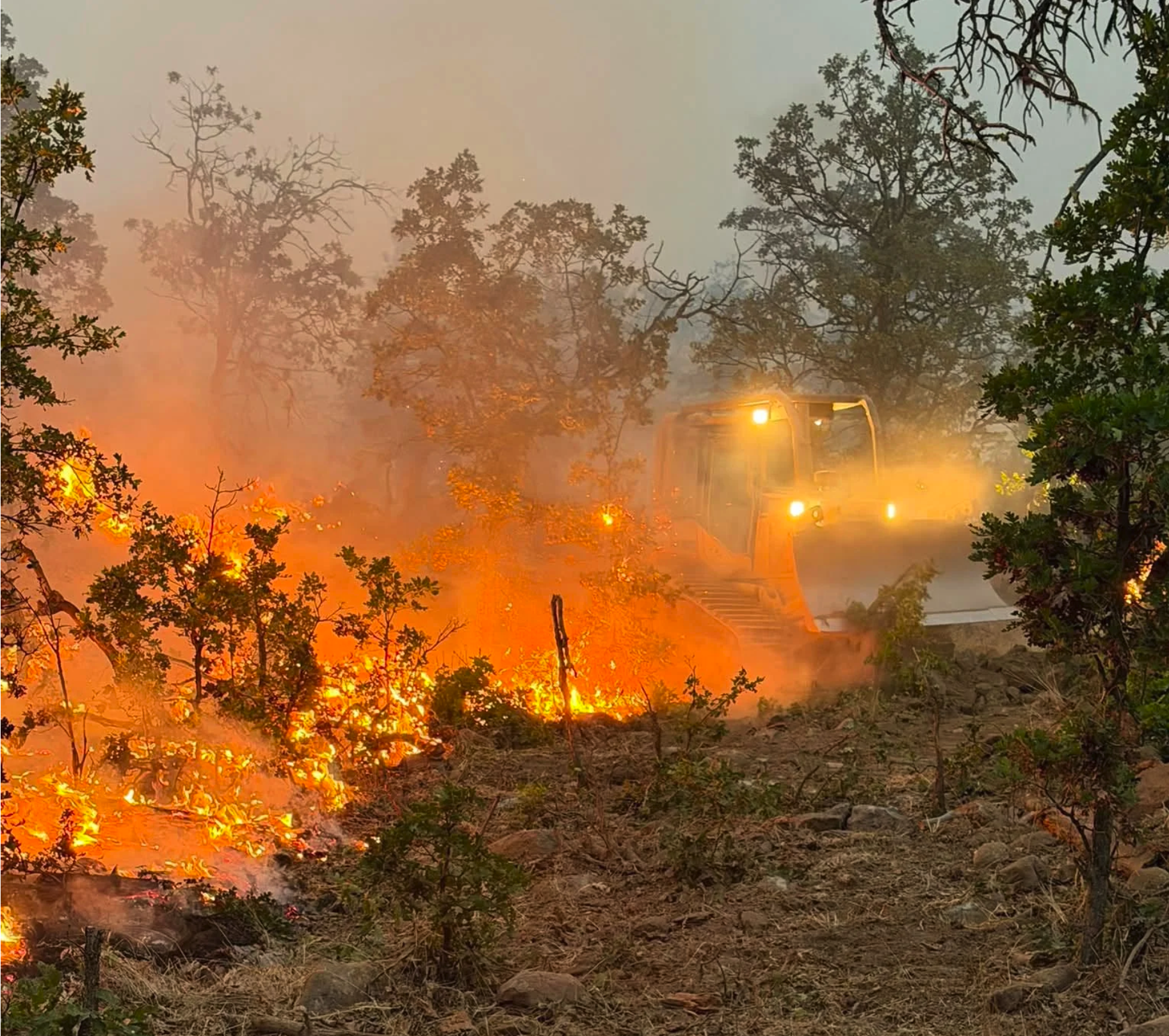
Bulldozers were used to create fire breaks in the fast moving Grasshopper Fire in August. The 90,000 plus acre blaze has had reverberating affects on Wasco County from economic loss to recovery and how to think about and protect against fire in the future. Photo courtesy the Grasshopper Fire Facebook page
By Aaron Girdham
The Dalles, Ore., Sept. 8, 2026 — The 90,000-acre Grasshopper Fire left Wasco County locals looking ahead to the future of fire seasons with a concerned gaze. Its fast pace and aggressive presence sent what many property owners grazed by the line of fire considered a personal warning.
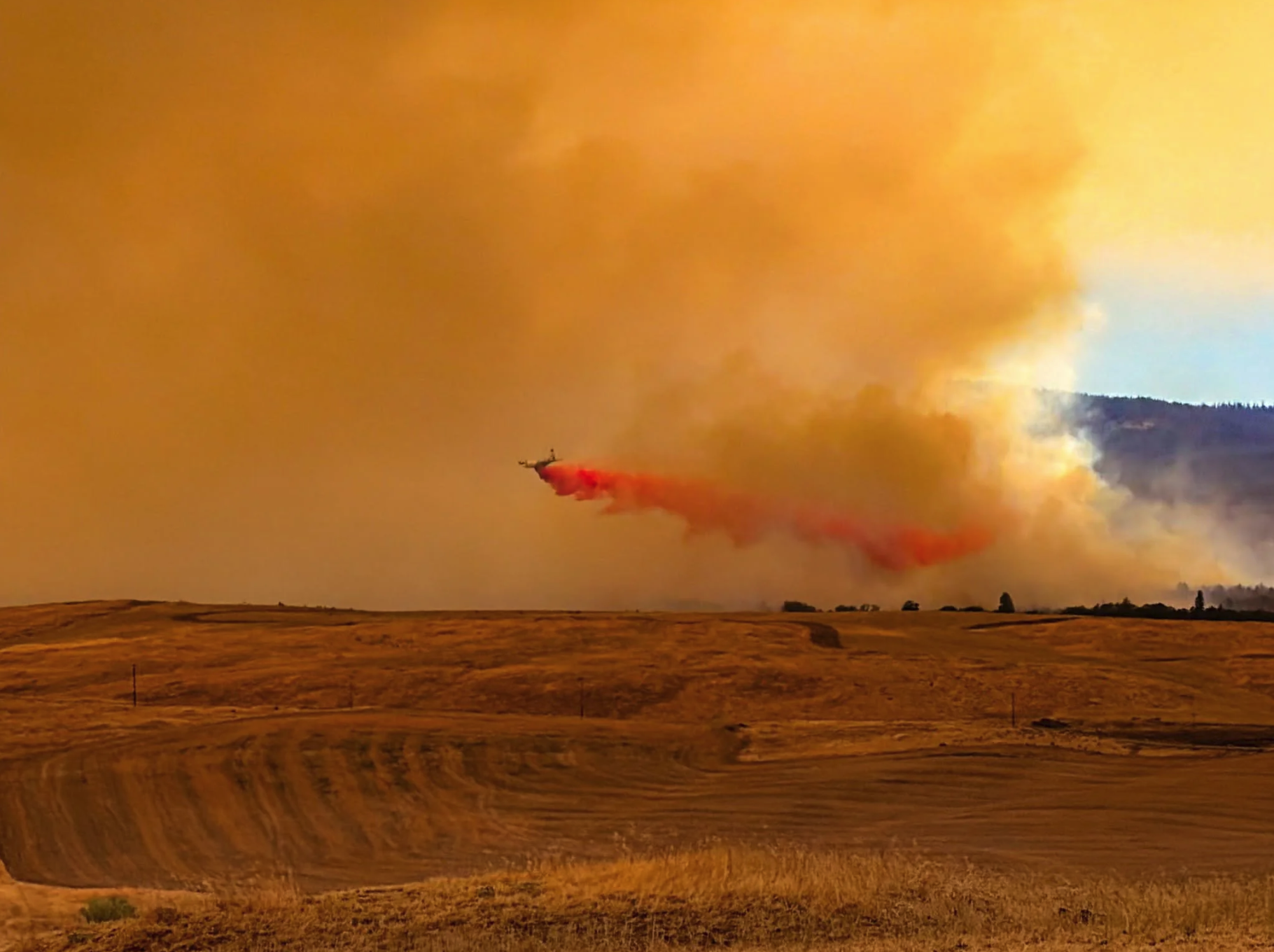
Grasshopper has claimed six houses west of the Dufur area and sent more than 1,000 people into evacuation at its pinnacle. At one point, the fire burned through 3.5 miles in about an hour near Tygh Valley, giving cause to delay the Wasco County Fair.
It has stretched from approximately two miles west of Highway 197 to the Mount Hood National Forest. It has threatened several rural communities, Mount Hood Meadows ski property and The Dalles watershed while on its rampage.
“If you don’t laugh at your luck you cry,” said Lisa Gambee, a Tygh Valley resident with 29 acres bordering the White River Wildlife Area. The flames came within four miles of her property.
“I think it’s been really interesting, our understanding of fires has really changed. I’ve had this property for 30 years. With the Larch Creek Fire in 2018, it was all about preparation to stop the fire. Then Rowena burned (56 homes) and that was a real wake up call. It doesn’t just become how you fight. It’s now how do you rebuild.”
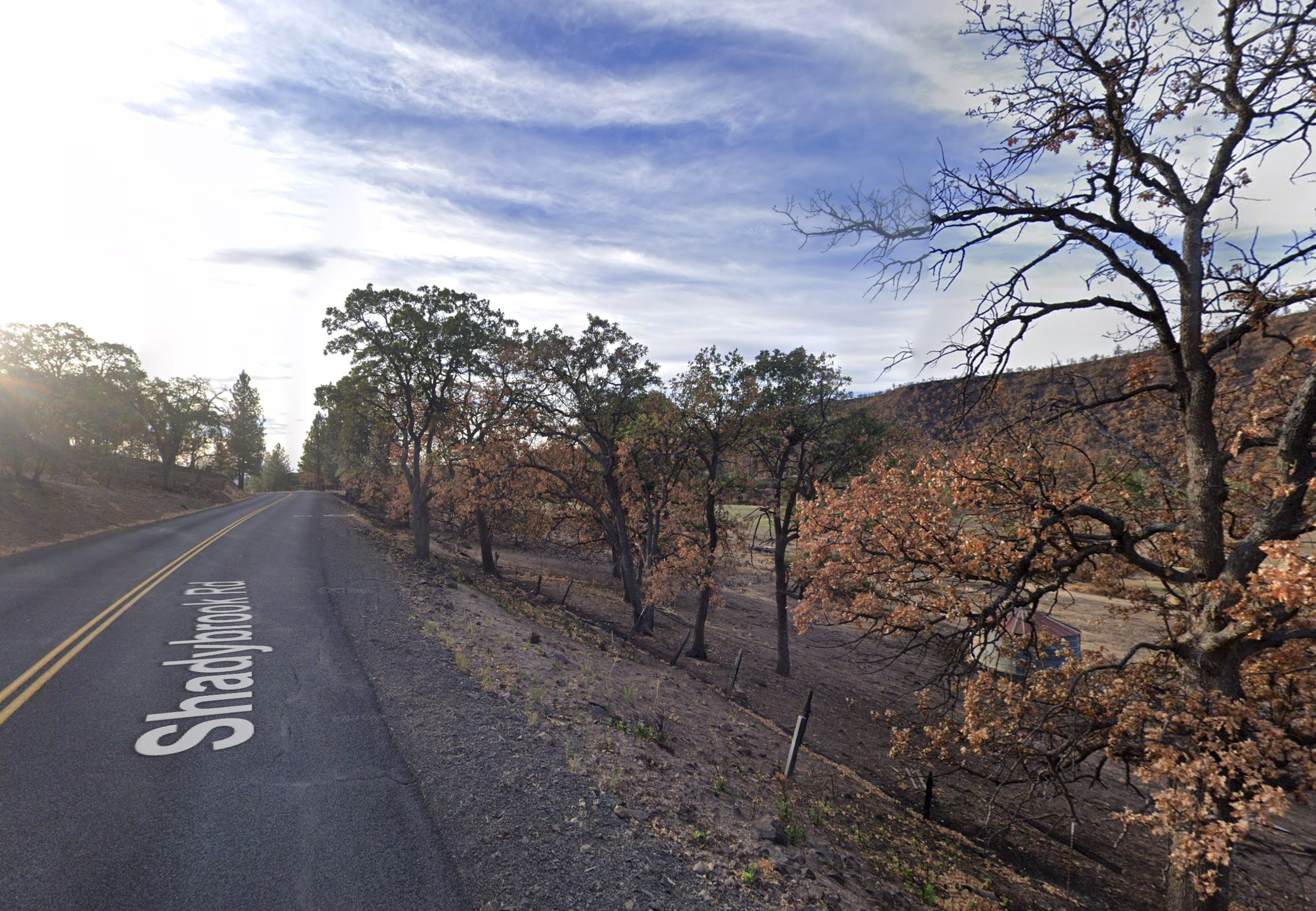
Burned trees along Shadybrook Road after the Larch Creek Fire of 2024 near Tygh Valley.
She explained that while it was harrowing to see the fire come so close, one of the biggest problems she recognizes is the smoke that remains for weeks.
“I’m sitting here now with my eyes stinging from smoke,” she said over the phone. “We evacuated for ten days total, but that was mostly from the smoke. When we got the level three notice we were already out of town to get fresh air.”
Gambee said the experience has also shaped the issues she is considering as a candidate for Wasco County commissioner. She faces John Grant in the General Election on Nov. 3.
“...I am concerned for the well being of our vulnerable community as the smoke comes in. I also realize it affects many businesses in Wasco county: driving away tourists and causing damage to buildings. So there are so many questions I am looking to answer. Are there programs we can put into place immediately to help them? Do we have the right kind of funding to do more communication outreach and programs, getting people connected to safety measures? How to promote that through out Wasco county and provide those resources; how to help our businesses affected by the smoke; do we have supplies, like box-fans for residents and business owners who need them?”
“We must realize that it’s not always up to someone else to solve the problems the fire causes. We have to step in before it’s to late. As a homeowner the thought has shifted from the government will take care of it to know I actually have some stakes in the game, and that is the mentality I am bringing in to my office.”
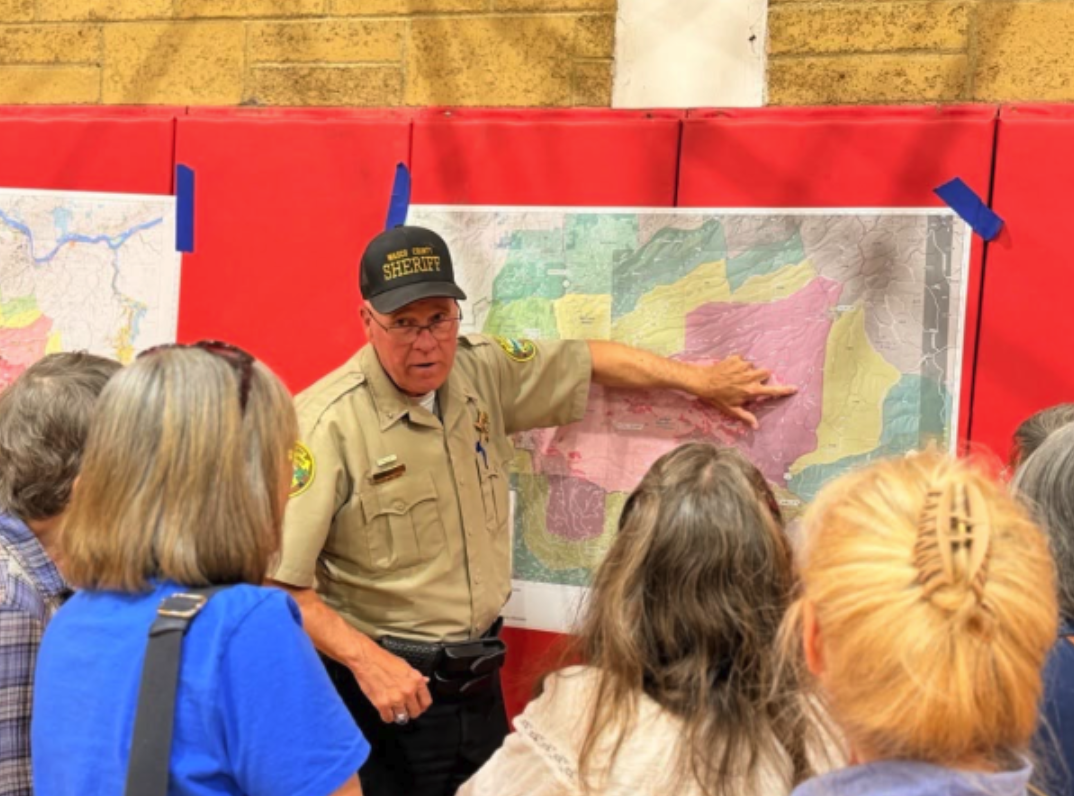
Wasco County Sheriff Lane Magill offered information on fire location to locals during the Grasshopper Fire public meetings. He and Wasco County Commissioner Jeff Justesen also had to make the call on postponing and moving Wasco County Fair events in late July.
Neighbors Helping Neighbors
Amid the destruction of 6 homes on Aug. 12, Wasco County Sheriff Lane Magill got a different kind of phone call.
Someone Magill has known for more than 40 years wanted to help several people who had lost their homes in Friend. The donor, who wished to remain anonymous, ultimately gave tens of thousands of dollars to help them recover.
Magill said his role was simply to make the connection.
“It wasn’t my place to know the donation,” he said. “My job was to connect them to the individual who wanted to donate.”
For a sheriff accustomed to hearing from people on some of the worst days of their lives, the gesture offered a welcome counterpoint to the devastation.
Magill harkened back to the Rowena Fire and the generosity that followed there.
“Everybody calls us on their worst day, and we kind of see the bad — the worst of the worst,” Magill said. “There are people like this that are very stark reminders there is still good in the world and good people in the world.”
For Magill, seeing neighbors quietly step forward to take care of neighbors is one of the good parts of the job — and, after a fire, a reminder that not everything left in its wake is loss.
Fire near The Front Porch
For the farmers and ranchers of Wasco County, the fight is real, and the Grasshopper Fire brought the flames to their front porches.
The Underhills have been farming outside the Dufur area since 1989.
“Before 2018 we thought that a 200 acre fire was huge,” said Tim Underhill. “Between 2018 and now, we’ve had three close calls when fire has come up to about 50 feet to our house from both sides. My wife has had those moments where she has had to grab and go at the last possible moment.”
“We did not get an evacuation notice this year, but the fire came within half a mile from both my parents house and my daughter’s house and I was out there fighting it.”
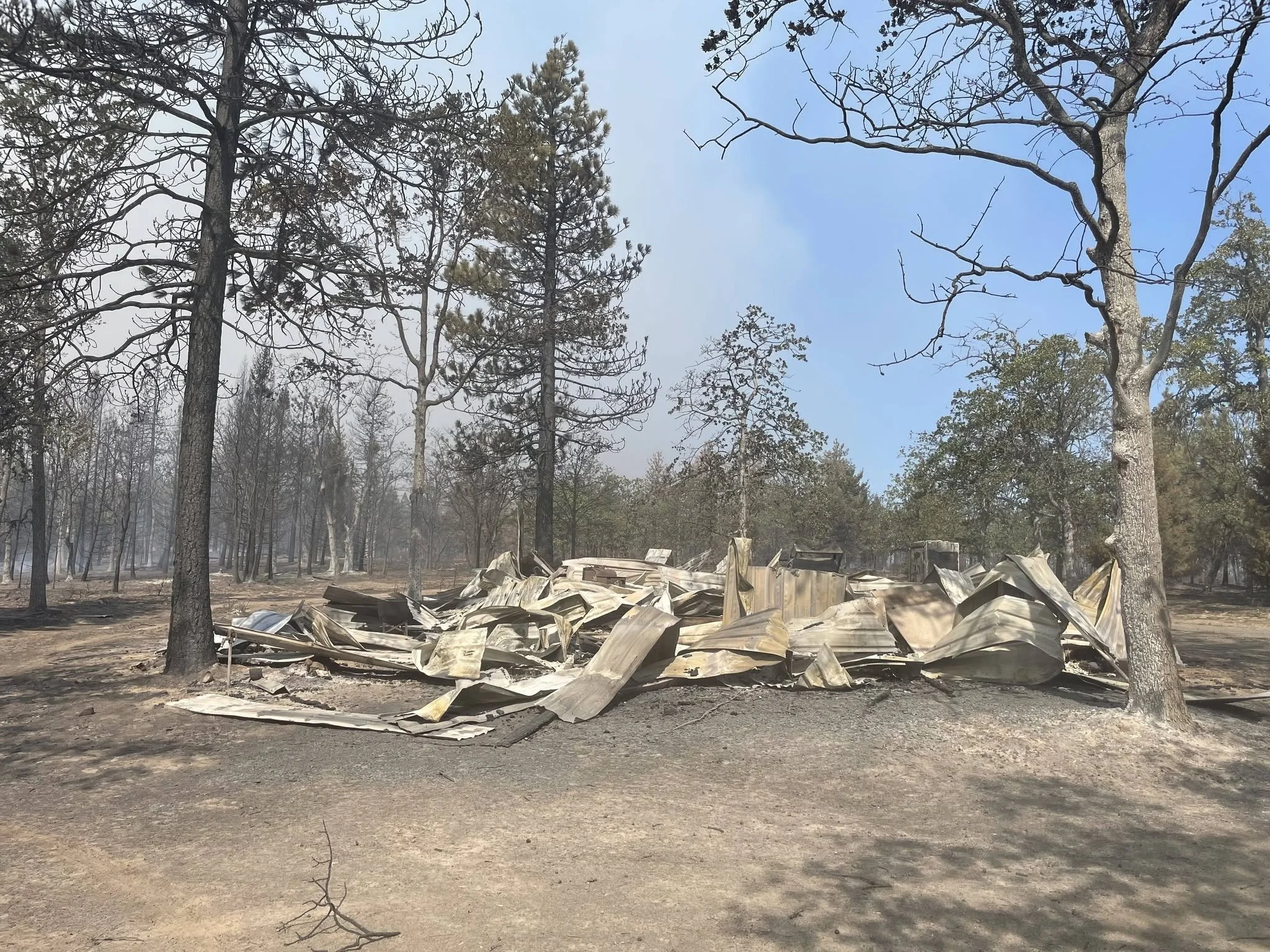
Above are the metal roofing and remainder of a barn on the Jake French property in Friend. The Grasshopper Fire tore through French’s property near Friend, racing about 4 miles in an hour amid swirling winds. French said in his Facebook post that three firefighters became trapped at the property but fought to save the house as surrounding forest and fields burned. The experience left French with hard lessons about defensible space, insurance coverage and preparing property long before fire season.
Jumping On It
“When most people are running away from the fire we (farmers and ranchers) are running to it, because it has the potential to destroy our livelihood. Out here it is time to fight the fire when you see the smoke. You don’t even have to get it named. If there’s an issue we’re on top of it. If there is a house on fire, we are not equipped to get it out. If there is timber on fire, we are not equipped to put it out. The grass lands is our effective area. With our farming properties we can prevent fire spreading and fight it. The thing is you can feel overwhelmed, throw your hands in the air and give up your property or you can at least try something.”
Bobbi Underhill, Tim’s wife, explained what that “something” looked like.
“Tim’s mom called one night and you could just hear it in her voice. Tim and his dad were a mile up from his parent’s house discing the fields as the fire was coming up. It was about five miles up from my daughters house, and that is where the houses were lost. Going down Dufur valley road there was either a rig or an ambulance or some kind of structure protection vehicle in every driveway ready to protect residents. When we got at the house the Police were there and they were so efficient at going house to house and asking if people were leaving or staying. We stayed, but we were racing the flames.”
The Underhills explained that the fire brings out a sense of community among farmers and ranchers in the area.
“To be able to help other people, to know how that feels, to have someone come to help you, To be able to see a line of pickups—your neighbors coming to your aid is just incredible. We do well as a team. Getting a line of people to fight the fire is tremendous. The first guy knocks the flame down, the second guy does a little more, the third guy puts it out, and the fourth guys is looking for the little smoldering flame. But it’s such a blessing to know that your neighbor has your back when the fire is close to your property and home.”
Tim said at one point while fighting the flames, a line of farmers connected their hoses and shared their water trucks to suppress the incoming fire.
Learning Respect
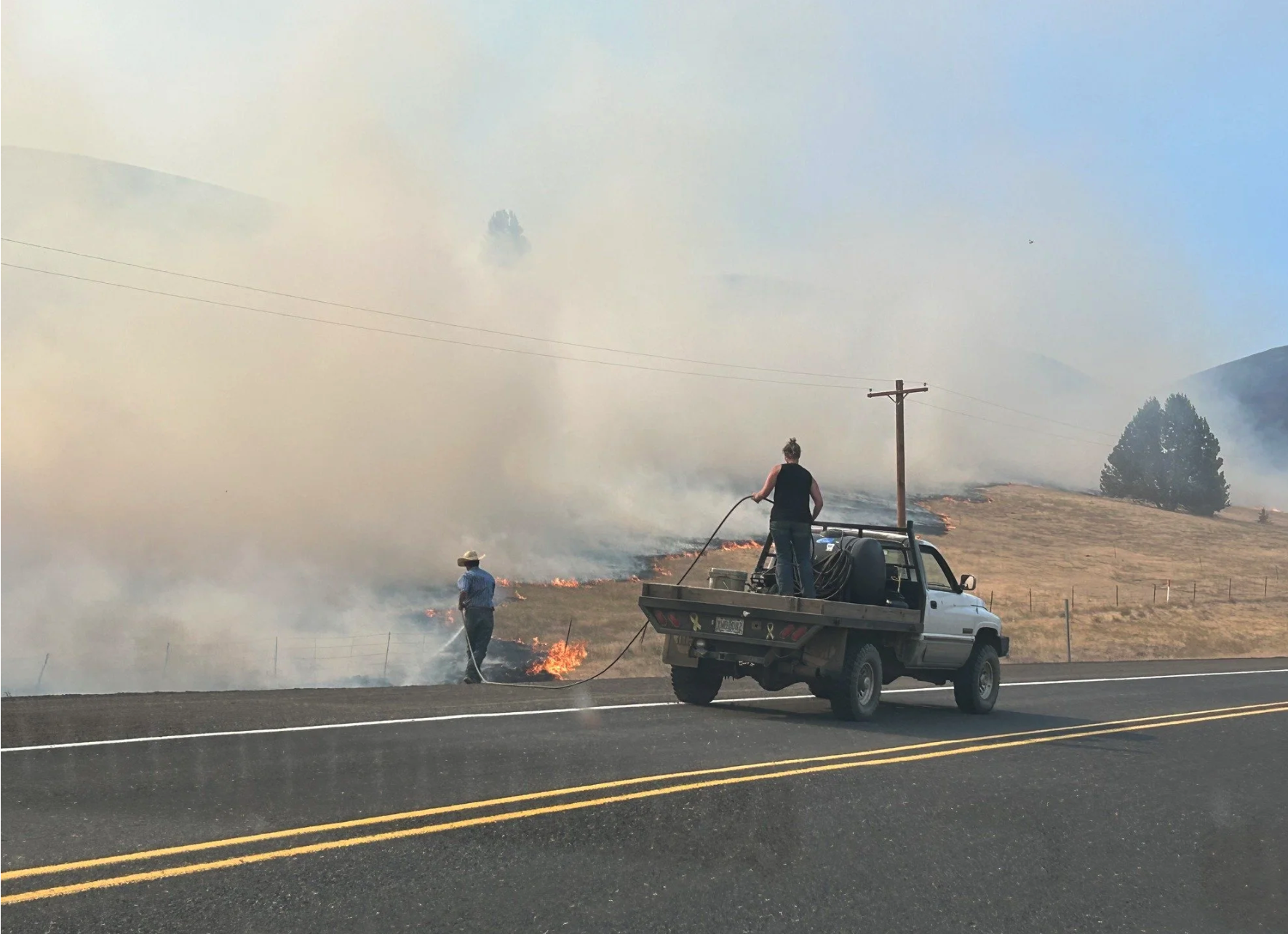
File Photo - Volunteer firefighters spent weeks putting out flames near Dufur and protecting their homes as $14 million was spent combating the Larch Creek blaze in 2024. It ran from the Shadybrook Community and jumped Highway 197 on the Tygh Valley Grade. Thousands of hours of work and immense property damage were incurred.
“We are also learning to respect the fire fighter’s structure and the way they do things, because somebody will always need to be in charge. If we’re communicating it’s great. They know what we are doing, we know what they are doing and it changes the dynamic of how we can protect our properties. With the establishment and training of the Rangeland Fire Protection Association we are learning how to work better as a team. I am so grateful for the learning in this situation because large scale fires are new to him.
“It’s been great as well because the Rangeland Fire Protection Association came to this area about three years ago and have been training and informing the local farmers, ranchers, and landowners about fire safety in our little farming community. We receive in-person training and lectures, then take an annual exam to be familiar with their terminology and know how to be more efficient with fighting strategies. It has become a lot more effective for farmers than ever before.”
Rangeland Fire Protection Associations are nonprofit groups of volunteer landowners trained and equipped to provide initial wildfire response in rural areas that often lack traditional fire protection. Wasco County has two — the Bakeoven-Shaniko RFPA, established in 2019, and the Petersburg RFPA, established in 2023 and expanded in 2025. The associations are formed by landowners under Oregon law and work with the Oregon Department of Forestry, which helps provide training and equipment. Because the organizations are largely volunteer-run, they rely heavily on state and federal grants for firefighting equipment, protective gear, insurance and other operating costs. The goal is to give farmers and ranchers the training and tools to safely attack fires on rangeland while coordinating their efforts with professional firefighters.
Camp Morrow Sends Campers Home
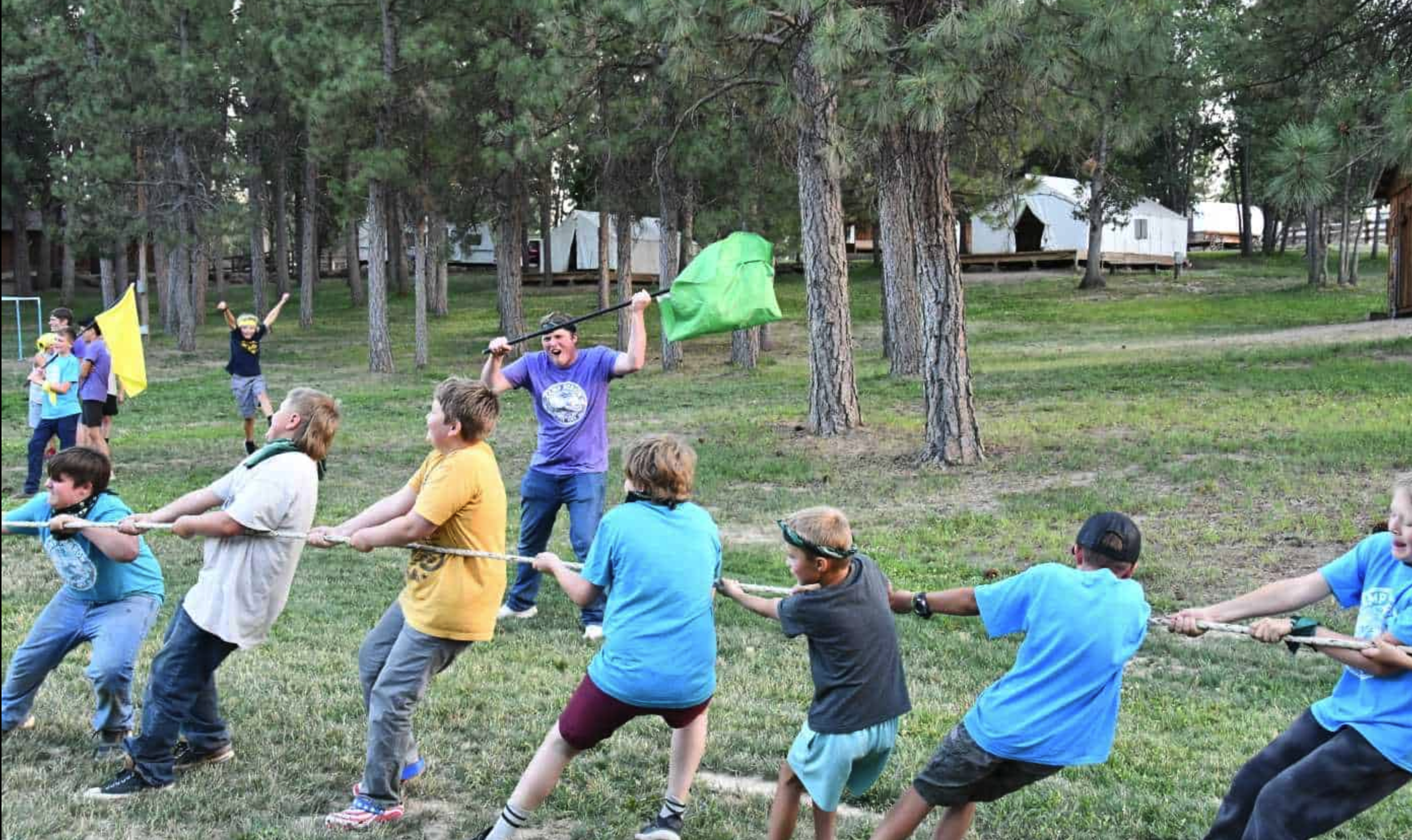
In the thick of the evacuation zone for the Grasshopper Fire was a nearly 80-acre youth summer camp called Camp Morrow. It is a quiet, beautiful camp on the edge of a lake, but is surrounded by an ample amount of ponderosa pines and live oak in the dry grasslands. It has been in operation each summer since 1958. Within the past two years, however, the camp has had to undergo two full evacuations.

Tubing on Pine Hollow Reservoir was cut short this summer as helicopters began dipping to put out nearby flames. Photo courtesy Camp Morrow
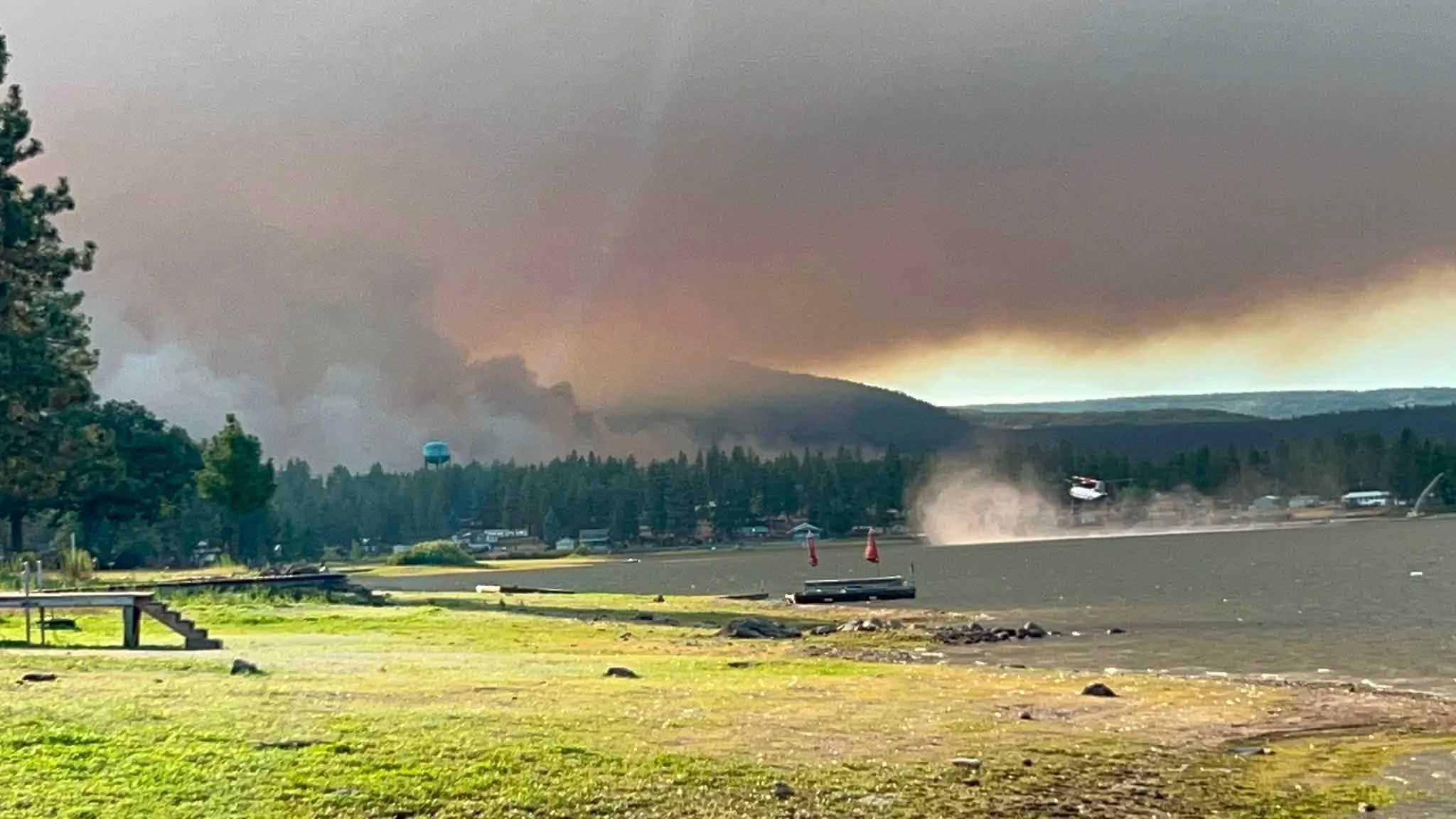
A helicopter hovers above Pine Hollow Reservoir to dip for water on July 28, five days after the fire started reportedly by lightning. Photo courtesy of Wamic Rural Fire Protection District.
“The Grasshopper fire was reported on July 23rd. I saw it driving back home and called the fire department,” said Camp Morrow Executive Director Chip Shetler. “ I knew it would be bad for us because the wind was blowing west to east. It can be hard, but so far we haven’t had to evacuate spur of the moment.
Two years ago we had to evacuate 200 campers. We decided to do it during the day, to prepare fully for evacuation. We did it in a very orderly way and it wasn’t rushed. Most of the campers didn’t really know about it until we were ready. The timing was better this year. When we got the evacuation notice, the kids had already left camp that day, so we just had to focus on the staff. It’s about being prepared, knowing all of your emergency plans and exit routes before hand. Fortunately we have close communication with the fire district and we are some of the first to know of movement. The school district also works closely with us, allowing us to use busses, if necessary, to ship kids out.
We had a 24-hour delay between camps, and were able to cancel the next camp. We have had to cancel many camps this year because of the size of this fire and it’s smoke. We canceled up to September. We’re a summer based business, so when we loose four weeks of our summer that is a big percentage of income lost. Economically, it proves to be a rough year when fires come near.
We refund back all of the camper’s money, and then donate all of the perishable food items. The finance is set up so that what people pay to come here is fifty percent of the operational budget. So we do not receive that portion.
Grasshopper came within half a mile from camp, and that became very hot. If the wind would have shifted the fire would have landed right on us. We definitely had ash dropping here. The few of us who stayed behind had little water suppression units on our pickups and were mostly watching for spot fires.”