
By Joshuah Albert
The Dalles, Ore., Sept. 14, 2026 — The Grasshopper Fire reached 97% containment Monday as firefighters found little remaining heat across much of the nearly 94,000-acre burn area and increasingly shifted their efforts toward repairing roads, dozer lines and other damage left by weeks of firefighting.
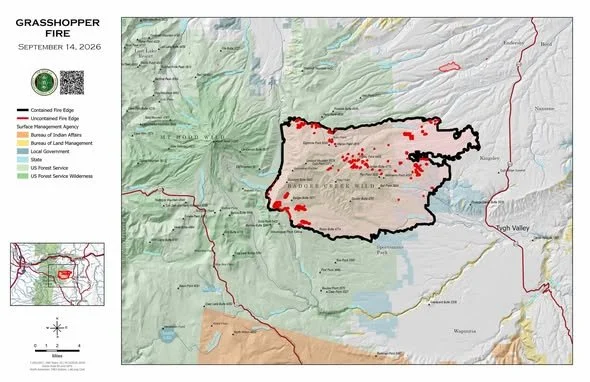
The lightning-caused fire was reported at 93,982 acres Monday with 282 personnel assigned.
Rain, wind and cooler temperatures swept across the fire Sunday, with the western side receiving more precipitation than the eastern portion.
The wet conditions created new safety concerns and prevented hand crews from working in some locations, including direct-line construction in the Boulder Creek drainage.
Instead, firefighters and heavy equipment operators worked from paved and gravel roads, continuing suppression repair and removing debris.
Little residual heat found
Fire personnel reported finding little residual heat as they worked across portions of the fire.
Backhoes were cleaning culverts along Forest Road 4410, while crews conducted hazard-tree removal and cleared right of way along Forest Road 2730-200.
Crews were also repairing dozer lines near the former Flag Point Lookout, which burned July 31 during the fire.
Surplus firefighting equipment is being removed from dozer lines along the southern edge of the fire as areas that once required active suppression increasingly move into recovery.
A mosaic left behind
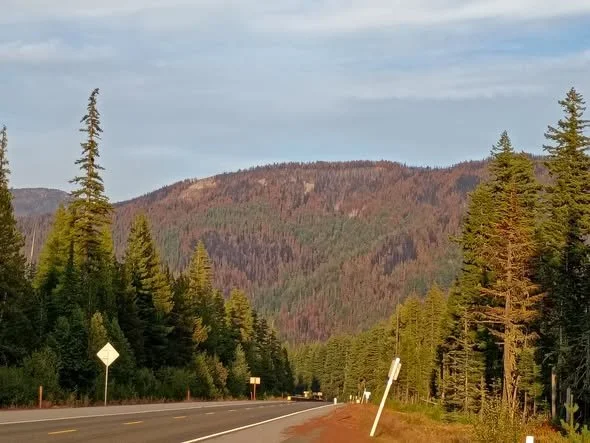
Fire officials said the Grasshopper Fire burned unevenly across the landscape, leaving what firefighters and forest managers describe as a “mosaic burn.”
Some areas experienced intense fire that reached the tree crowns and killed trees. Elsewhere, lower-intensity fire burned vegetation near the ground while leaving larger trees green and standing.
Other trees were not directly consumed by crown fire but suffered enough heat damage to turn their needles reddish. Fire officials said many of those trees are likely to die because of extensive foliage damage.
The resulting landscape will contain vegetation of different ages as plants and trees regenerate in the coming years, potentially providing varied wildlife habitat and seed sources for future forest growth.
Fire officials also said previous fuels-reduction work appears to have reduced fire severity in some areas. Removing brush and smaller trees before the wildfire reduced the amount of fuel available to carry intense fire through those locations.
Warmer, drier weather returns
Monday begins another warming and drying trend, with fire officials forecasting temperatures in the mid- to upper 50s and wind gusts up to 13 mph around the fire.
National Weather Service Portland forecasts also show a substantial warming and drying trend beginning Wednesday. A fire-weather spot forecast issued Monday morning calls for cooler conditions Monday and Tuesday followed by a “sharp warming/drying trend” Wednesday through Friday.
In Hood River, NWS forecasts highs around 70 Monday and Tuesday, climbing into the upper 70s Wednesday and lower 80s Thursday. Dry weather is expected through the weekend.
Evacuation notices remain in effect in portions of Hood River and Wasco counties, and a forest closure remains in place on the Mt. Hood National Forest.
Fire restrictions also remain in effect despite the recent rain and increasing containment.

Support Local News!
Available for Everyone; Funded by Readers.