
Grasshopper Fire recovery could cost $50 million on federal land as Wasco County seeks help
By Joshuah Albert
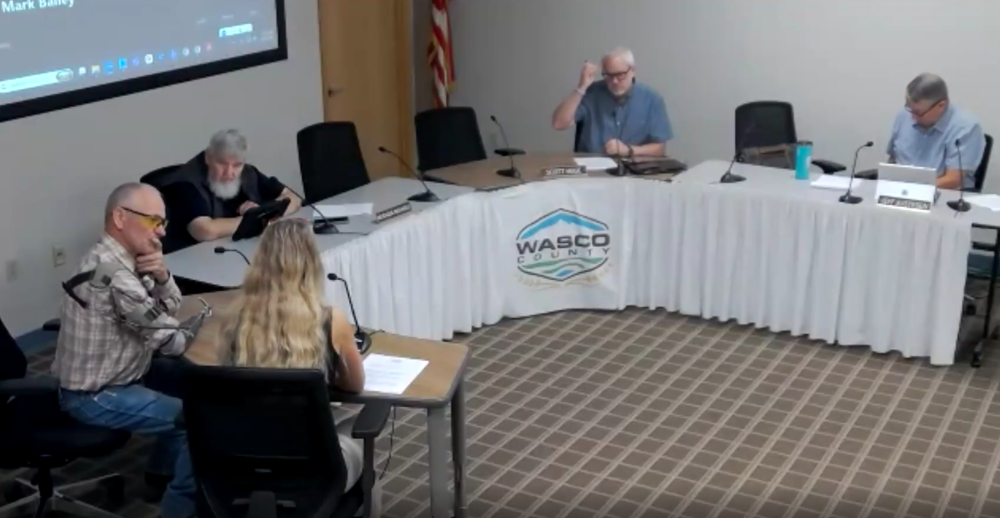
The Dalles, Ore., Oct. 9, 2026 — Recovery efforts following the massive Grasshopper Fire could cost nearly $50 million on federal land alone, according to a preliminary estimate discussed Wednesday by the Wasco County Board of Commissioners, prompting county leaders to seek federal assistance while warning that the financial consequences of major wildfires are becoming increasingly difficult to manage.
Commissioners agreed by consensus Oct. 7 to support two letters addressing recovery needs following the fire. One is directed to Oregon's congressional delegation and seeks assistance, including funding, while the second is addressed to the Mount Hood National Forest supervisor and outlines recovery priorities.
The letters were presented by Wasco County Community Development Director Kelly Howsley-Glover, who also serves as a co-convener of the Wasco County Forest Collaborative.
Howsley-Glover said the correspondence builds on work presented to commissioners at an earlier meeting organizdd and run by regional forest collaboration facilitator Andrew Spaeth reflects priorities identified by the collaborative.
Commission Chair Scott Hege pointed to the preliminary recovery estimate as evidence of the enormous financial consequences of wildfire.
It was also cited that the fire's total costs could exceed $150 million, although the meeting did not establish a verified final figure or provide a detailed breakdown of those expenses.
The discussion went beyond the immediate recovery effort, focusing on whether greater investment in forest management and fuel reduction could prevent future fires from becoming similarly destructive and expensive.
Commissioners discussed the collaborative's work to establish fuel breaks, reduce hazardous vegetation and create a network of treated areas intended to limit the spread of future fires.
They also questioned whether adequate resources had been available during the early stages of the Grasshopper Fire, contrasting the cost of prevention with the much larger expenses associated with suppression and recovery.
The county's letters are intended to reinforce earlier conversations with federal officials and establish a written record of local recovery priorities.
No new county appropriation for the recovery work was approved during the discussion.
County moves forward with endowment investment strategy
Commissioners also unanimously approved a formal acknowledgment of investment risks associated with the Oregon Local Government Intermediate Fund, advancing implementation of the county's recently established endowment. The are seeking to invest $15 million in Google fees with additional investments during the next 15 years.
The acknowledgment was required as part of the process for using the state-managed investment fund.
County officials explained that the fund is intended for longer-term investments and offers the potential for higher returns than the traditional Local Government Investment Pool, which public agencies commonly use to manage their funds.
Unlike the traditional pool, which has limits on deposits, the intermediate fund provides greater flexibility for investing larger amounts over extended periods.
However, commissioners were required to acknowledge that investments can lose value and that the Oregon State Treasury may impose restrictions on deposits and withdrawals.
The statement read into the record said investments in the fund "are subject to loss."
Hege said the county's investment committee had extensively reviewed the fund and believed it offered an appropriate combination of safety and potential returns.
He emphasized that Oregon counties operate under strict investment restrictions and that the county would not be pursuing speculative investments.
The endowment was established at a previous commission meeting. Wednesday's action did not authorize a new appropriation or identify a specific amount being transferred into the fund.
Public transit reductions affect South Wasco County
Residents of South Wasco County are receiving fewer public transportation services following reductions implemented July 1, according to an update from Mid-Columbia Economic Development District Executive Director Jessica Metta.
Metta told commissioners that The Link, which operates Wasco County's public transportation system, reduced its South County service from twice weekly to once weekly.
The agency also eliminated weekend office and dispatch operations, making it more difficult for some riders to arrange last-minute Dial-A-Ride transportation.
The changes followed funding pressures and uncertainty surrounding state transportation revenue.
The South County route serves communities including Maupin, Tygh Valley, Wamic and Pine Hollow, transporting residents to The Dalles for shopping and other needs.
Metta said the agency's transportation programs particularly serve older adults, people with disabilities, low-income residents and people with limited English proficiency.
Despite the reductions, The Link continues to operate its Red and Blue routes in The Dalles, regional connections to Hood River, and other transportation services.
The agency offers an annual Gorge Transit Pass for $40, allowing riders to use participating fixed-route services throughout the Gorge. An $80 annual pass also includes Dial-A-Ride service, subject to availability.
Metta reported that ridership and service hours had declined somewhat, but said the changes were not currently a major concern for the agency.
The county and MCEDD are also preparing for a change in how state transportation funding is administered.
Under a legislative change, certain payroll tax revenues supporting transit could eventually flow directly to MCEDD rather than passing through Wasco County's finance department.
Metta said approximately 90% of the applicable statewide transportation improvement fund payroll taxes collected in Wasco County return to support local transportation.
The change would require additional approvals, and the county would retain a role in determining how the money is spent.
A new two-year transportation funding plan is being developed, with a proposal expected to return to commissioners before submission to the state in January.
Gorge Commission review raises concerns about housing and growth
The Columbia River Gorge Commission is preparing for another comprehensive review of its National Scenic Area Management Plan, a process that could reopen longstanding debates over development restrictions, housing availability and urban growth boundaries.
Commission representatives told county officials that preliminary work is underway, with a formal review process expected to begin in July 2027.
The commission has been meeting with county planning departments to identify difficulties encountered in implementing the current management plan.
Hege identified restrictions on expanding urban growth boundaries as one of his primary concerns.
He argued that the limitations have made it difficult for communities such as The Dalles to accommodate growth and may contribute to rising housing costs.
The commission is seeking feedback from counties about economic development, regulatory challenges and opportunities to improve the management plan.
Representatives said the upcoming review would examine both regulatory provisions and broader economic and environmental objectives.
The discussion also highlighted financial challenges facing the Gorge Commission, which depends on funding from Oregon and Washington.
Commission representatives said budget reductions have constrained operations and could complicate the next management plan review.
No changes to land-use regulations were adopted at Wednesday's meeting.
Wildfire prevention work available at no cost to eligible landowners
Commissioners unanimously approved an equipment lease agreement allowing the Wasco County Soil and Water Conservation District to use a county-owned dump trailer purchased through a Community Wildfire Defense Grant.
County Wildfire Coordinator Melissa Napoli said the trailer will support crews performing wildfire prevention and defensible-space work.
The equipment was purchased in June and will be used by crews managed through the conservation district.
Napoli said the existing grant program is entering its third year and is scheduled to conclude Sept. 9, 2029.
The program currently serves a designated area of South Wasco County, including communities near Friend, Pine Grove, Sportsman's Park and Maupin.
Eligible property owners can receive a wildfire risk assessment and vegetation management work at no cost.
Napoli said assessments generally take about an hour, after which crews are assigned to perform recommended work.
She said the program currently has capacity for additional properties and expects crews to continue working into approximately mid-November, depending on weather.
The county previously applied for another round of federal funding but narrowly missed qualifying.
Napoli said she hopes to seek additional funding that could expand the program to much of Wasco County.
Residents within the current service area can contact the Wasco County Soil and Water Conservation District or the county Planning Division to request assistance.
Jail mental health evaluations receive three-year extension
Commissioners unanimously approved a three-year contract with Northwest Forensic Institute LLC for mental health evaluations of people held at Northern Oregon Regional Corrections, commonly known as NORCOR.
Wasco County Sheriff Miguel McIlvenna said the agreement allows qualified professionals to evaluate whether individuals facing criminal charges are mentally capable of assisting in their own defense.
The program provides an alternative to transporting some individuals to Oregon State Hospital for evaluations, potentially reducing delays in criminal proceedings and unnecessary time in custody.
McIlvenna said the county typically requires approximately eight evaluations annually and used all eight available evaluations under the previous one-year agreement.
The sheriff's office budget covers the service, with an annual cost discussed at approximately $4,200.
McIlvenna said the program helps protect public safety while ensuring defendants receive evaluations within required time frames.
He also said timely evaluations can prevent cases from being jeopardized by delays in the legal process.
Other county actions
Commissioners unanimously appointed Ian Chandler and Michael Springston to the Wasco County Board of Property Value Appeals, which reviews property owners' challenges to assessed values.
County Clerk's Office representatives said additional volunteers are still being recruited.
County Clerk Chrissy Zaugg also provided an election update, saying ballots for the Nov. 3 general election were scheduled to be mailed Oct. 14.
Zaugg encouraged voters to return ballots early and use official drop boxes to avoid possible postal delays.
She said voters who expect to be away during the election can contact the clerk's office to arrange early ballot issuance.
Commissioners also approved a consent agenda that included an amendment to a Gorge Recovery Center agreement funded through opioid settlement dollars.
The amendment allows the organization to redirect part of its existing funding toward purchasing a vehicle to transport people to and from services.
County staff said the change would not increase the organization's overall funding allocation and that the vehicle would revert to the county if it ceased being used for its authorized purpose.
The meeting concluded without additional public testimony.

Support Local News!
Available for Everyone; Funded by Readers.