
New Column: NICHOLS & CENTS - Pieces of Eight
From the Editor — We are introducing a new column this week by Rodger Nichols. He provides insight on rare and collectable coins and the interesting details and idioms that surround them. Rodger is an old friend as well as a great story teller and is often found providing interesting tidbits on coins with friends and new acquaintances.
"Pieces of eight! Arawk! Pieces of eight!"
— cry of the cartoon parrot

Rodger Nichols
The Dalles, Ore., May 7, 2026 — Few coins have such a hold on the public imagination as the "pieces of eight" sought by 17th and 18th century pirates on the Spanish Main. To mention the name is to invoke images of Long John Silver, hidden treasure chests and the Jolly Roger.
The "Spanish Main" was the coastal region of the Americas controlled by the Spanish Empire that bordered the Caribbean Sea and the Gulf of Mexico.
Yet few people today know much about the fabled coin, or the fact that its use in the early American colonies led to a series of popular slang expressions still being used 200 years later...
Early Spanish explorers were delighted to discover vast deposits of gold and silver in the New World, and they lost no time in plundering the wealth of the native peoples and shipping the loot back to Spain.
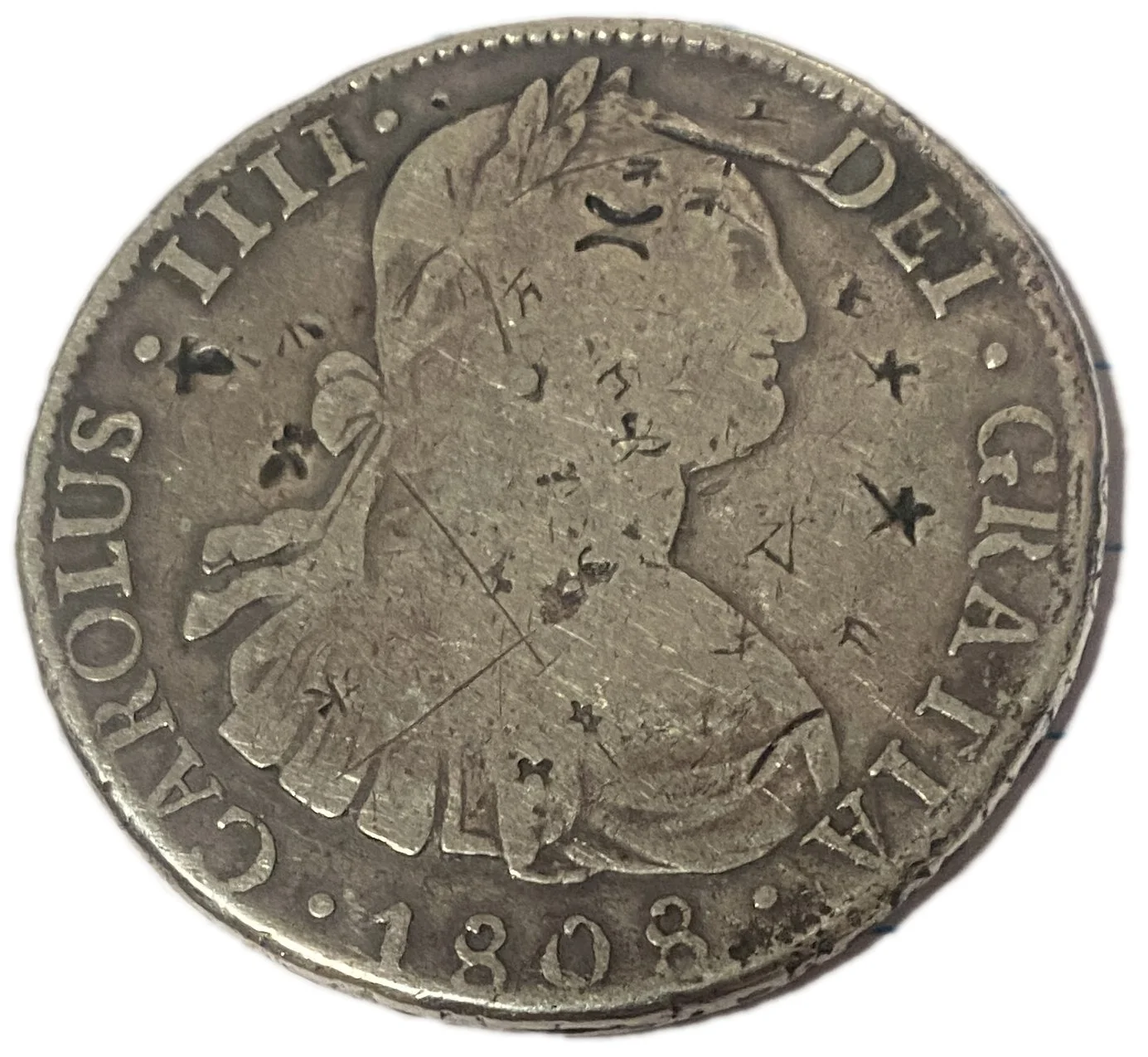
Real “Piece of Eight”
As the first settlers and missionaries arrived they began turning the raw metals into coins, both for their own use and as a convenient way to measure and ship quantities of the metal back to Spain. Mints were set up throughout Latin America from Mexico to Argentina. Early efforts produced crude "cob" coinage stamped on both sides but with rough edges only approximating circles.
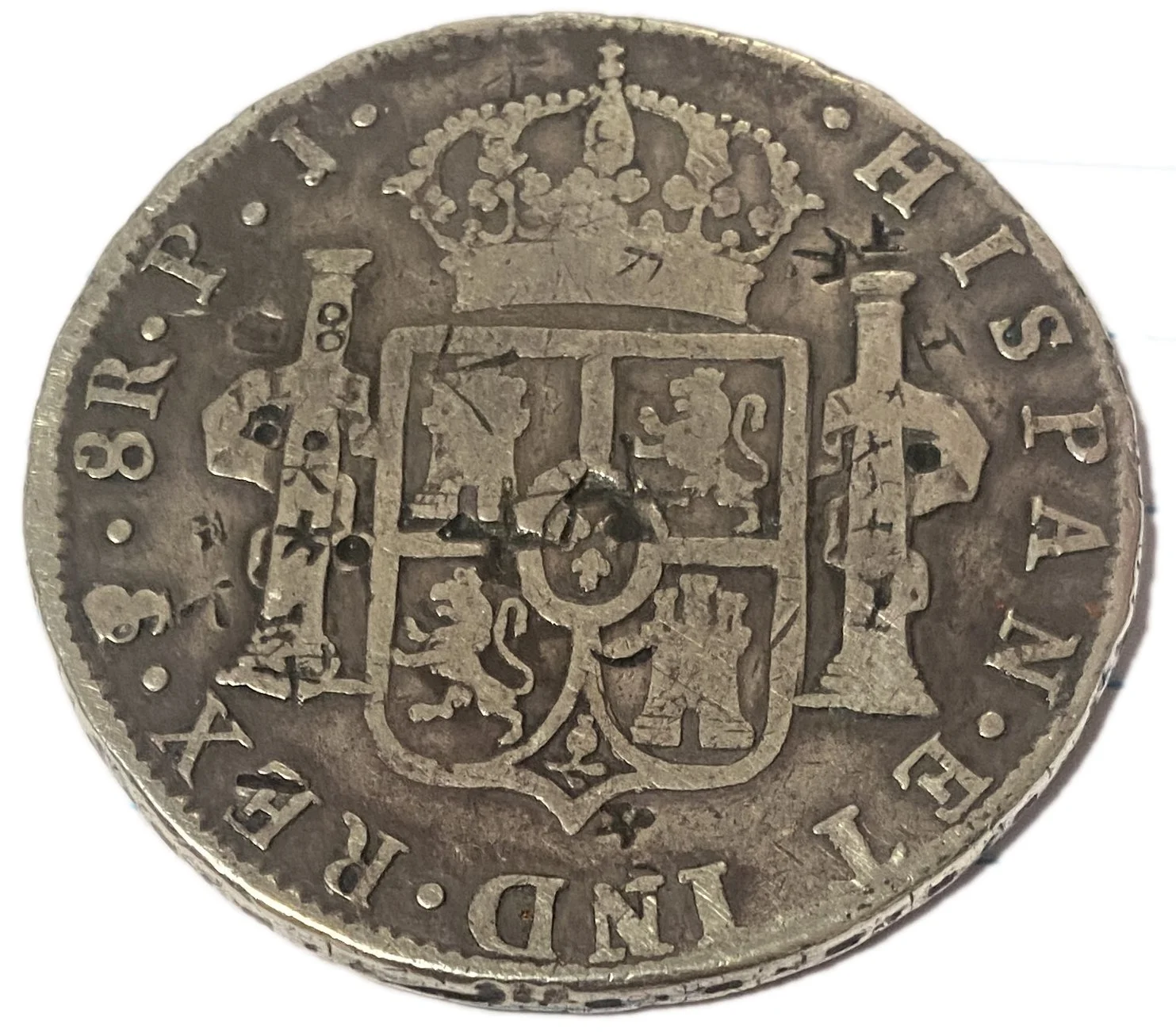
Real “Piece of Eight”. You'll notice the coin is covered with what are called "chop marks" by numismatists. Chop marks are small counterstamps or imprints stamped onto coins by merchants and money changers to verify a coin's authenticity, weight, and metal purity. Since they were added after the minting process, they were originally thought of as detracting from the value of a coin. More recently, the tide has turned, and they are considered a visible proof of the coin's age, coolness and travels in Asia.
By the 1760's, more sophisticated equipment arrived in the New World, leading to coins such as the one pictured above. Our example was minted in Bolivia in 1808. It features a portrait of Charles IV of Spain on the obverse and the Spanish coat of arms on the reverse, flanked by two pillars representing the Pillars of Hercules at the Straits of Gibraltar, signifying the coins were made "beyond the Pillars" and thus came from the New World. For this reason, they are often referred to by numismatists as "Pillar Dollars," Values on such coins range today from about $30 to thousands, depending on age, condition and scarcity.
Where do the "pieces of eight" come in? After the American Revolution, the founding fathers found themselves with a new nation that had little circulating coinage. British tight control of hard money left few coins in their colonies, and the then-explored areas of America were poor in metal deposits. To add to the problem, the Continental Congress had financed the war with paper money that inflated so fast the phrase "not worth a Continental" entered the language.
Faced with the demand for hard money, one of the first acts of Congress was to approve the circulation of "Spanish milled dollars" (pieces of eight) as legal tender equivalent to a U.S. dollar.
The pieces of eight were called so because their denomination was 8 "reals", that being the current unit of Spanish money. While there were smaller 4, 2 and 1 real coins, there were far more of the larger pieces of eight made. Thus it often became necessary to "break" the larger coins for change. And in those days, the term "break" was taken a bit more literally.
Hammer and chisel were applied to chop the coins into halves, quarters or pie-shaped eighths. Each eighth, equal to one real, was known as a "bit". Thus "two bits" were a quarter, "four bits" a half and "six bits" three-fourths of a dollar.
In addition, the bits were sometimes further cut into sixteenth-sized portions, and the resulting tiny sliver of silver was known as a "picayune," a word used even today to denote something stunted and undersized.
So the next time you talk about a "two-bit" something or other, remember to thank the Spanish conquistadores.
About Rodger Nichols
Rodger Nichols has been evaluating coin and currency estates, both U.S. and foreign, for local lawyers since 2010. If you have gathered or inherited coins and currency, and want to find out their value, call or text Rodger at 541-980-1728.