
The Dalles faces mounting street repair bill as deferred maintenance approaches $9 million
By Joshuah Albert
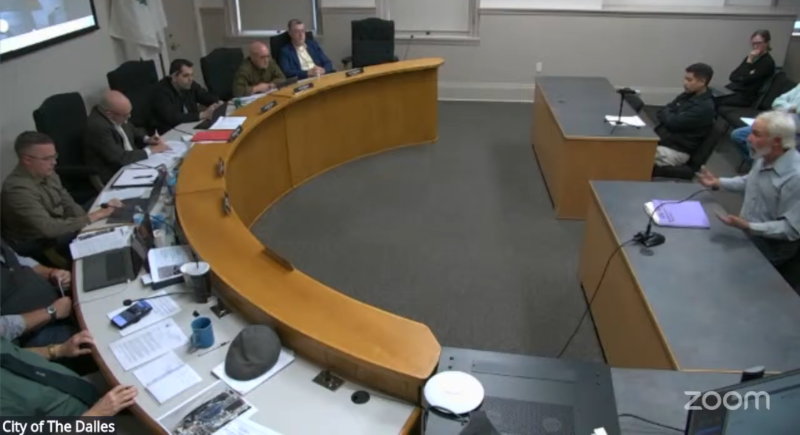
The Dalles, Ore., Sept. 29, 2026 — The Dalles is confronting an estimated $8.5 million to $9 million backlog in deferred street maintenance that could balloon beyond $40 million within a decade if current spending levels continue, prompting the City Council on Monday to begin weighing new fees, taxes and other funding sources to keep the city's roads from deteriorating further.
No new tax or fee was approved at the Sept. 28 meeting.
Instead, councilors directed city staff to return with detailed scenarios showing how much additional money would be required to maintain or improve the city's pavement network — and what combinations of revenue sources could pay for it.
The scale of the problem became clear when staff estimated that raising the city's overall Pavement Condition Index, or PCI, to 80 within five years would require about $24 million in additional spending on street maintenance and rehabilitation.
The city's current maintenance budget is about $400,000 annually, staff said.
Public Works staff said deferred street maintenance was estimated at about $4.5 million when the city began using its StreetSaver pavement-management system. The latest estimate puts that backlog between $8.5 million and $9 million.
If funding continues at current levels, staff projected deferred maintenance could reach $40 million or more by 2036.
The problem is compounded because pavement becomes dramatically more expensive to repair as its condition declines. Preventive work such as crack sealing and chip sealing can extend the life of streets at relatively low cost, while badly deteriorated roads eventually require expensive reconstruction.
Staff presented several possible sources of additional revenue, including a higher local gas tax, a street utility fee, increased system development charges, general fund support and other revenue.
A street utility fee received considerable discussion. Such a charge could operate similarly to the city's existing $2 monthly stormwater utility fee, which staff said generates roughly $250,000 annually.
A new street fee could appear on utility bills and be specifically dedicated to transportation maintenance and rehabilitation.
Councilors did not settle on an amount or endorse imposing such a fee Monday.
Staff also presented a hypothetical increase in the city's existing 3-cent-per-gallon local gas tax. The city projects the current tax will generate about $523,000 this year.
Staff initially estimated that adding 2 cents per gallon could generate another $200,000 annually, bringing collections to roughly $700,000 to $720,000.
Mayor Rich Mays questioned that calculation during the meeting, noting that $523,000 divided by the existing 3-cent tax would suggest substantially more revenue per penny.
“If you take the 523 and you divide that by 3 cents, that's $175,000 per penny,” Mays said. “Times two would be $350,000. That's my math.”
Staff did not resolve the discrepancy during the meeting, meaning the revenue estimate will need additional clarification before the council considers the option further.
Another possibility presented was a prepared food and beverage tax. Staff emphasized that it was not recommending that option but included it because some Oregon cities use such taxes to support public services.
Staff cited Ashland, Cannon Beach and Yachats as examples of communities with a 5% prepared food and beverage tax and estimated that a similar tax in The Dalles could potentially produce roughly $1 million to $1.5 million annually. No council action was taken on that proposal.
Councilors instead appeared interested in seeing several funding and repair scenarios before deciding whether residents, motorists, businesses or the city's general fund should contribute more.
One scenario discussed would gradually increase the city's overall PCI over a longer period rather than attempting the $24 million, five-year push.
Staff estimated that increasing the PCI by roughly one point per year over 10 years could require about $2 million more annually, on top of the existing $400,000 maintenance budget.
Once the system reached a PCI of about 80, staff estimated roughly $2.5 million annually could be needed to maintain that condition.
Councilor Dan Richardson asked staff to bring back options with specific targets, timelines and dollar amounts rather than asking councilors to choose among funding mechanisms without knowing what each would accomplish.
Councilor Ben Wring also asked for a scenario examining whether the city could maintain streets that remain in reasonable condition while concentrating additional investment on the worst roads in the network.
Public Works officials said those scenarios could be modeled.
The discussion also highlighted the savings possible when city crews perform work themselves.
Staff said some pavement-preservation treatments performed in-house cost substantially less than contracting the same work. Public Works has also purchased a machine to apply mastic asphalt, a material recently demonstrated on portions of city streets, including the Sixth Street Bridge.
The machine had not yet arrived as of Monday, although staff said it was expected soon.
Members of the public also urged the council to address the deteriorating road system.
Chuck Covert told councilors that delaying repairs ultimately makes the problem more expensive.
“The longer we wait ... the cost to get us back up to where we were increases significantly,” Covert said.
Another speaker urged the council to seriously consider a user fee, arguing that everyone benefits from functional streets regardless of whether they personally own a vehicle.
Former Councilor Carolyn Wood praised recent street-maintenance work, particularly chip sealing, while also discussing difficult roads such as Morton Street.
City Manager Matthew Klebes summarized the council's direction as a request for a more detailed comparison of how other cities finance streets and financial models showing what different levels of investment would accomplish.
That work could include transportation utility fees, general fund contributions and gas taxes, along with comparisons with similar Oregon cities.
Klebes said the street discussion would likely return to council in January or February 2027, after the city advances work on its wastewater master plan. Depending on council direction, a potential funding action could follow around March or April, in time to inform the next fiscal year's budget process.
Council rules nuisance exists after property owner's appeal
In another action Monday, the council unanimously ruled that outdoor junk on a West Eighth Street property constitutes a nuisance under city code.
Code Enforcement Officer Arturo Dominguez told the council that the city's original notice had incorrectly suggested some material extended into the public right of way. After reviewing the property boundary with Public Works and the city engineer, the city withdrew that allegation.
The case before the council was therefore limited to materials stored outdoors on private property and specifically excluded whole vehicles and trailers.
Property owner Gary Levine challenged the city's determination during a lengthy quasi-judicial hearing.
After hearing from Levine and city staff, the council determined the outdoor materials met the city's definition of a nuisance.
The vote was initially announced as 4-1, then 5-1 before councilors clarified that all five councilors participating had voted in favor. The official result was 5-0.
Under city code, Levine was given three days following the council's determination to remove or abate the nuisance. Any city-performed abatement would be a separate action.
Winter shelter expanding in The Dalles
Klebes also announced that the Gloria Center shelter in The Dalles will move from an emergency-only model to regular winter operations.
Previously, the shelter opened only during severe winter weather. Under the change announced by Mid-Columbia Community Action Council, the shelter is expected to operate continuously from approximately mid-November through March.
Hood River's shelter, meanwhile, is shifting from seasonal winter operations to year-round service.
Klebes said he did not have details Monday about what funding changes allowed the expanded operations.
Dog licenses generate about $11,000
The city's revised dog-licensing program has issued 288 licenses and generated approximately $11,000 since the licensing requirement took effect July 1, Klebes reported.
Revenue supports the city's animal-control program and the Columbia Gorge Humane Society.
The city is beginning to receive reports from veterinarians that will allow its animal-control officer to contact owners about licensing requirements. Klebes said the city's initial approach will focus on education before enforcement.
Residential broadband rollout begins
Klebes also reported that Q-Life has begun taking early residential sign-ups as it rolls out broadband service in zones across The Dalles under the Gorgeous Broadband name.
He described the launch as the culmination of efforts involving the city, Q-Life and Northern Wasco County PUD to expand the regional fiber partnership and establish dedicated staffing for residential deployment.
City preparing expanded data center records
The city is also preparing an expanded section of its website dealing with data centers, water and wastewater infrastructure and tax-abatement agreements.
Klebes said the city plans to publish a more extensive FAQ along with original documents governing enterprise zone agreements, strategic investment program agreements, infrastructure agreements and related arrangements.
The updated material is expected online within the next several weeks.
Other action
The council unanimously approved its consent agenda, which included Sept. 14 meeting minutes, nuisance-abatement assessments against several properties and authorization to purchase replacement network hardware intended to improve citywide bandwidth reliability and cybersecurity.
The council's next regular meeting is scheduled for Tuesday, Oct. 13, a change from its normal meeting schedule because of a holiday.
Support Local News!
Available for Everyone; Funded by Readers.