
Google tax deals pour millions into Wasco County; commissioners eye $15 million endowment for windfall
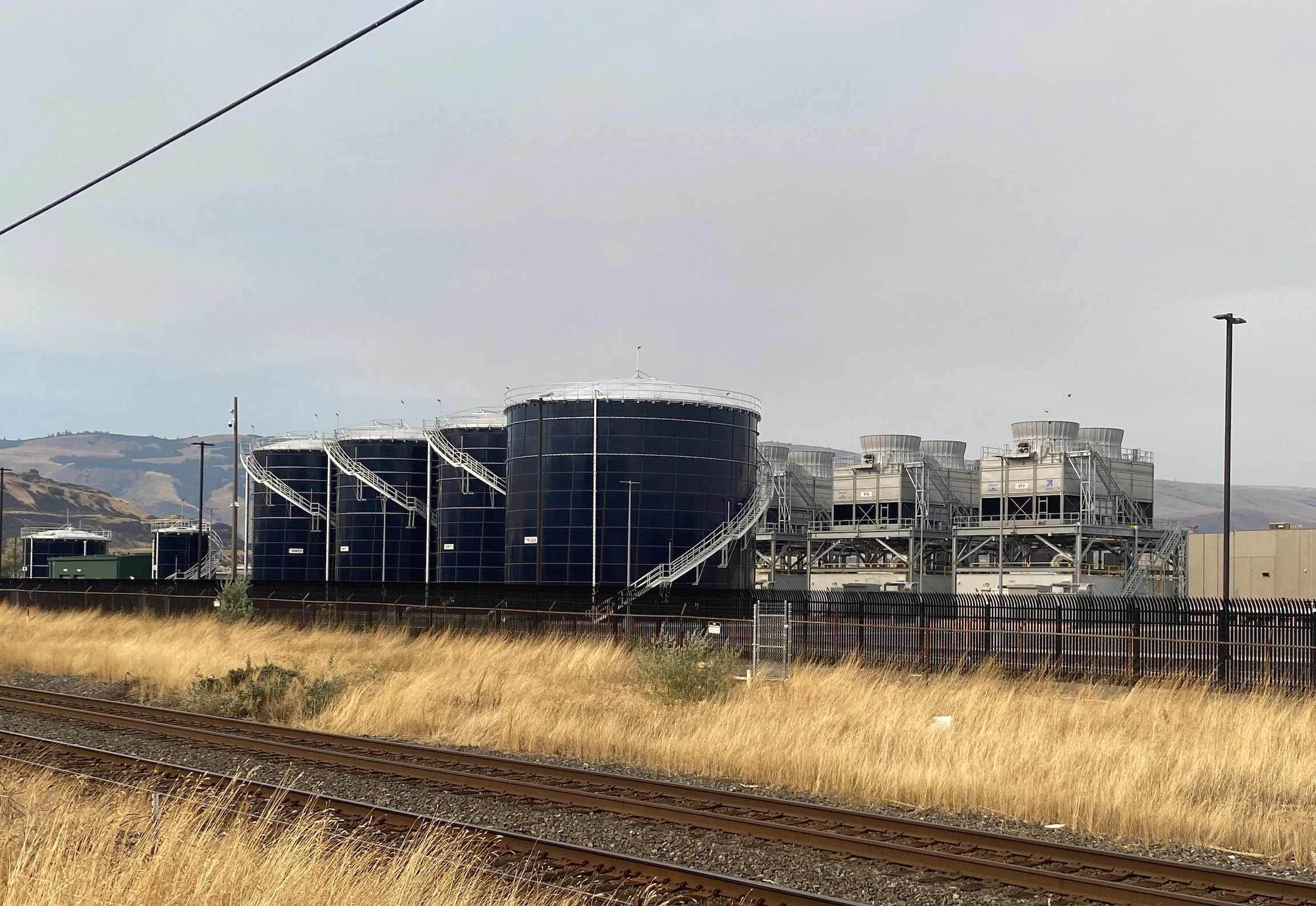
Industrial plant at the Google Data Center under construction on River Road. The plant with 280,000 square feet remains under construction. Once the facility gets a certificate of occupancy from the City of The Dalles, it will come on the property tax rolls at 60 percent of its capped value, likely bringing in around $10 million in fees, payments and property taxes.
By Tom Peterson

Wasco County Tax Assessor Jill Amery
The Dalles, Ore., Aug. 17, 2026 — Millions of dollars are flowing into Wasco County and other local taxing districts through Google's data center tax-abatement agreements, and county leaders are considering a long-term strategy that would lock away as much as $15 million of those one-time revenues until at least 2041.
Wasco County commissioners are scheduled Wednesday, Aug. 19, to hear a detailed presentation from Assessor and Tax Collector Jill Amery outlining how the county's property tax-abatement programs work, what Google's data centers are paying now and when currently exempt facilities are expected to become fully taxable.
The discussion comes as commissioners also consider creating the Wasco County Endowment and Resiliency Fund, an endowment-style investment fund intended to turn temporary revenues from Strategic Investment Program agreements and other tax abatements into a permanent source of income for future county needs.
County officials describe those revenues as a rare opportunity that should not be used to permanently expand government operations.
“These abatement programs are a one-time incentive designed to attract investment to the community, and the revenue received through them represents a one-time opportunity,” Amery wrote in a memo to commissioners. Once the abatements expire and negotiated payments end, property taxes are distributed according to Oregon law.
Millions already flowing from Google
Data Center 1: Paid $4.7 million in 2025.
Data Center 2: Pays $800,000 annually, split among the City of The Dalles, Wasco County and School District 21. It is scheduled to go on the property tax rolls in 2031-32.
Data Center 3: Pays $1.81 million annually in fees split between the city and county. It is scheduled to go on the property tax rolls in 2034-35.
Data Center 4: Paid $9.81 million in fees, payments and taxes in 2025.
Data Center 5: Still under construction. It is expected to pay more than $9.81 million annually in taxes after receiving its certificate of occupancy.
Google total payment and taxes in 2025: $17.12 million
The scale of those payments is illustrated by Google's newest data center projects, which operate under Oregon's Strategic Investment Program, or SIP.
For the 2025-26 tax year, one Google data center generated $1.56 million in property taxes, a $2.5 million Community Service Fee, a $5.76 million Guaranteed Annual Payment and a one-time $3 million initial payment, according to Amery's report.
The Guaranteed Annual Payment is split between Wasco County and the City of The Dalles and is designed to bring the community's compensation to an agreed-upon percentage of what the facility would pay if fully taxed. For the first SIP data center, that agreement guarantees 50% of the full-tax equivalent. The packet places that 2025 figure at $9.81 million. Amery said that amount was likely to fluctuate from year to year based on the value of property within the building, and that figure is essentially a snapshot of its value which will vary in years to come.
The $2.5 million Community Service Fee is spread much more broadly across local governments and public services.
North Wasco County School District 21 receives the largest share at $752,500, followed by Wasco County at $610,000, the City of The Dalles at $432,500 and Mid-Columbia Fire & Rescue at $302,500.
Other distributions include $97,500 each to the Wasco County Library and North Wasco County Parks and Recreation District; $67,500 to Wasco County ESD; $40,000 to Columbia Gorge Community College; $35,000 each to Wasco County 4-H and Extension and Wasco County Soil and Water Conservation District; and $30,000 to the Port of The Dalles.
More data centers eventually become taxable
The county's relationship with Google stretches back more than two decades.
Wasco County and The Dalles have negotiated three Long-Term Rural Enterprise Zone agreements with Google, beginning with an agreement signed in 2005. Each agreement runs for 15 years.
Google's first large-scale data center was the first in Oregon to use the 15-year Long-Term Rural Enterprise Zone program, according to Amery. During its exemption period, Google paid $250,000 annually in fees and made targeted contributions to Columbia Gorge Community College's Information Technology Program, Q-Life and economic development initiatives.
That facility became fully taxable beginning with the 2022-23 tax year.
Two other agreements remain in their exemption periods.
The second is scheduled to reach full taxable value in the 2031-32 tax year. Until then, Google pays an annual $800,000 fee divided among The Dalles and Wasco County, which receive $280,000 each, and North Wasco County School District, which receives $240,000.
The third agreement is scheduled to become fully taxable in 2034-35. Google currently pays $1.81 million annually under that agreement, split evenly between The Dalles and Wasco County at $907,133 each.
The packet does not estimate how much additional property-tax revenue local taxing districts will receive when those facilities become fully taxable.
County proposes locking away up to $15 million
At the same meeting, commissioners are scheduled to conduct the first reading of Ordinance No. 26-003, establishing the Wasco County Endowment and Resiliency Fund.
The proposal would capitalize the fund with up to $15 million from existing County Project Fund balances and add future county-retained SIP revenues, tax-abatement dollars and investment earnings.
Under the proposed ordinance, the county could not make appropriations or distributions from the fund until July 1, 2041. Money received from future economic-development agreements would be subject to its own rolling 15-year no-spend period, with investment earnings retained in the fund during those growth periods.
County officials say the strategy is designed to build “a self-sustaining financial cushion” rather than allowing temporary windfalls to finance short-term expansion.
After the fund matures, commissioners could appropriate up to 75% of the previous year's net investment earnings, while at least 25% would be reinvested to protect the fund's principal against inflation.
Those earnings could eventually pay for capital improvements, economic development, grant matches and community project loans. The ordinance would also allow earnings to support county staffing during economic downturns when needed to maintain core public services.
Accessing the principal itself would be considerably more difficult. The ordinance would generally prohibit dipping into principal unless the county experiences what it defines as a “True Catastrophe,” including a decline of at least 20% in total county tax revenues or a declared disaster requiring a local match exceeding $1 million or 5% of the fund's principal.
Such a withdrawal would require a unanimous vote of the Board of Commissioners, a public hearing and adoption of a 10-year repayment plan within 180 days.
Betting on a growing tax base
County administrators say the timing is intentional.
As existing SIP and enterprise-zone agreements expire over the next 15 years, county officials expect more data center property to enter the regular tax rolls.
The endowment memo also points to projected “retooling of existing datacenter structures outside of abatement agreements,” saying those changes could result in incremental tax increases for the county General Fund and other local taxing districts during the 15-year period.
In the meantime, the county's plan would attempt to preserve a portion of today's extraordinary revenues for decades.
County staff says the long-term goal is to create a “perpetual, non-tax-derived revenue source” capable of supporting regional infrastructure, emergency resilience and stable public services.
Commissioners are scheduled to consider the first reading of the endowment ordinance Wednesday. Amery's tax-abatement revenue presentation is scheduled for 10:20 a.m.