
Housing Programs Lift Clients Toward Self-Sufficiency
From Mid Columbia Housing Authority:
By Sheree Hernandez
The Dalles, Ore., April 15, 2026 — Reducing dependence on public assistance is a primary goal of many of the Mid-Columbia Housing Authority programs. The agency supports low-income Gorge individuals and families in affording reliable, safe housing through federal and state funding, and rental assistance is supplemented by the Bridges to Health Pathways and Family Self-Sufficiency (FSS) teams, which help them become independent.
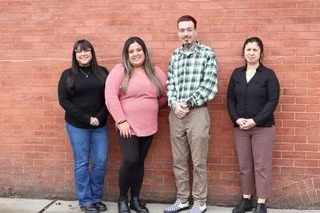
Bridges to Health provides community health workers helping clients walk through the journey and offer support for life issues that can improve a client’s physical and mental health. Josh Sendejas and Jeannette Gutierrez bring their lived experience to this role, and it helps them relate to clients.
When a new person comes to the agency seeking assistance, they are paired with a caseworker to review their overall picture. Sendejas says their role is to help work toward housing stability. “We’re able to provide a lot more than traditional programs,” he said.
“I get to be one-on-one with clients,” Guitierrez said. She is happy to be part of a team that helps people apply for housing, find resources to help pay for applications, and make referrals to help clients improve their lives and take away some of the burden of stress that low-income individuals struggle with.
The Pathways checklist helps identify where clients are struggling and need assistance. Housing is always a main factor alongside employment issues, but there may be other factors like healthcare, mental health needs, disabilities, household size, and more that create challenges to be able to afford the ever-rising costs of housing in the Columbia River Gorge.
The duo is always excited when a client successfully qualifies for rental assistance and finds a suitable home that helps them live a better life. The programs are not meant to be permanent. It is a step toward housing stability, with the goal of eventually coming off assistance.
Once clients have obtained housing with vouchers sponsored by the U.S. Department of Housing and Urban Development (HUD), they are invited to begin participating in the Family Self-Sufficiency (FSS) program, also funded by HUD. This voluntary five-year program offers an opportunity to build a significant savings account that is released upon successful completion of the program and can be used for a future down payment or other family needs.
Sonia Chavez and Silvina Bustos are the coaches who walk people through the process. It begins with meeting clients for a thorough discussion about their goals. Typically, the first goal is to improve their jobs and move into higher-paying professional work for long-term stability. Generally, up to seven goals are identified and paired with real steps to achieve them.
HUD recipients are required to pay 30% of their income toward their housing, and the voucher helps cover the remaining monthly rent. When they enter the program, their baseline amount is recorded. Each time a client receives a pay raise, they are required to contribute a full 30% of their new income level.
The difference between the baseline and the new requirement is the amount that MCHA will save in an escrow account for the FSS client. For example, if the client’s portion goes up by $100, then $100 is also placed in their MCHA-held savings account. Funds for the escrow account are not the client’s original money paid for their rent. That has already been spent on their monthly household responsibility. The funds come from HUD and can only be released when the client fully meets all requirements and graduates from the program.
“Do you want to better yourself and have a savings?” Chavez said this is the question she poses to clients during their enrollment interview. “I always like to make them dream.”
Bustos explained that to finish the program, the client must meet the goals they set for themselves, be employed, and ensure everyone in the household is off cash welfare assistance at the time of graduation. She also said it is possible to exit the program before the five-year period if they meet all the requirements.
Coordinators work hard to make sure everyone understands all the rules. If they exit without meeting any of the goals, they forfeit the escrow account. Bustos explained that clients have to be responsible for their actions and do the work to take advantage of this program.
According to Compass Working Capital, the average FSS savings a graduate receives is $8,500. The biggest escrow savings awarded through MCHA was $44,000 for a client who started with zero income and got a full-time job. Her goal is to buy a house.
“Programs like these provide meaningful, tangible benefits to clients while supporting their efforts to build stability and move toward greater independence,” said Karen Long, executive director for MCHA. “We are so grateful to apply a comprehensive approach that benefits the local economy by providing $750,000 of federal dollars a month in rental assistance, and to administer programs such as Bridges to Health Pathways and the Family Self-Sufficiency program to help low-income residents find housing stability and improve their daily lives.”
Support Local News!
Available for Everyone; Funded by Readers.