
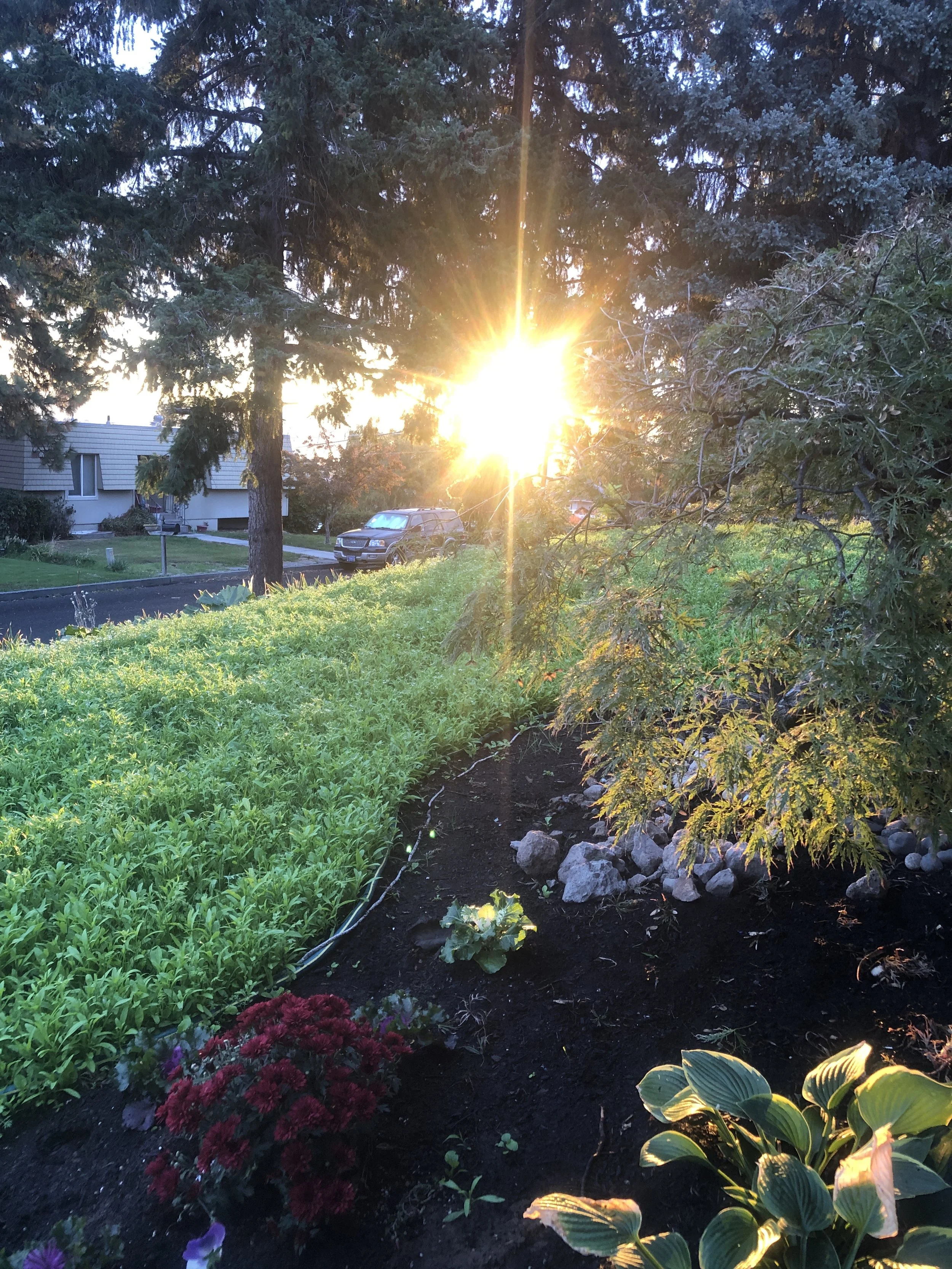
Fall sunrise over fleur de lawn, an eco-friendly mix of flowers that requires less fertilizer and water.
Story and photos by Dana Greyson
The Grass Is Greener On the Other Side of the Street

Dana Greyson
The Dalles, Ore., April 2, 2026 — Across the street, our neighbor Jim Bailey’s emerald grid-mowed lawn is a pristine oasis. I’ve teased him by coming out with a ruler to see if it was off a millimeter anywhere. (It’s not.)
Despite their popularity and the beauty of Jim’s green oasis, I’m not a fan of traditional lawns for my own yard; I consider them eco-unfriendly, high maintenance monocultures. Or maybe I’m just too lazy.
When we moved in our front lawn could most diplomatically be described as “patchy.” It grew in clumps, some brown, some bare sandy dirt. The greenest areas were the dandelions, which grew with vigor and abundance. Other than dandelion removal—initially killing pollinating bees while reluctantly spraying Roundup, then later manually removing as many as 400 dandelions a day—I did little to improve my lawn’s appearance. My husband, Wayne, on occasion used our secondhand plug-in electric lawn motor to mow our weedy lawn.
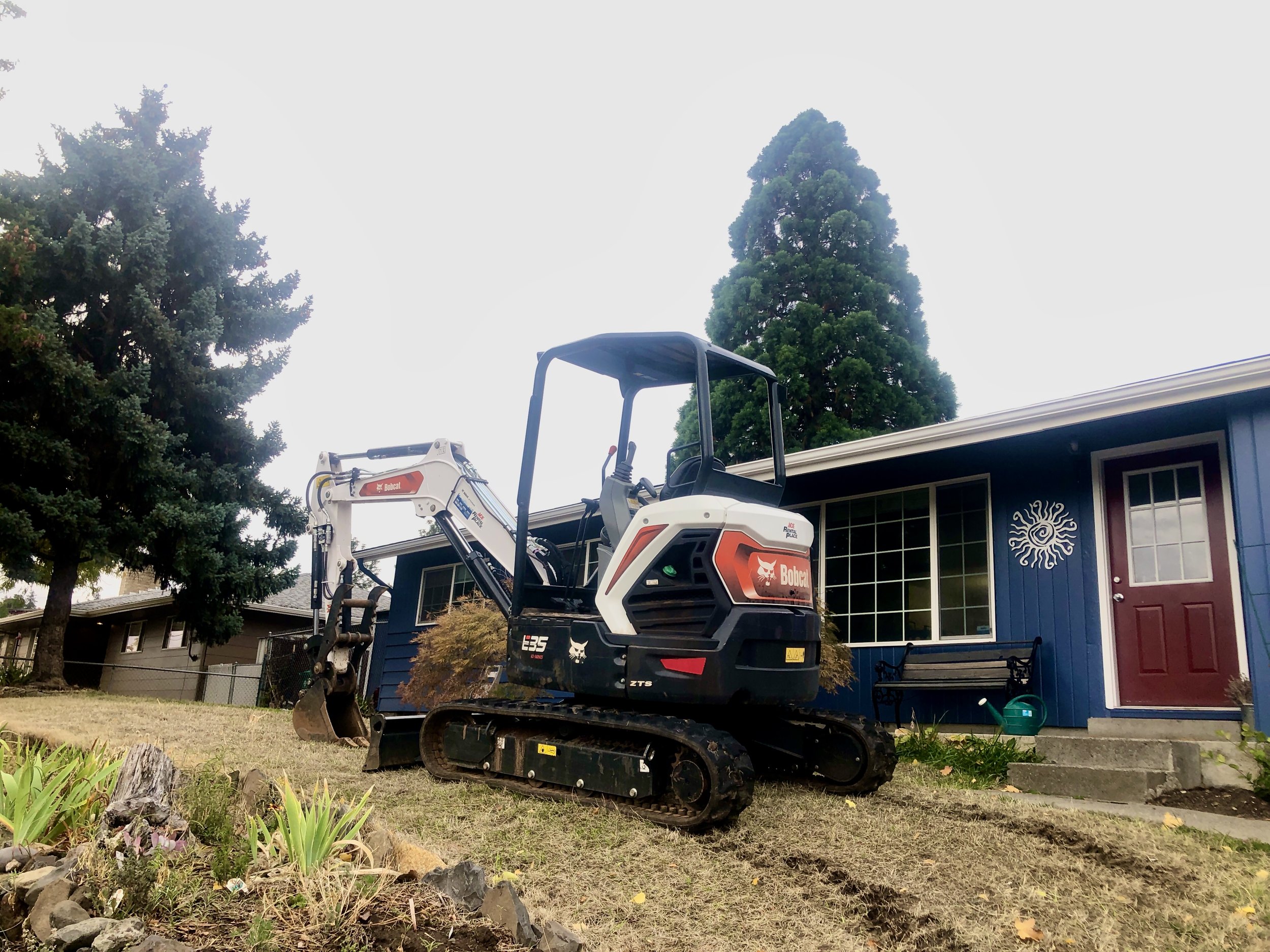
We rented a Bobcat and dug a deep trench to remove and replace our existing water pipes.
Six months later, we decided to not play whack-a-mole to fix our badly leaking water pipes. We rented a Bobcat and dug a deep trench to remove and replace our existing water pipes. That tore up our lawn, massively compacting the entire area to a concrete-like density. Our front yard looked awful, but I wasn’t sure what to do about it. I did nothing. Time passed. “You know,” Jim observed the following summer, “If you don’t water your lawn, it will die.”
Yup, I told him, that was the idea. He’s a nice neighbor, so he didn’t push it, though there’s little doubt our disheveled yard drove him crazy.
Considering Options to Traditional Lawns
Years earlier, my parents opted out of a front lawn. Instead, they choose a mix of Saint John’s Wort as an evergreen groundcover, red volcanic rock borders, and gravel pathways with steppingstones. It was low maintenance, but other than the sunny yellow Saint John’s Wort blossoms, I found the look uninviting, nothing more than a pathway to the front door. Still, I considered a nice fire-safe rock garden, but the stones get a bit too hot here in the summer for me. “Just put in a lawn,” Wayne suggested to alleviate our eyesore as I continued to stall. “Seed or sod.”
But I just couldn’t warm up to it.
I seriously considered another low-maintenance option—a fake lawn. My sister-in-law’s was surprisingly realistic looking. It didn’t feel like grass, but I wouldn’t need to water or weed it. Mostly sold on the fake lawn option, I went to Dirt Huggers to get a recommendation for a local landscapers who could install a fake lawn. Instead, Pedro, who works Dirt Hugger’s kiosk and bulldozer for a landscaper referral, suggested checking out an ecolawn. He tipped me off to PT Lawns, as they’re Portland Oregon-based and make lawn-alternative seed mixes. There are other ecolawn alternatives to PT Lawns—just Google the options. After more research,* I decided to put in ecolawn.
What Is An Ecolawn?
Ecolawns are a mix of clover, grasses and sometimes other seeds like yarrow and other flowering annuals and perennials. Wildflower meadows are a close cousin to clover lawns, also gaining popularity.
Compared to traditional turf grass lawns, ecolawns
use substantially less water
don’t require fertilizer
need less frequent mowing
Clover—a legume—improves the soil quality by adding nitrogen. That way, if you get tired of your clover lawn and decide to remove it later on, your soil will be more fertile for whatever you plant next.
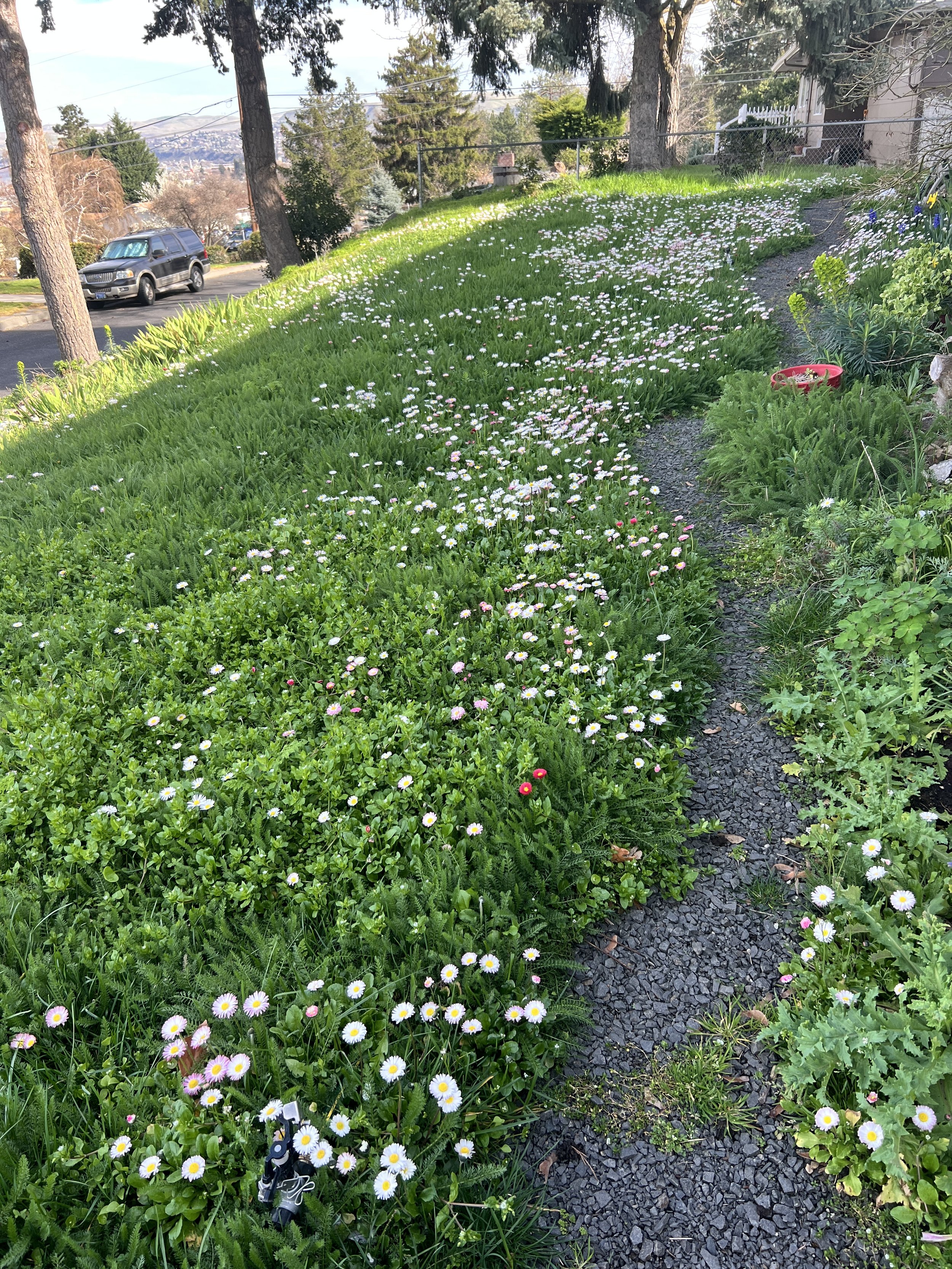
Clover Ecolawn along a gravel path invites an ankle-tickling excursion.
Putting In An Ecolawn
Seed suppliers provide instructions on when, how and how much to sow for your area. Fall and spring are both excellent times to start a clover mix lawn.
Since my front yard is over eighty-five percent sand, after I removed the dead grass, I laid down about four inches of mulch and shallowly tilled it in. I went back and removed the additional grass clumps that surfaced after tilling. I then hand-sowed PT Lawn’s PT 755 Fleur de Lawn® (two kinds of clover, three kinds of grass, and flowers—yarrow, sweet alyssum, baby blue eyes and English daisy), mixed with sand for better distribution. I lightly raked the sandy seeds in and watered one to two times daily for about two weeks. Because I sowed in the fall, Mother Nature took care of the majority of the watering after that.
Due to my chosen mix, by spring, the lawn not only filled in nicely, but we also enjoyed beautiful blossoms.
After seeing my ecolawn, two local friends—Charlotte Hendricks and Laura Johnson—both decided to put in their own clover mix lawn.

Laura Johnson's dog, Tucker, on her clover lawn.
Maintaining An Ecolawn
To manage my lawn, I alternate between using a weedwhacker for a less manicured look, and a mulching mower for a somewhat more uniform look.
It took a while for me to dial in my lawn’s watering frequency and duration. Between that and letting my lawn get too tall, followed by cutting it too short, some areas got sunburned. I emailed PT Lawn for guidance. Based on their advice, one Saturday last fall I thatched, aerated and overseeded. Because the English daisies and yarrow dominated my lawn, I overseeded with clovers only. Over the years, while the variety of blossoms decreased, the English daisies continue to blossom through most of the year, in my lawn and as welcome volunteers in other parts of my yard. Throughout the winter my lawn remained lush and vibrant.
Currently, my lawn is dotted with hundreds of cheerful field of English daisies. The few dandelion blossoms that emerge are promptly removed. It helps that I also remove my upwind neighbor’s dandelions, and that I make sure the bees have lots of other good stuff to pollinate.
My friend Charlotte put in her Fleur de Lawn last spring. Because the clover was more dominant in her lawn than the English daisies, she overseeded hers this fall with another round of Fleur de Lawn. Her dogs like the lawn but choose to do “their business” elsewhere;” her lawn is looking good.
Laura, because of her dog, Tucker, opted for PT Lawn’s PT 767 Dog Park Eco-Lawn Mix with Microclover®—a mix of micro clovers, fescues and ryegrass. She seeded in hers last spring, was pleased by fall and is even happier with how it looks now. Tucker, lounging on Laura’s lawn, clearly gives it his woof of approval.
Is An Ecolawn for You?
Clover mix lawns are not for everyone. My friend Marilyn Richardson gasped when she heard about mine.
“You deliberately planted what I’ve spent years removing from my lawn!” she said.
But my lawn-loving neighbor Jim regularly compliments it.
Want to Learn More?
Oregon State University (OSU) Extension knowledge base—clover mix lawns
Getting seed (plus sowing and growing info) PT Lawns Eco-Lawns and Meadows (the Portland Oregon-based company whose seed mix I used; there are other clover mix lawns out there…just Google them. Or you can create your own mix)
Dana Greyson is a master gardener newish to The Dalles. Her yard is still a science experiment.