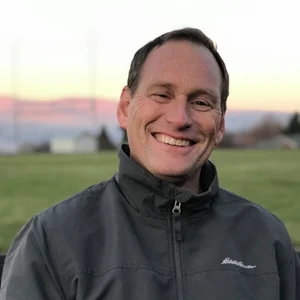
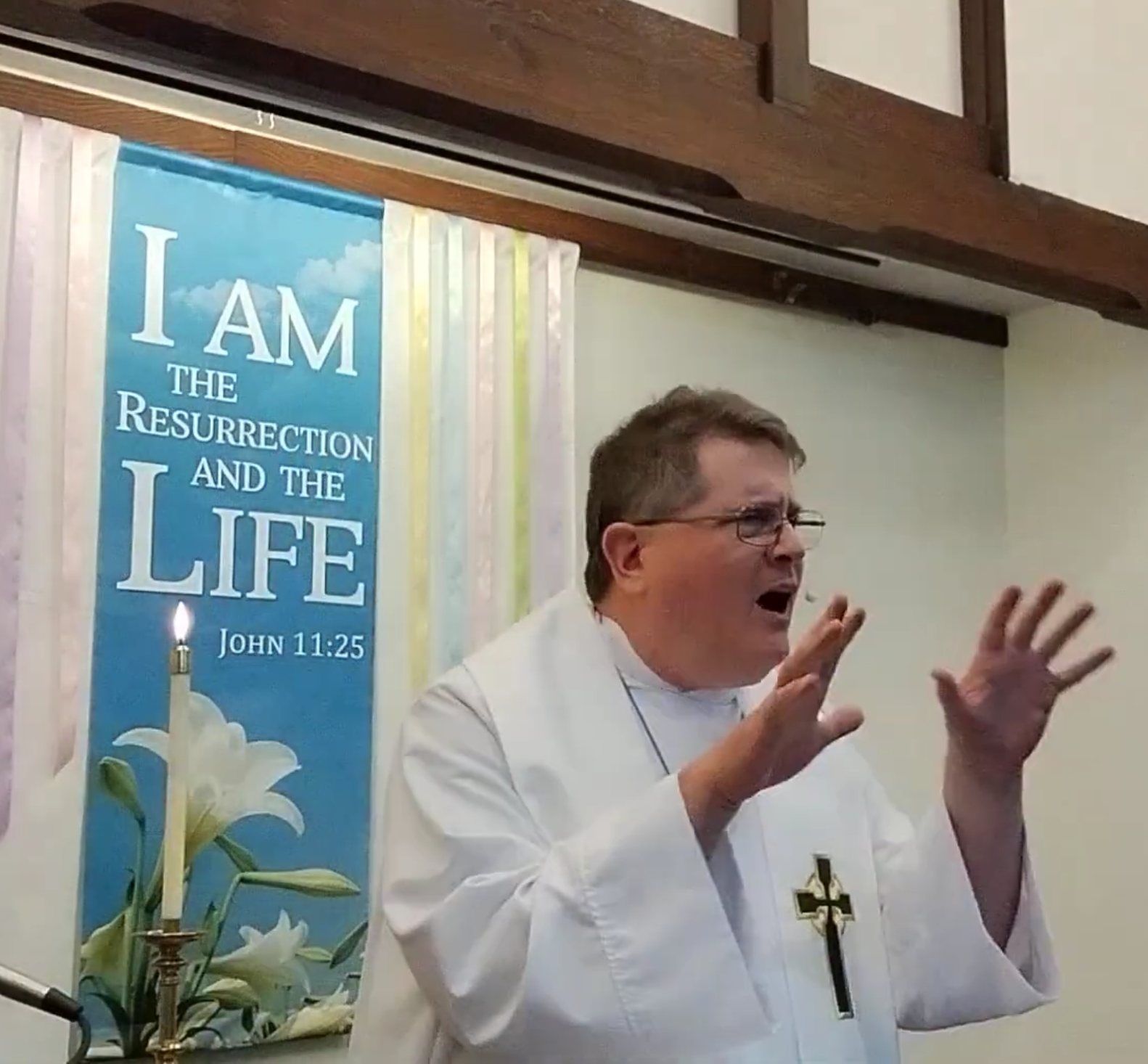
The Dalles, Ore., April 15, 2026 — What brings a new minister to a small Columbia Gorge community, and what does he hope to build once he arrives?
Those are the questions Rev. Christopher “Chris” Hayward answered for CCCNews as he prepares to be formally installed as pastor of United Church of Christ Congregational of The Dalles during a public service at 3 p.m. Sunday, May 3.
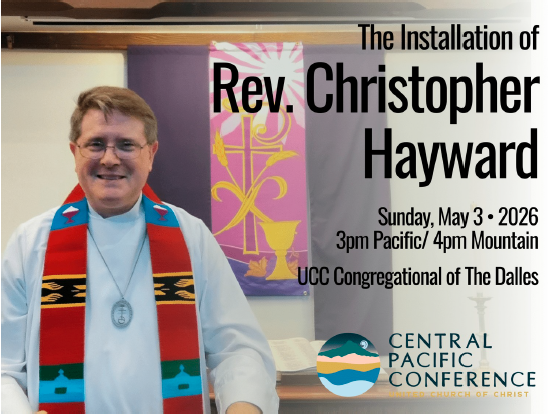
The installation, hosted at the church at 111 E. Fifth St., will include participation from the Central Pacific Conference and the wider United Church of Christ, with clergy invited to gather at 2:40 p.m. for prayer and procession. A reception will follow.
Ahead of the ceremony, Hayward provided the following question-and-answer conversation about his path to ministry, his vision for the congregation and what he hopes to bring to The Dalles.
CCCNews: Name, age, hometown?
My name is Christopher Hayward, but please call me Chris. I was born and raised in Spokane, Washington. Do I have to give my age? Suffice it to say I graduated from high school in the last century and from seminary in 2004. I've been pastoring churches since 2013.
What drew you to The Dalles and this particular congregation, and what did you see here that made you say “this is the place”?
In 2021, I moved from Spokane to Central Iowa to serve a rural church about 30 minutes outside of Des Moines. We did a lot of good work together. Eventually, however, I found myself missing all those geographical features we Pacific Northwest folks take for granted: mountains, rushing rivers, waterfalls and evergreen forests. Additionally, my family still mostly lives in Spokane, and I was finding it difficult to keep in touch.
At the same time, my denomination — the United Church of Christ — does not have a large number of churches in the Pacific Northwest, particularly ones that can afford to have a full-time pastor. When I saw that United Church of Christ Congregational in The Dalles was looking for a pastor, it piqued my interest. I mean, the scenery of the Gorge alone is a major draw.
I met with the search committee, and I was impressed with both its size (nine members) and its breadth (diversity of race, gender and political views). Many of our congregation members give back to the community on a regular basis, like packing backpacks for school kids, serving on boards of local nonprofits or advocating for marginalized groups. When I saw the level of engagement this church has, I wanted to get involved.
Looking back, when did that thread of spirituality first show up in your life—was there a moment, or has it been something that built over time?
I grew up in a pretty religious family. My dad had been an elder in our church; my mom was a licensed minister. We were in church every Sunday. Consequently, I can't recall a time when I didn't have a spiritual sense in my life.
I came from a fairly conservative fundamentalist background. In college, exposed to so many other ways of interpreting Scripture and seeing the world, I could no longer follow the same path. It broke me out of the small world that I had lived my life in. Pretty quickly, I found my way into the United Church of Christ.
It helped being an English major, since I just had to take those analytical tools I learned in my course of study and apply them to the Bible. In our denomination, we use the term “call to ministry” to describe a person’s sense that they should become an authorized minister. That came to me also while at college. It just felt right to be standing up leading worship. Other people could see it too.
After college, I went straight to seminary. In the past, I tried to resist that pull, but that was a losing proposition. Serving churches is where I belong.
The United Church of Christ emphasizes being open and affirming—how does that show up in your day-to-day work with this community?
First, I should probably clarify something about the United Church of Christ. While it is true that our national body emphasizes being “open and affirming” — a term we use to describe being welcoming of all people, especially LGBTQIA+ individuals — we operate under what’s called a congregational polity. That means each local church is free to make its own decisions. The national setting has no authority over local churches; it can only make recommendations.
As a result, there is a range of attitudes across our churches. Some are fully open and affirming, while others are not. We even have an interest group within the denomination made up of churches that are not open and affirming. That said, attitudes are slowly changing. My last pastorate was in Central Iowa — hardly a liberal haven — and both of the small, rural parishes I served had declared themselves open and affirming. I wasn’t even their first openly gay pastor.
As to my daily work, I try to make sure our church is as inclusive as we can be. My thinking mostly revolves around the language that I use and the language our church uses in its communications. Churches are notorious for using “insider language” that people from outside don’t understand. Words like liturgy, chancel, narthex and doxology aren’t familiar to most people.
We don’t use those words to be exclusive, but they can have that effect. At a previous church, one longtime member asked why we printed the Lord’s Prayer in the bulletin when everyone already knew it. There was no malice in that statement — just the assumption that everyone in the sanctuary would know our version.
But if our mission includes welcoming new people, we can’t make that assumption. You want people to know what's going on during worship. Confused people — or people who feel excluded — probably won’t come back. I want everyone to feel welcome.
As you step into this role, what are your priorities in your first year, both inside the church and out in the broader community?
The author Frederick Buechner said, “The place God calls you to is the place where your deep gladness and the world’s deep hunger meet.” While that applies to individuals, I think it also applies to local churches.
So my first year I set out to establish myself as someone the congregation can rely on, but I also am looking to see what are the interests/passions of our church and what are the needs of our larger community. My goal is to line those two things up. That's where we can focus our time, talents and treasure.
Ministry, however, rarely resolves in such a direct way. Despite my experience in parish ministry, each church is a unique organism. Skills from one environment might not translate to another. I will spend a great deal of time during this first year just figuring out how things work in my new church.
An especially important task is to learn who does what in the church. I joke about the “elves” who quietly and behind the scenes take care of so much of the work. Who washes the cloths on the altar? Who changes the filters in the furnace? Who replaces the light bulbs? As pastor, I need to know who is taking care of what. That's not always an easy task, because you often don't even know who to ask.
For people in town who may not attend church, what would you want them to understand about what you and this congregation offer?
That's a loaded question. The religious landscape in the United States has changed a lot since the 1950s, when the so-called “mainline churches” held sway. Those churches, including my own denomination, contain a diversity of people from different classes, political persuasions and even religious beliefs.
In today’s religious world, however, when people hear the word “Christian,” they often think of someone who is a fundamentalist. They imagine a church where everyone looks the same, thinks the same and even votes the same. They imagine a Christianity that is patriarchal, homophobic and dogmatic.
I want those who don't attend church to know that our church isn't like that. We have LGBTQIA+ individuals in positions of leadership. My two immediate predecessors were both women. We have Democrats and Republicans who play prominent roles in our church. When we study the Bible, we don't all have the same beliefs. Some are more traditional; some are not.
Nevertheless, we are a community joined in love for God and for neighbor. We're a downtown church; we have unhoused members of the community who might drop in once in a while. We also just like to have fun together. These folks love their church potlucks.
“Faith,” as I understand it, is principally about trusting in God. It's direction that you orient your life around. Do you choose to follow the teachings of Jesus to love God and love your neighbor? Do you choose to stand up for the most vulnerable in society? Or do you just go with the flow and do what society tells you is OK?
I want people to understand that faith is not first and foremost a set of beliefs. It's to live your life in a way that trusts in God.
What’s one experience from your life that still shapes how you approach your work as a minister today?
When I was in seminary, I interned at an urban church in San Francisco. Because the sanctuary was not at street level, you had to go up a flight of stairs to attend church. Though the church had installed a platform lift to allow access for people with mobility issues, the lift wasn’t usable. You needed a key to summon the lift to your floor, and then you needed to use a key inside the lift to keep it moving.
Ideally, keys would have been left at each floor, but the church also hosted a daycare during the week, and the keys would disappear. When I asked my supervisor about it, she told me she didn’t have time to address the issue, even though she knew it was important.
I came up with a solution by chaining keys to the wall on each floor and securing one inside the lift so they stayed in place.
The lesson I learned, however, was that it's OK to leave something important undone. It doesn't mean you don't care about it; you're just one person and you have to budget your time and energy.
I also learned another important lesson from that experience: if something really matters, other people will care about it too. If it’s a real issue, you can trust that someone else will step forward to fix it. That’s not to say I just sit around and wait for others to take care of church problem; it’s simply my way of recognizing that I can’t do everything. No one can — and that’s OK.