
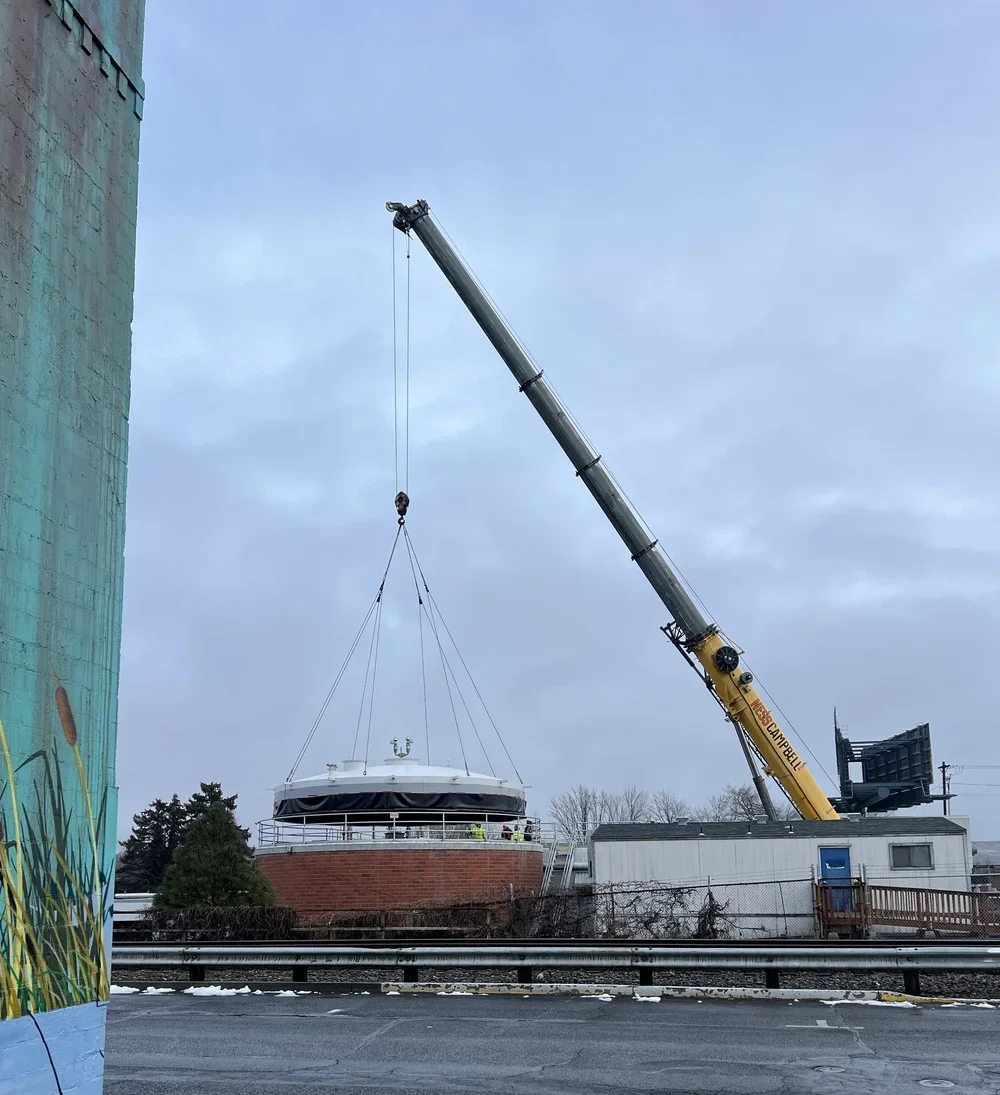
File Photo - Uppercut Barber Mike Nagle captured this photo On Monday, Feb. 17, 2025 on First Street in The Dalles as repairs were done to sewage plant’s digester which utilizes bacteria to break down raw sewage.
The Dalles, Ore., Nov. 10, 2026 — The Dalles is facing an estimated $92 million in wastewater infrastructure improvements over the next decade, a financial challenge that could require annual sewer rate increases of 6.5% while city officials consider whether large industrial customers should shoulder a greater share of the costs.
The projected increases were presented to the City Council during its Nov. 9 meeting as part of an update to the city's wastewater facilities master plan, which identifies major repairs and improvements needed to keep the aging system operating and meet state environmental requirements.
Consor Engineering, headquartered in Houston with offices in Portland sent Project Consultant Austin Rambin and financial analyst Deb Gadardi to provide the cost and scope of the project to councilors on Monday.
The financial analysis identifies approximately $73 million in wastewater treatment and collection system improvements over the next 10 years, before inflation. That includes about $41 million during the first five years and another $32 million during the following five years.
With inflation factored into the capital improvement projections, the estimated cost rises to approximately $92 million.
Among the most pressing projects is a $12 million upgrade to the wastewater treatment plant's secondary treatment system, including rehabilitation of its aeration basin and installation of new blowers to meet stricter ammonia limits in the city's wastewater discharge permit.
The city also must rehabilitate its wastewater outfall line to the Columbia River, another project required by the Oregon Department of Environmental Quality.
Consultants told councilors that these are not improvements the city can indefinitely postpone.
The financial challenge comes after several years of relatively modest sewer rate increases. During the past five years, The Dalles raised rates twice, each time by 3%, while leaving rates unchanged during the other three years.
According to the financial analysis, continuing with 3% annual increases would generate approximately $15 million in capital funding capacity over the planning period, far short of the infrastructure investment needed.
Consultants instead modeled annual increases of approximately 6.5%, assuming the city finances 70% of its capital improvement program through borrowing.
That borrowing could include the Oregon Clean Water State Revolving Fund, which currently offers interest rates of approximately 1.93%, with potential repayment terms of 30 years and limited principal forgiveness.
However, consultants emphasized that the city has not secured funding commitments from state or federal agencies for the proposed improvements.
The rate projections also assume modest customer growth, increasing operating expenses and sufficient financial reserves to meet lending requirements.
No sewer rate increase was approved Monday. The council is expected to revisit the financial plan Dec. 14, with potential implementation of updated rates through the city's fee-setting process in January.
Industrial customers could pay more
One of the most significant discussions Monday centered on whether the city's largest wastewater customers are paying enough to cover the demands they place on the system.
Consultants recommended restructuring portions of the city's sewer rates to recover additional costs from industrial customers and businesses requiring specialized wastewater services.
Under the proposal, approximately six authorized or permitted industrial sites would pay an additional $5.77 per month for each equivalent residential unit of wastewater flow.
Because the charge is based on wastewater volume, larger users would pay more.
Consultants estimated the proposed changes would increase the wastewater costs assigned to that industrial customer class by approximately 10%, in addition to the broader 6.5% rate increase.
The proposal also includes higher charges for industrial wastewater containing elevated levels of pollutants, including biochemical oxygen demand and total suspended solids.
Restaurants and other businesses with grease interceptors could also face a new monthly charge to recover the city's costs of administering its fats, oils and grease program.
Approximately 80 commercial sites could be affected by that charge.
The proposed restructuring could reduce the first-year increase in the basic sewer rate from 6.5% to approximately 4.7%, with the additional revenue coming from the new industrial and commercial charges.
The consultants' model would then return to 6.5% annual increases in subsequent years.
Councilor Scott Richardson questioned whether the city should go further in requiring industrial customers to contribute toward the infrastructure improvements.
"Why are we not raising as much money as we can possibly raise now, so we don't have quite as much to borrow in the coming years?" Richardson asked.
He also questioned why the financial analysis did not more aggressively examine charges based on peak wastewater discharges and other demands placed on the system by large customers.
Consultants explained that a broader examination of industrial demand would require additional analysis, potentially including water service arrangements and agreements with industrial customers.
Richardson requested a more comprehensive financial picture before the city commits to the major improvements.
Councilors also discussed whether future property tax revenue from industrial development, including the expiration of tax abatements, could help finance infrastructure.
City Manager Matthew Klebes cautioned against building financial plans around revenue that has not yet materialized, particularly because wastewater operations are primarily supported by customer rates rather than property taxes.
He said the city would continue pursuing grants, federal assistance and favorable financing arrangements, but should not assume that uncertain funding will become available.
Councilors requested additional funding scenarios when the consultants return in December. The council's next major wastewater discussion is expected Dec. 14, when consultants are scheduled to return with additional financial information and potential funding scenarios. Changes to sewer rates would require subsequent council action.
Council closes construction spending loophole with $500,000 cap
In another significant decision, the council unanimously approved new restrictions on how much additional money the city manager can authorize when construction projects encounter unexpected expenses.
Resolution 26-031 establishes a cumulative change-order limit of 20% of the original construction contract or $500,000, whichever is less, for qualifying public improvement contracts originally awarded by the council for more than $100,000.
Any proposed increase exceeding that threshold must return to the City Council for approval before the city commits to the additional work.
For example, a $1 million construction contract could receive up to $200,000 in cumulative changes under the city manager's authority. A $5 million contract would be limited to $500,000.
The change followed several council discussions about balancing construction efficiency with oversight of public spending.
Councilor Ben Wring raised concerns about a loophole in the city's previous contracting rules that could potentially allow repeated change orders below individual approval thresholds without a cumulative spending limit.
He described the risk as "death by a thousand cuts."
The new rules establish a ceiling on cumulative spending while allowing city staff to respond to unexpected construction conditions without repeatedly stopping work for council approval.
The council had previously considered requiring notification when changes reached 15% of a contract's original value, but removed that provision after establishing the $500,000 maximum.
Wring said the revised policy provides reasonable safeguards without imposing unnecessary administrative burdens on city staff.
The discussion also touched on the First Street streetscape project, where city officials said they had negotiated a substantial reduction in a proposed change order for archaeological services.
Klebes said the city uses staff expertise and, on larger projects, outside consultants to review the necessity and cost of proposed changes.
The resolution does not authorize additional project funding or establish new construction projects.
Sewer connection could help preserve 16 apartments
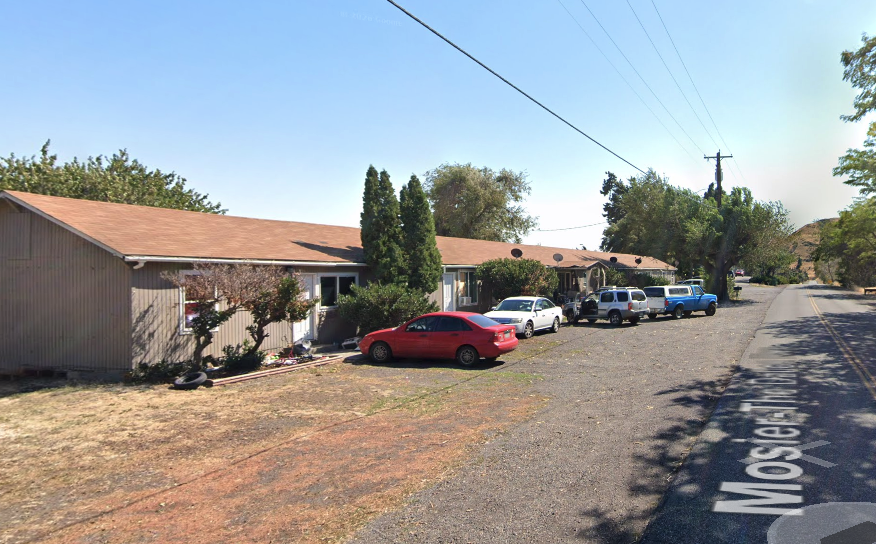
The council also unanimously approved a sewer connection intended to address failing septic systems at a 16-unit apartment complex outside city limits.
Resolution 26-034 conditionally authorizes the Pinewood Apartments, formerly known as the Golf Course Apartments, to connect to the sanitary sewer system serving the Columbia Gorge Discovery Center area along Highway 30, across from The Dalles Country Club.
Public Works Director Dale McCabe said the apartment owner approached the city approximately a year ago after experiencing septic system failures.
The property contains two buildings with eight apartments each.
McCabe said the property owner worked with Wasco County and North Central Public Health to establish that the existing septic system was failing and that installing a replacement septic system was not feasible.
The proposed connection would use the existing Crates lift station, which was installed around 1995 to serve the Discovery Center.
Under an intergovernmental agreement established that year, Wasco County owns the lift station and associated infrastructure, while the city operates and maintains the facilities.
McCabe said the original agreement specifically anticipated eventually providing sewer service to the apartments.
The apartment owner will pay for the necessary improvements, including a private sewer line, two new manholes and a short section of public gravity sewer line.
The owner will also pay applicable system development charges and the city's outside-city sewer rate, which is 1.7 times the rate charged to customers within city limits.
An additional payment to Wasco County may be required to reimburse a portion of the county's original infrastructure construction costs. That amount has not yet been established.
Councilors questioned whether approving the connection could create expectations for additional development outside city limits.
McCabe said future connections would require further evaluation of available system capacity and separate council authorization.
The connection could also improve operation of the existing sewer system.
McCabe explained that low wastewater flow has contributed to hydrogen sulfide buildup, which can damage concrete infrastructure. Adding the 16 apartments could increase flow and potentially reduce the problem.
Councilors also discussed the possibility that denying the connection could threaten existing housing.
City officials said the property might have to explore other options, potentially putting some of the apartments at risk if the septic problems cannot be resolved.
The project remains subject to additional requirements, including scenic area review.
Downtown businesses could receive help with infrastructure fees
The council also heard about a newly expanded incentive program intended to help businesses open or relocate within The Dalles Urban Renewal District.
Councilor Richardson reported that the Urban Renewal Agency had approved a program amendment allowing financial assistance with system development charges.
Those charges help pay for infrastructure needed to support development but can create significant upfront expenses for small businesses.
Richardson said the fees can amount to several thousand dollars or more, creating an unexpected financial burden for entrepreneurs.
The new assistance is intended to reduce those barriers while preserving the infrastructure funding generated by the charges.
Richardson encouraged business owners considering renovations, new businesses or relocations within the urban renewal district to contact city Economic Development Officer Jake Anderson about available incentives.
The transcript did not specify the program's total budget, individual award limits or eligibility requirements.
Housing, homelessness and public outreach
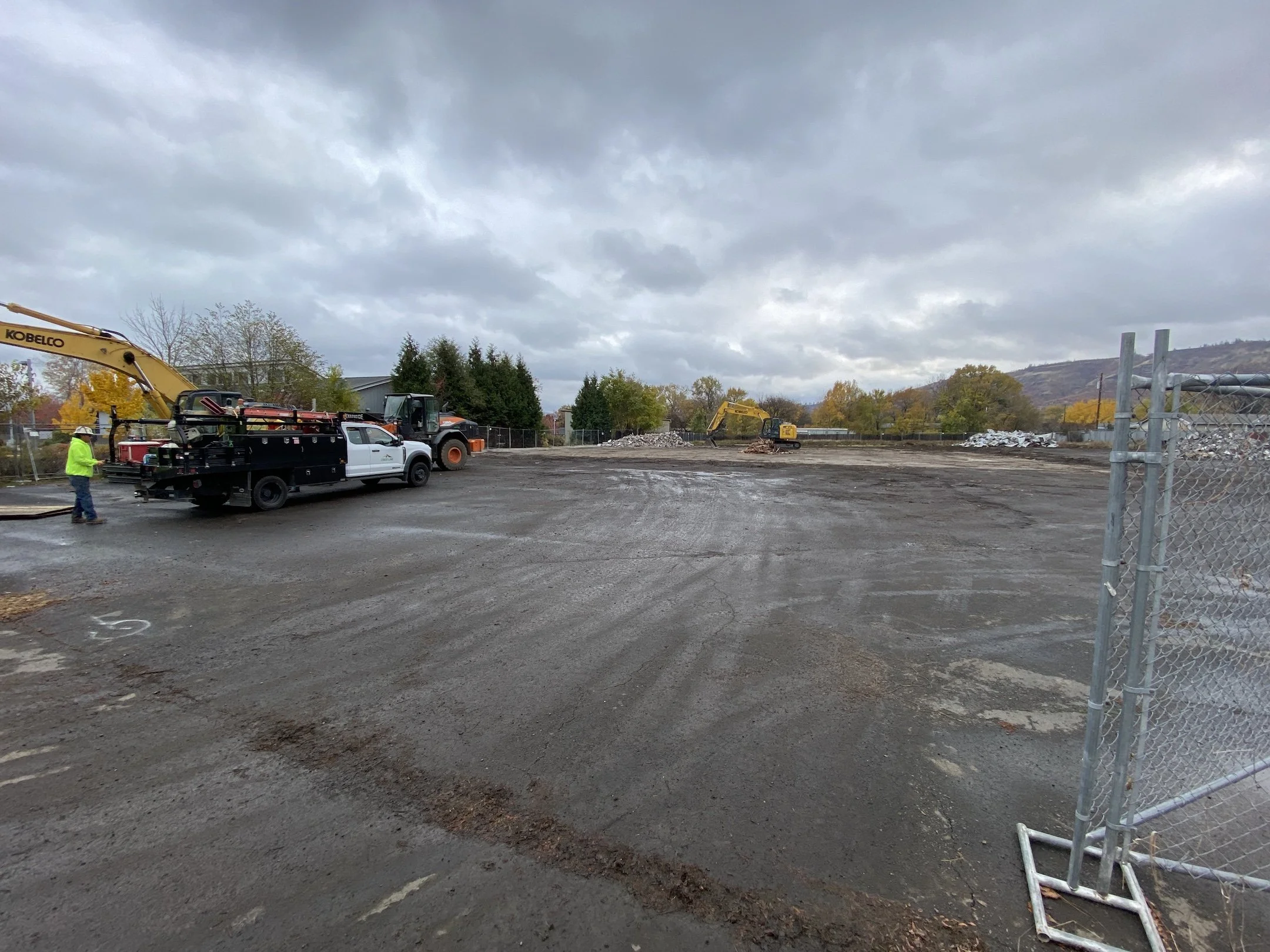
Quick Work - Crestline Construction crews started the demolition of Westgate Market on Monday, Nov. 9 and were near completion this afternoon, Wednesday, Nov. 11. Construction is expected to commence on the Chenowith Loop affordable housing project in coming weeks.
Several other community developments were discussed during council and staff reports.
Councilor Richardson said Columbia Cascade Housing Corporation is preparing to begin construction on a 76-unit housing development along Chenowith Loop Road. A groundbreaking is expected in the coming weeks.
Councilors also reported progress in local homelessness services following an Oct. 30 meeting involving city officials and service providers.
Councilor Wring said outreach efforts associated with Bread and Blessings and the Gloria Center have helped service providers establish relationships with people who previously had been difficult to reach.
Councilor Timothy McGlothlin reported that seasonal pallet shelters are expected to open in mid-November.
How People Get There News
Klebes also announced that the city received 450 verified responses to a community communications survey conducted in partnership with the University of Oregon.
A virtual follow-up discussion is scheduled for noon to 1:30 p.m. Friday, Nov. 13, followed by an in-person listening session from noon to 3 p.m. Saturday, Nov. 21, at Brick City Games. The in-person session is intended for survey participants.
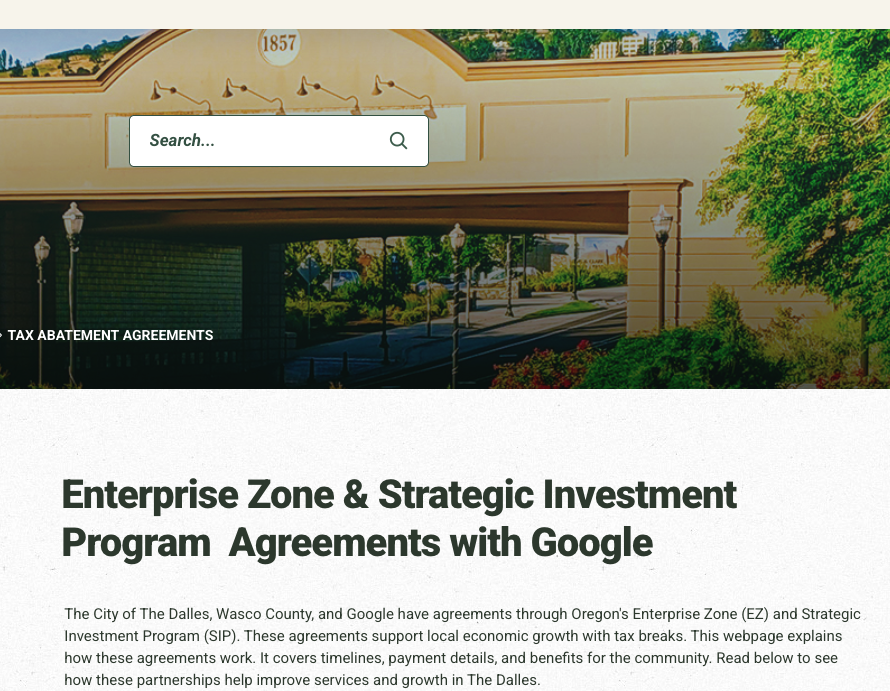
The city has also launched an online information page dedicated to Google's data centers in The Dalles, including enterprise zone and Strategic Investment Program agreements, water usage information and tax payment records.
The page is intended to give residents easier access to information about the data centers and their financial and infrastructure relationships with the city.
Other council business
The council approved its Oct. 26 meeting minutes and authorized the city manager to execute a national opioid settlement agreement as part of its consent agenda.
During public comment, resident Russ Brown urged the city to more aggressively enforce ordinances prohibiting residents and landscaping companies from blowing leaves and yard debris into streets, where the material can clog storm drains.
Brown argued that the city spends substantial resources cleaning streets and catch basins while repeat violations continue without meaningful consequences.
City officials acknowledged the enforcement challenge, citing the workload of the city's two code enforcement officers.