
The Dalles, Ore., May 28, 2026 — The average water bill in The Dalles is projected to climb from about $55 per month today to more than $150 per month over the next two decades as the city undertakes what officials describe as a generational rebuilding of its water system.
The price tag is substantial: approximately $259 million in water-system projects over the next 20 years, followed by another $151 million in projects identified beyond that planning horizon.
That long-term investment moved back into the spotlight Tuesday, May 26, when the The Dalles City Council approved the city's updated Water Management and Conservation Plan, a state-required document that outlines how the city intends to secure and manage water supplies through 2035.
While the plan itself does not authorize construction spending, it serves as the latest chapter in a much larger discussion about aging infrastructure, future water demand and how residents will pay for improvements expected to shape the city's water system for generations.
The recent rate hike of 7.3 percent in February is just a start on price increases as city leaders work to put together equitable payment solutions for the huge investment to come.
For residents opening utility bills, the obvious question is why?
City officials say the answer has less to do with future growth than many people assume and more to do with infrastructure that has quietly aged beneath the community for generations. The city's main treatment plant is roughly 75 years old. Critical transmission pipelines are approaching 80 years old. Water losses exceed state targets. Storage facilities need rehabilitation. New supply options must be developed to ensure the city can meet future demand.
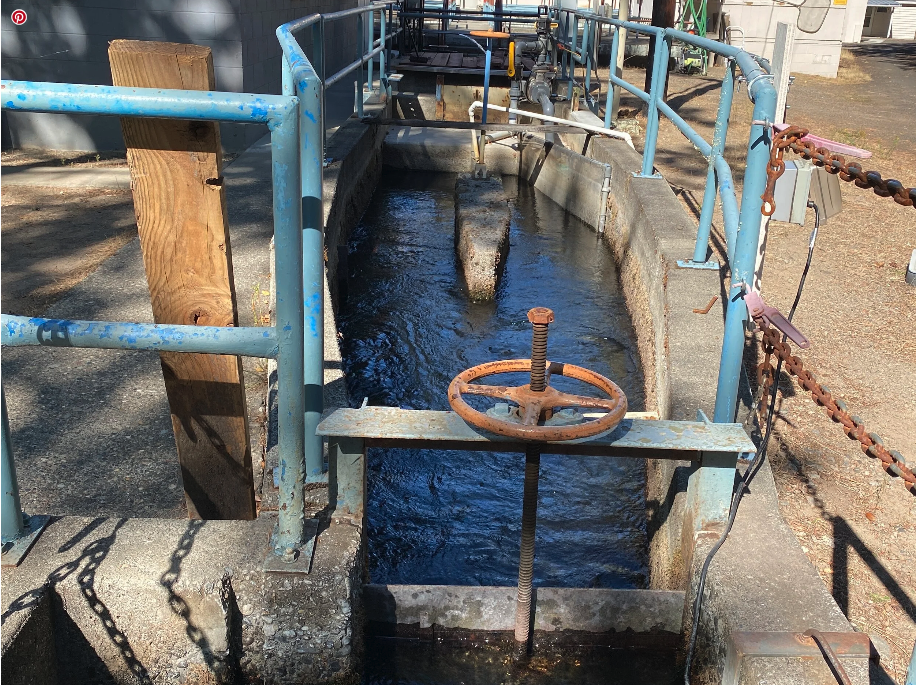
Intake at the city’s Wicks Water Treatment plant on Mill Creek south of The Dalles. The 75 year old plant needs to be replaced, according to city officials. It would also be simultaneously expanded in order to increase water production for projected increasing industrial water demand via Google.
The result is a water system that now requires major reinvestment.
"We've reached the point where the bill can no longer be deferred," is the message city documents and recent council discussions collectively convey.
The newly adopted Water Management and Conservation Plan and the Water Master Plan approved in December paint a picture of a community that has enough water today but faces difficult financial decisions about how to maintain that reliability in the future.
A bigger question sits underneath the entire discussion.
If future demand is expected to come largely from industrial and commercial growth, mostly from Google, why are residential customers facing significant rate increases?
The city's answer is that much of the spending would be necessary even if another data center were never built.
Where the money goes
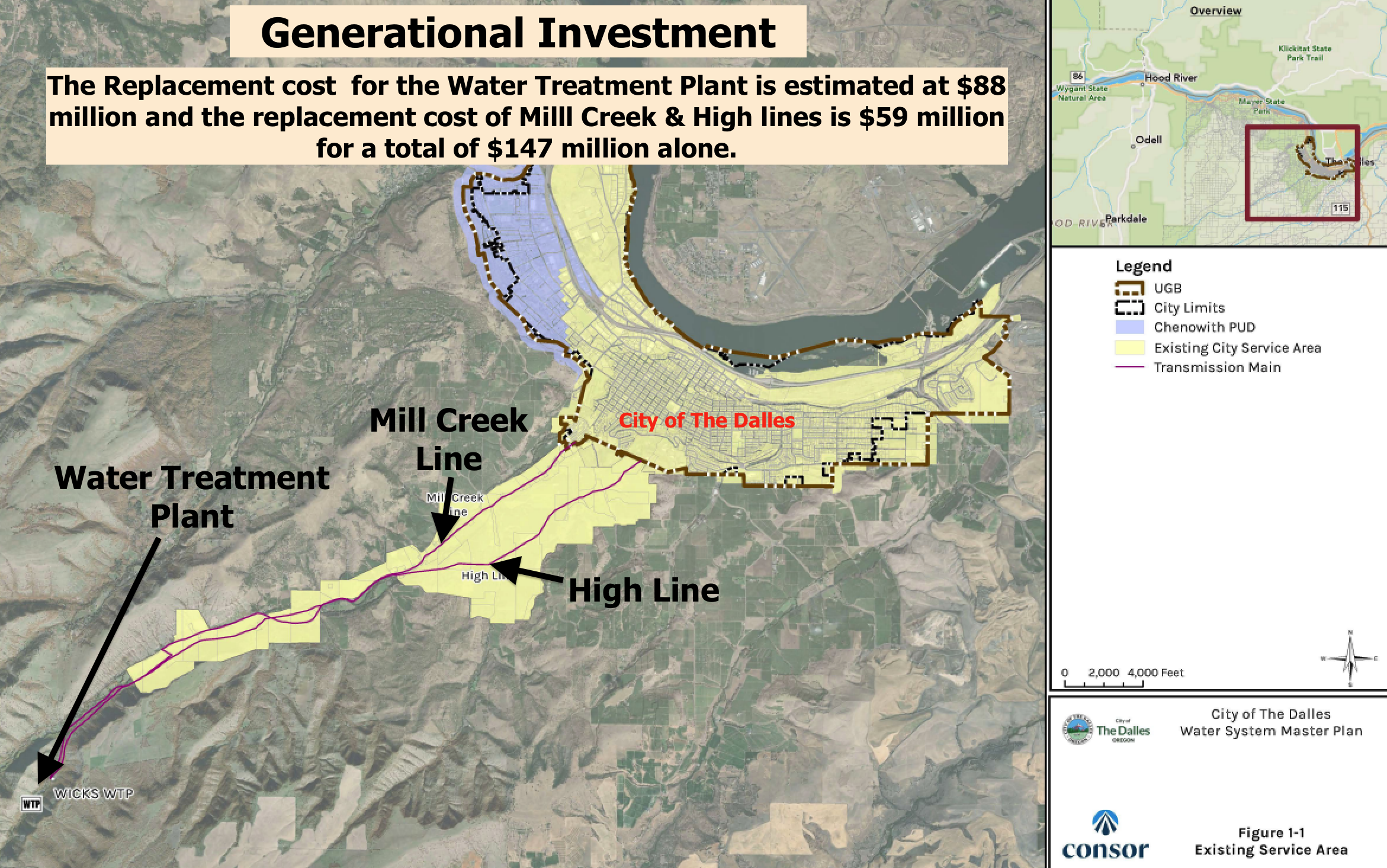
The largest project identified in the Water Master Plan is replacement and expansion of the Wicks Water Treatment Plant, estimated at approximately $88 million.
Most residents have never seen the facility, but it is one of the most important pieces of infrastructure in The Dalles. Located southwest of town, the plant treats raw water before it enters the city's distribution system. Portions of the facility date back roughly 75 years, and city documents describe deteriorating concrete structures and aging piping systems that will eventually require replacement.
The second-largest project is replacement of the city's primary finished-water transmission line estimated at nearly $59 million.
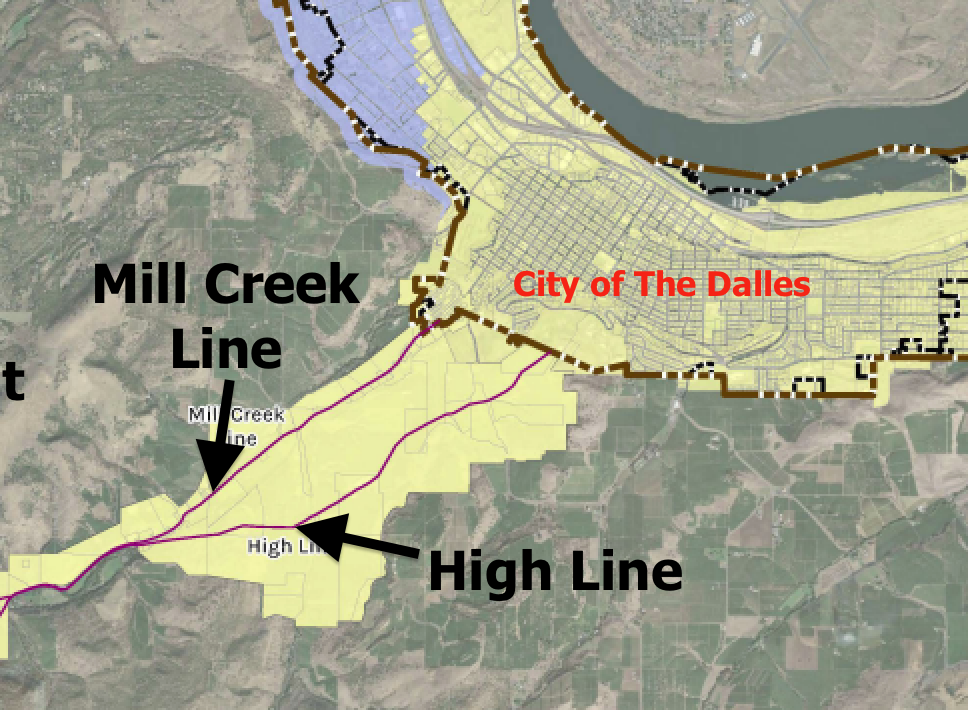
Mill Creek and High lines are being eyed for replacement at a projected cost of $59 million. The city loses 17.5 percent of its potable water through leaks in the system. It is suspicioned but not proven that these two 80-year-old steel pipes are a part of the problem.
Think of this pipe as the city's main artery.
After water leaves the Wicks treatment plant, it travels through this transmission system to reservoirs and neighborhoods throughout The Dalles. City documents describe portions of the line as approximately 80 years old, unlined, deteriorated and leaking.
If the treatment plant is the heart of the water system, this pipe is the aorta.
One of the largest projects in the city's water plan is Riverside Storage Phase 2, a proposed 4.5-million-gallon reservoir near the Riverside Water Complex near Google’s new data centers. The project is estimated to cost $19.7 million.
Unlike the city's new ASR wells, which store water underground, this project would create a large above-ground reserve of treated drinking water.
The reservoir would provide additional storage for the rapidly growing 310 Pressure Zone, helping maintain water pressure, firefighting capacity and reliability during periods of high demand for all residential and commercial property from Brewery Grade through the Port of The Dalles, bordered along Sixth Street.
There's another interesting detail buried in the plan.
The master plan says the city already determined that the Riverside service area will be short approximately 4.5 million gallons of storage capacity in both the 10-year and 20-year planning horizons. That's why this reservoir appears in the capital plan.
That means Riverside Storage Phase 2 isn't being proposed as a luxury or optional project. The consultants identified it because the existing storage system does not meet future storage targets for that service area.
In simple terms, the project would increase the city's ability to store treated water before it is needed. Water storage allows operators to meet peak summer demand, respond to emergencies and maintain service during maintenance or disruptions elsewhere in the system.
Another $7.5 million is identified for additional Aquifer Storage and Recovery, or ASR, wells.
Councilor Dan Richardson described ASR as a savings account for water.
The system allows the city to inject treated water from Wicks into a well during periods of lower demand and pump it back out when demand increases. The city currently operates one ASR well at the Google site on River Road and has authorization for additional wells in the future. The benefit in the ASR system is reduced water loss from evaporation, however, costs to operate the system have yet to be bourne out through mutliple years of operation.
The Water Master Plan also identifies approximately $17.5 million for improvements to Crow Creek Dam and its spillway during the next 20 years, with another $59.7 million identified beyond the current planning period.
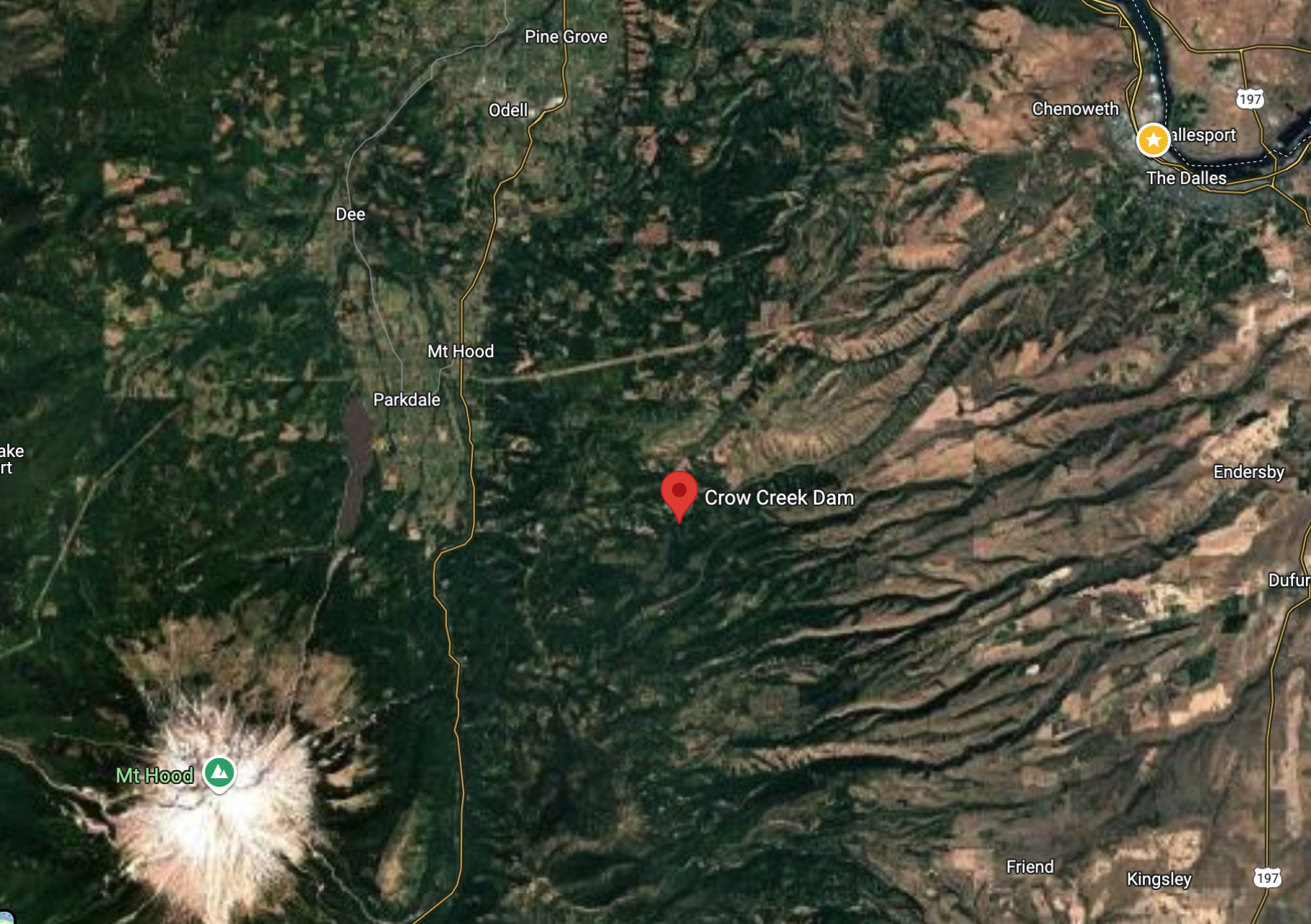
Red pin above shows location of Crow Creek Dam in The Dalles Watershed. U.S. Rep. Cliff Bentz introduced the bill to give 150 acres of U.S. Forest Service property near the dam to The City of The Dalles. It passed the House and is is waiting in the Senate Committee on Energy and Natural Resources. The reservoir is 13 miles northeast of Mount Hood. Water is released from it into South Mill Creek that leads to the Wicks Water Treatment plant on Mill Creek Road.
Crow Creek functions as one of the city's long-term water storage assets. Expanding storage capacity would provide additional protection against drought, changing snowpack conditions and future growth.
Additional projects include approximately $3.4 million to rehabilitate Garrison Reservoir and roughly $2 million to modernize the Wicks treatment plant's SCADA system, the computerized network that monitors pumps, valves, reservoirs and treatment processes throughout the water system.
Most residents will never see these projects.
They will, however, see the bills.
What happens to rates?
According to the Water Master Plan, a typical residential customer using 8,000 gallons of water per month paid approximately $55.30 under the previous rate structure.
That same customer is projected to pay about $80.82 per month by 2030 and approximately $151.70 per month by 2044.
The increase will not happen all at once.
The city's plan called for the initial 7.3% increase in water utility revenues in February, followed by additional annual increases over multiple years.
While those numbers may alarm residents, city officials argue the increases would be significantly higher without revenues associated with industrial development.
Google fees shoulder some of the weight

The new data center at River Road chipped in $9.8 million in Wasco County in 2025 in taxes and fees, boosting local services and creating an economic development nest egg for city and county officials.
According to city documents, Strategic Investment Program revenue tied largely to data-center development is expected to contribute approximately $3 million annually toward water-system costs.
Without that revenue, the first two years of rate increases would have been substantially higher, according to the Water Master Plan.
Google bought their Water Rights
The city's relationship with Google also adds another layer to the discussion.
Before construction of its Riverside data center campus, Google acquired industrial water rights associated with the former Northwest Aluminum property. Those rights allowed access to approximately 3.88 million gallons of water per day or about 1.4 billion gallons annually.
Rather than developing a separate private water system, Google transferred those water rights to the city as part of a broader infrastructure agreement. In exchange, the city agreed to construct water and wastewater infrastructure serving the Riverside Industrial Area.
Under the agreement, Google committed approximately $28.5 million toward water and sewer improvements. The infrastructure not only serves Google's existing and future data centers, but also creates capacity for other commercial and industrial development within the Riverside district.
City officials have pointed to that investment as evidence that large industrial users are helping fund major infrastructure improvements rather than relying solely on existing ratepayers.
The arrangement also explains why some of the projects now appearing in long-range planning documents are concentrated around the Riverside Water Complex. What began as infrastructure needed to support development on the former aluminum smelter property has evolved into a key component of the city's broader water strategy, including aquifer storage and recovery, additional storage capacity and future industrial service.
At the same time, the city's Water Management and Conservation Plan projects that most future water-demand growth through 2044 will come from commercial and industrial users rather than households, ensuring continued debate over how future costs should be divided among residents, businesses and industry.
Google is also a massive water user - in 2025 the company used 550 million gallons of city water and that is set to increase significantly. In total, Google is likely to triple that usage in years to come, but they do have to pay for the water like any other commercial user. The company is looking at pay the city of The Dalles more than $1 million annually if they use 1.4 billion gallons a year.
What is driving future demand?
One of the most significant findings in the conservation plan is that future water demand is not being driven primarily by residential growth.
The city's population is expected to grow modestly over the next two decades.
Residential demand grows only slightly.
Commercial and industrial demand, however, is projected to increase much more dramatically. It is projected to increase from approximately 2.6 million gallons per day (MGD) in 2024 to approximately 5.7 million gallons per day by 2044, according to the Water Management and Conservation Plan.
That finding helps explain why debate over future water investments often returns to large industrial users such as data centers.
Critics question whether residents are helping pay for infrastructure built primarily to support future industrial growth.
City officials counter that residents are paying for infrastructure that should have been replaced regardless of future growth.
Both arguments contain elements of truth.
The plans show industrial demand becoming a larger share of future water use. The plans also show a treatment plant, reservoirs and transmission system that are reaching the end of their useful lives.
The challenge for city leaders will be convincing residents that future costs are being allocated fairly.
Will The Dalles have enough water?
For now, the answer is yes.
Neither the Water Master Plan nor the newly adopted conservation plan suggests The Dalles is facing an immediate water shortage.
City officials repeatedly emphasized that the system can meet current demand.
The concern lies decades into the future.
The conservation plan projects future peak-day demand eventually exceeding reliable peak-season supply unless additional water sources and storage projects are developed.
That is why the city continues to pursue a combination of expanded storage, aquifer recovery projects, transmission upgrades and future supply options.
The plan also identifies another issue: water loss.
The Dalles reported water losses of approximately 17.5% in 2024, significantly above the state's 10% benchmark.
To address the problem, the city plans to investigate approximately 14 miles of transmission infrastructure between the Wicks Water Treatment Plant and city reservoirs - again Mill Creek and High lines.
If significant losses are identified, additional pipeline replacement projects could become necessary.
The city is not running out of water today.
But the documents approved by council make one thing clear: maintaining a reliable water supply for the next generation will require one of the largest infrastructure investments in modern city history.
The debate now shifts from whether those investments are needed to who should pay for them and how much residents are willing to spend to ensure water continues flowing from mountain watershed to kitchen faucet for decades to come.