
Thoughts from the Tractor Seat: One Furrow at a Time
By Ken Polehn
Bess, Swe, and the lessons hidden in an old Oliver plow
Sometimes history doesn't come from a book.
Sometimes it is sitting in the corner of an old farm building, covered with dust, waiting for somebody to stop long enough to notice it.
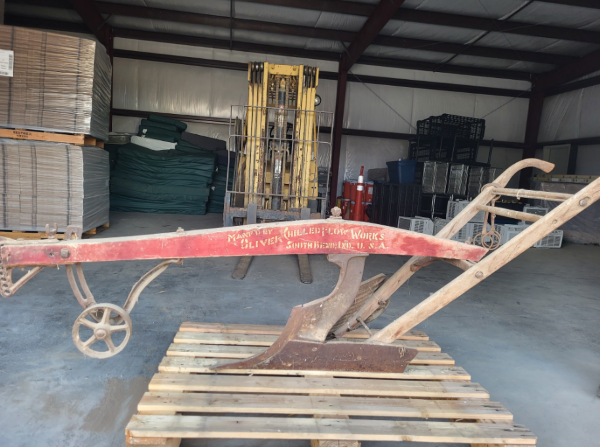
I recently did that with an old horse-drawn walking plow that has been around our family for as long as I can remember. Across its faded red wooden beam, you can still make out some of the gold lettering:
Oliver Chilled Plow Works — South Bend, Indiana.
The paint is worn. The iron is rusty. The wooden handles show their age.
And I've decided I wouldn't change a thing.
The Technology of Its Day
Today, we might look at a horse-drawn plow and think of it as primitive. But in its day, an Oliver chilled-iron plow represented some of the best agricultural technology available.
James Oliver developed a process that produced an extremely hard wearing surface on a cast-iron moldboard while retaining strength underneath. The result was a plow that resisted wear and did a better job of shedding soil.
It was innovation.
We sometimes forget that every generation of farmers has embraced technology.
A chilled-iron plow was technology just as surely as today's GPS, yield monitors, moisture sensors, drones and satellite-guided tractors are technology.
But as I stood looking at this old plow, I wasn't thinking very much about technology.
I was thinking about my grandfather Otto.
Bess and Swe
Grandpa used to tell me about farming with his team of horses.
He remembered them by name.
Bess and Swe.
That small detail has stayed with me all these years.
Today we tend to remember tractors by make, model, horsepower, and sometimes even serial number. Grandpa remembered Bess and Swe.
They weren't simply a source of horsepower. They were his team. He worked beside them day after day. He knew their personalities, their habits, and probably which one was going to test his patience on a particular morning.
I can't prove this particular Oliver plow belonged to Grandpa Otto.
Maybe it did.
Maybe it didn't.
But looking at those worn wooden handles, I couldn't help wondering:
Did Grandpa's hands once hold these?
Were Bess and Swe once hitched to the other end?
I may never know.
But somebody's hands held them.
Somebody stood behind this plow when the red paint was bright and the gold lettering was easy to read. Somebody looked across a field, called to a team of horses and started walking.
Imagine Walking an Acre
Those of us who farm today talk about acres almost casually.
Ten acres. Forty acres. A hundred acres. Four hundred acres.
We climb into a tractor, pull an implement through the field and watch those acres accumulate on a monitor.
But imagine walking them.
Every one of them.
Behind a team of horses.
Your hands wrapped around wooden handles while the plow cut into the earth.
Every rock would come back through those handles. Every root. Every hard spot. Every change in the soil.
There was no air-conditioned cab.
No radio.
No GPS telling you whether you were straight.
You watched the horses. You watched the ground. You felt the plow.
And you walked.
One step at a time.
One pass across the field at a time.
One furrow at a time.
From Horse Teams to Satellites
Agriculture has changed almost beyond recognition in just a few generations.
My grandfather's generation knew horses.
My father's generation watched tractors become more powerful and capable.
My generation has watched tractors become computers on wheels.
Today satellites can guide equipment across a field within inches. Sensors measure moisture. Computers record yields. Cameras identify plants. Artificial intelligence is beginning to find its way into the everyday work of agriculture.
Sometimes I wonder what Grandpa Otto would think if he climbed into one of today's tractors.
He might not recognize much inside the cab.
But I suspect he'd recognize everything outside the window.
There is still soil.
There is still weather.
There is still a crop.
And there is still a farmer wondering what tomorrow will bring.
For all our technology, agriculture has never figured out how to eliminate uncertainty.
We still hope the frost stays away.
We hope there's enough water.
We hope the heat doesn't become excessive.
We hope the crop is good.
We hope there are enough people to harvest it.
And after we've done everything we know how to do, we hope the market pays enough to cover what it cost to grow.
The equipment has changed dramatically.
The uncertainty hasn't.
Why I Won't Restore It
Someone could restore this plow beautifully.
The rust could be removed. The wood could be sanded. Pieces could be replaced. The beam could once again be painted bright red and the Oliver lettering recreated in gold.
It might look almost like it did when it left South Bend more than a century ago.
I'm not going to do it.
This plow is staying exactly as it is.
The more I looked at those handles, the more I realized something.
The wear is part of the story.
If Grandpa Otto's hands actually held those handles, why would I want to sand away the marks they may have left?
And even if this wasn't his particular plow, somebody's grandfather held them.
The faded paint tells us time passed.
The rust tells us this implement worked for a living.
The worn wood tells us human hands were there.
A perfectly restored plow might show us what it looked like when it was new.
This one tells us what happened afterward.
I think that matters more.
One Furrow at a Time
And maybe that is where this old plow has one more lesson to teach.
A farmer walking behind Bess and Swe couldn't plow the entire field at once.
He could see the acres ahead of him. He knew how much work remained. He probably knew there were other fields waiting when this one was finished.
But worrying about the entire field wouldn't turn a single acre.
There was only one thing he could do.
Put his hands on the handles.
Keep the team pointed in the right direction.
Walk forward.
When he reached the end, he turned around and did it again.
One furrow at a time.
There is some wisdom in that.
We spend a lot of our lives looking across fields that seem awfully big.
We worry about next year.
We worry about our families.
We worry about our businesses and livelihoods.
We worry about a world that sometimes seems to be changing faster than we can understand it.
And sometimes we wonder how we're ever going to get from one side of the field to the other.
Maybe Grandpa Otto's generation understood something we occasionally forget.
You don't plow the whole field with one pass.
You simply keep moving in the right direction.
There will be rocks.
The plow will catch a root now and then.
The horses may not always cooperate.
The furrow probably won't always be perfectly straight.
Sometimes you may even have to stop, back up and try again.
But you keep your hands on the handles and keep moving forward.
Then, eventually, you turn around and look behind you.
Where there was once an untouched field, there are furrows stretching into the distance.
That's progress.
Not because it happened all at once.
Because somebody kept going.
What We Leave Behind
I think about that more as I get older.
Grandpa Otto probably never imagined that decades after he was gone, his grandson would still remember the names Bess and Swe.
They were probably just part of an ordinary day's work to him.
Yet here I am telling their story.
That makes me wonder which ordinary things from our lives will become someone else's history.
Maybe someday one of my grandchildren or great-grandchildren will look at this old piece of wood and iron and ask:
"What was that used for?"
I hope it is still rusty.
I hope some of that faded red paint is still there.
And I hope you can still make out a little of the gold Oliver lettering.
Because then I'll have a story to tell.
I'll tell them about their great-great-grandfather Otto.
I'll tell them about two horses he remembered fondly named Bess and Swe.
I'll explain how farmers once walked behind their horses, feeling the earth through wooden handles as they turned the soil.
And I'll tell them why I chose not to make this old plow look new again.
Because progress isn't always about replacing what is old.
Sometimes old things remind us how we got here.
And occasionally, if we're willing to listen, they can teach us something about where we're going.
Life doesn't give any of us a perfectly straight field.
There will always be rocks we didn't see coming. There will be roots that stop us in our tracks. There will be weather we can't control and circumstances we never planned for.
Grandpa couldn't control all of those things either.
But he could control the next step.
Maybe that's enough.
Keep your hands on the handles.
Keep your eyes toward the other end of the field.
And keep moving forward—one furrow at a time.
About the Author
I was born in 1961 into a second-generation farm family in The Dalles. I grew up on a tractor seat, moving irrigation pipe with my sisters before school, and spent my summers picking cherries alongside the children of migrant families who returned year after year. My wife, children, and parents have all worked the same land. I’ve served as county Farm Bureau president, sat on the county fair board, and continue to support 4-H and FFA. I’ve seen firsthand what happens when farmers are squeezed out—not just of business, but of the conversation.
Support Local News!
Available for Everyone; Funded by Readers.