
Thoughts from the Tractor Seat: Your Vote Shouldn’t Depend on the Speed of the Mail
By Ken Polehn
The Dalles, Ore., Oct. 12, 2026 — Out here in Eastern Oregon, we understand distance. We measure it in miles to the grocery store, hours to the nearest hospital, and sometimes days waiting for something to arrive in the mailbox.
So I recently learned something about our postal system that left me scratching my head.
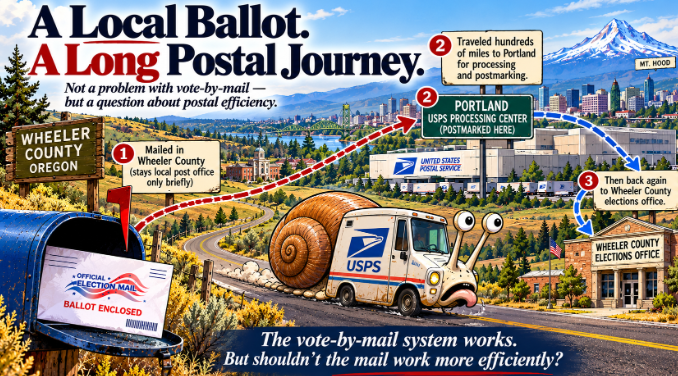
Imagine living in Wheeler County. You fill out your ballot, sign the envelope, and place it in your mailbox. Your county elections office may be only a few miles away. Yet that ballot could travel hundreds of miles west to Portland for processing and postmarking before returning east to the county where it began.
If I shipped a box of cherries from one side of The Dalles to the other by way of Portland, people would question my management. Yet that kind of routing can happen with something far more important: our votes.
A problem worth understanding
In May 2026, Oregon Secretary of State Tobias Read warned that postal changes required ballots from Eastern, Central, and Southern Oregon to travel to Portland for processing and postmarking before returning to local election offices.
The concern is not only delivery time but the official postmark. Under Oregon law, a ballot mailed by Election Day can be counted if it has a qualifying postal indicator and arrives within seven days. But USPS acknowledges that transportation changes can prevent mail from reaching a processing facility on the day it was mailed.
As a result, the postmark may not reflect when a voter actually handed over the ballot. A citizen can do everything right and still face uncertainty because of the system’s routing and processing.
According to the Secretary of State, 7,314 ballots received during the seven-day grace period after the May 2026 primary were rejected for late postmarks, a 35 percent increase from the 5,404 rejected in the comparable 2022 primary.
Not every late postmark resulted from postal delays. Some voters undoubtedly mailed their ballots too late. But when the state warns that processing changes create additional risks, we should pay attention.
This isn't about vote-by-mail
This is not an argument against Oregon's vote-by-mail system. It offers convenience, gives voters time to study candidates and measures, and is especially valuable for working families, older residents, and people in remote communities.
My concern is with the system responsible for getting ballots where they belong.
Why should election mail travel hundreds of miles away from its destination just to receive a date stamp? Could local post offices provide postmarks before sending ballots into the regional network? Could ballots addressed to county elections offices be handled through more direct arrangements?
Regional sorting facilities exist for reasons, including automation and cost control. But a system designed for efficiency should be willing to show that it actually delivers efficiency.
A lesson from the farm
In agriculture, every unnecessary mile adds cost, and every extra handling increases the chance of damage or delay. When a process stops making sense, we examine the route and change it.
The Postal Service and government agencies should do the same with election mail.
The issue also extends beyond ballots. Rural Americans depend on the mail for prescriptions, financial documents, business correspondence, replacement parts, and other necessities. For someone miles from the nearest town, reliable mail is an essential connection to the country.
For the November election, Oregon voters should know that the Secretary of State recommends mailing completed ballots no later than October 27. Official drop boxes remain available through 8 p.m. on November 3. Voters mailing closer to Election Day can request a free manual postmark at a local post office counter.
Those are useful precautions, but they should not replace a larger conversation about reliability.
A local ballot shouldn't need a statewide sightseeing tour to reach its local destination. We can support vote-by-mail while expecting better routing, clearer postmarks, and dependable service for rural communities.
Perhaps the most efficient route between two points in rural Oregon should not have to pass through Portland.
One furrow at a time.
Ken Polehn writes Thoughts from the Tractor Seat, offering perspectives on agriculture, rural communities, public policy, and the issues connecting everyday Americans.

Support Local News!
Available for Everyone; Funded by Readers.