
Volunteers rally to save a classic carousel ride
By Tom Peterson
The Dalles, Ore., Feb. 5, 2026 — Inside the former Elks Lodge in downtown The Dalles, the National Neon Sign Museum glows with neon signs spanning more than 120 years of American roadside history. Upstairs, under a single spotlight, another form of craftsmanship is quietly being brought back to life.
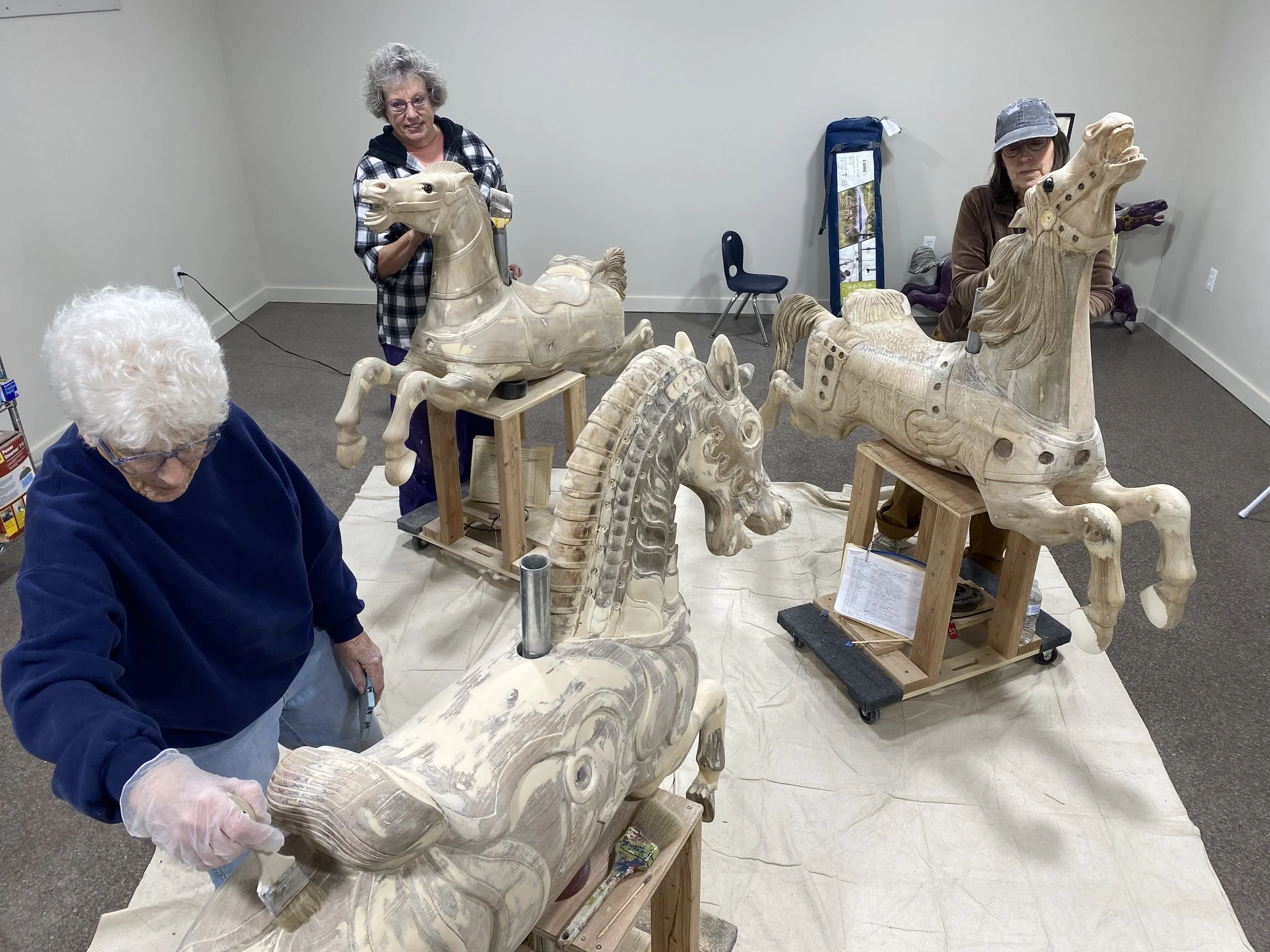
Lynne Kadlec, Sally Forster and Therese Wunderlich work on the painstaking process of sanding carousel horses at the National Neon Sign Museum in downtown The Dalles in late January. Volunteers are working on 80 of the carved equine adorned in jewels and elaborate ornamental carvings as the museum works toward having the carousel ready in part for the public in 2028.
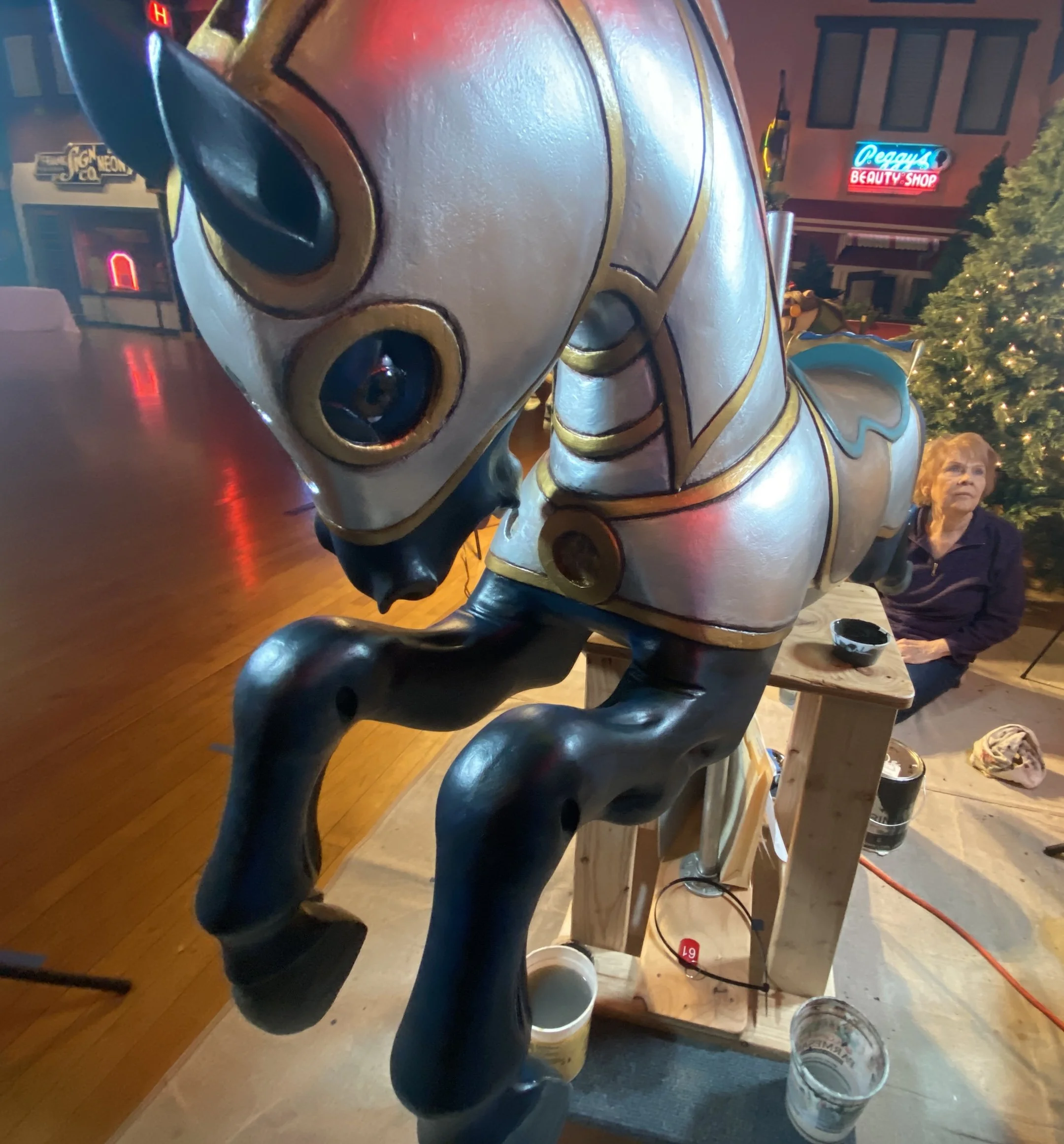
Volunteer Linda Wilson stood beside a carved wooden horse from the historic Jantzen Beach Carousel, brush in hand, carefully painting its ornate exterior.
“I have fun with it,” Wilson said. “I’m mixing a color to make a wash to put scales on the romance side of this one.”
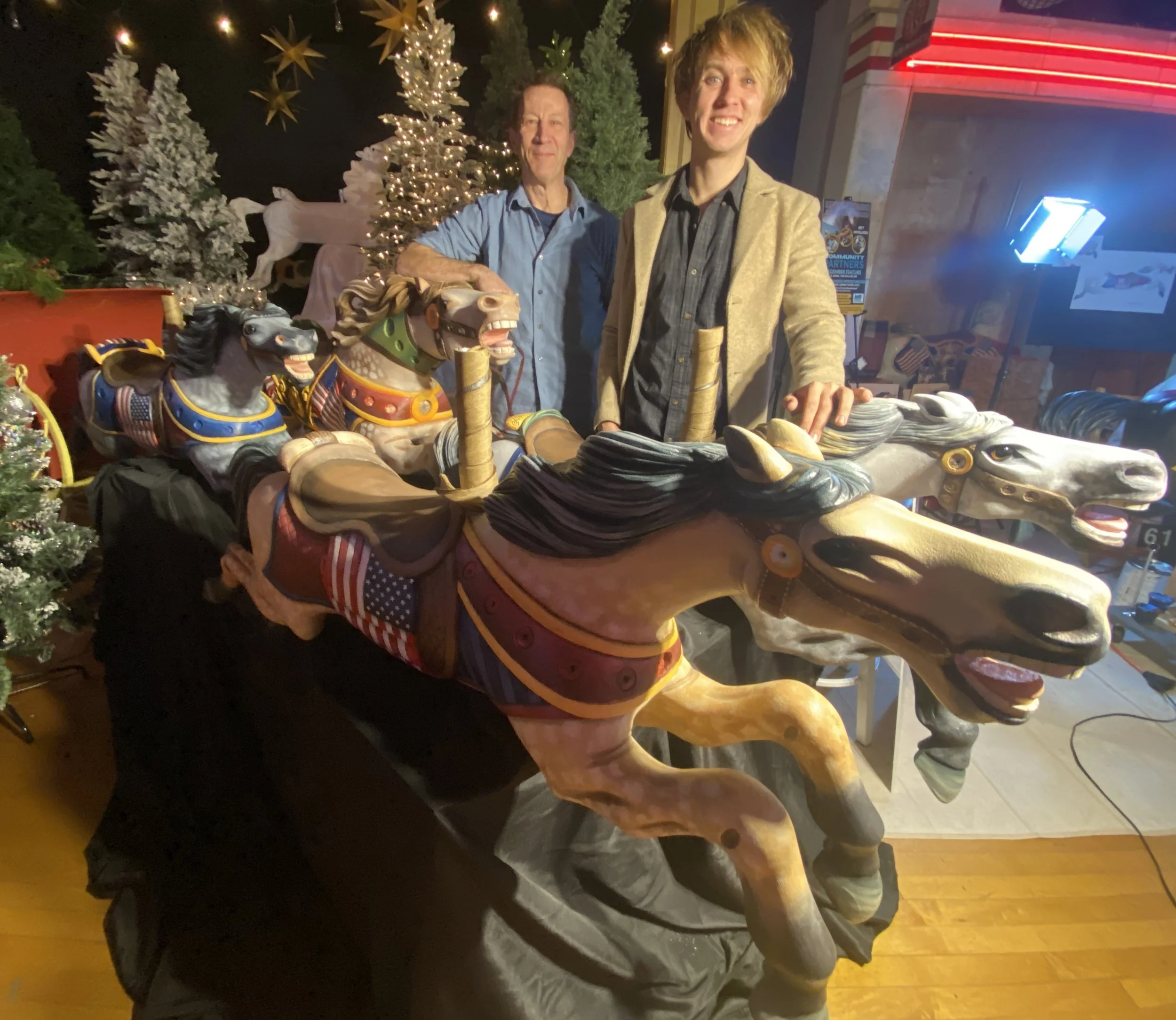
David and Simon Benko stand proudly with a family of horses that have undergone the restoration process.
The “romance side,” Wilson explained, is the outward-facing side of the horse — the portion visible to riders as they approach. It is richly detailed and decorative. The opposite side, known as the “money side,” is far plainer, since riders have already paid once it comes into view.
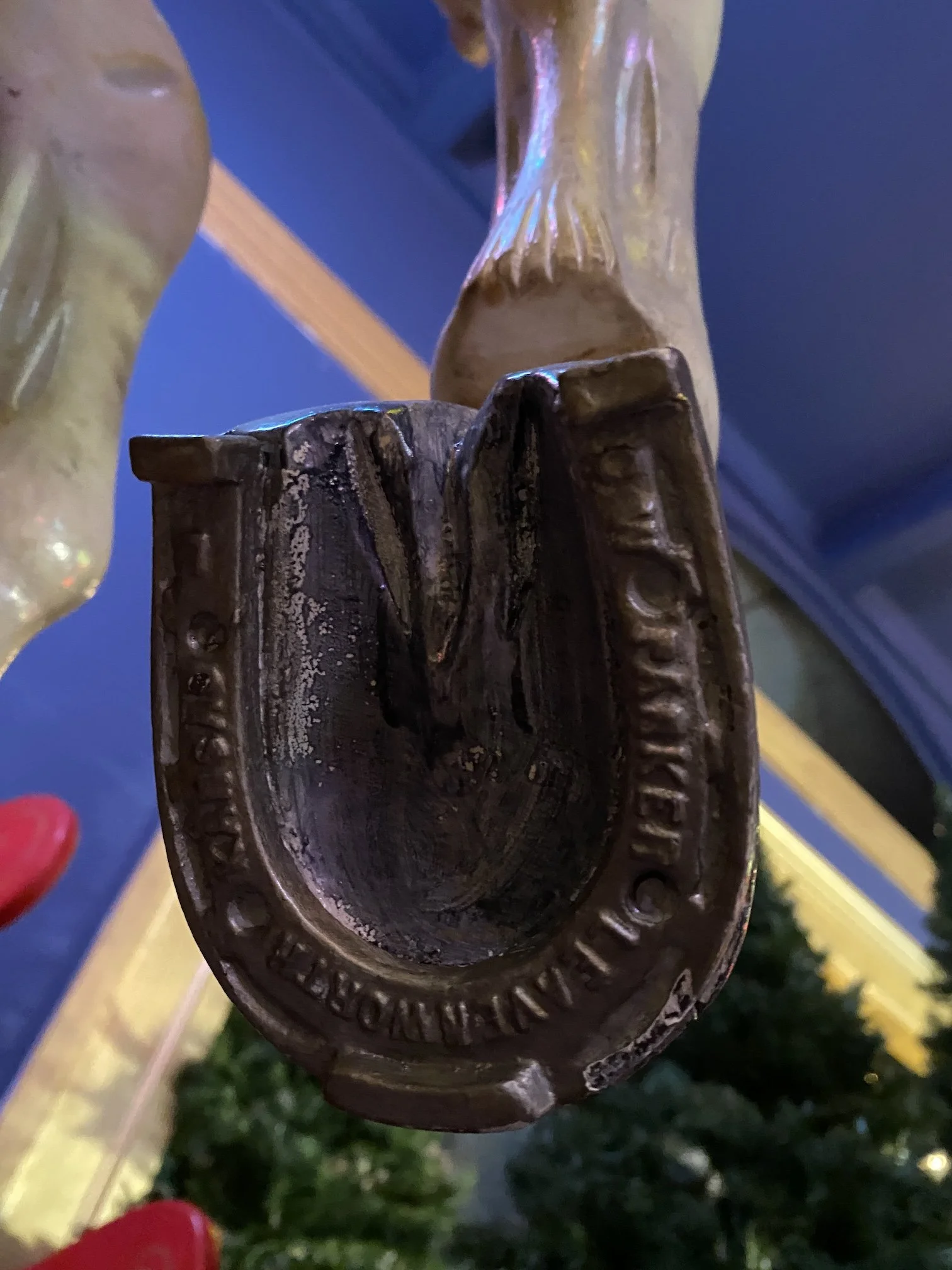
Stamped into the horseshoes are the words “11 Worth,” identifying Leavenworth, Kansas, where the horses were carved and assembled. Wilson said some research points to german prisoners held there during World War I were among the craftsmen responsible for carving and assembling the figures.
Nearly a century of use has left its mark. The horses have undergone multiple repairs and layers of paint over the decades, including copper patches. Epoxy rebuilds of worn features — such as a carved sunflower worn nearly flat after generations of riders brushed past it.
“They are so beautiful,” Wilson said. “It’s an honor to work on them. Someday I’m going to ride one.”
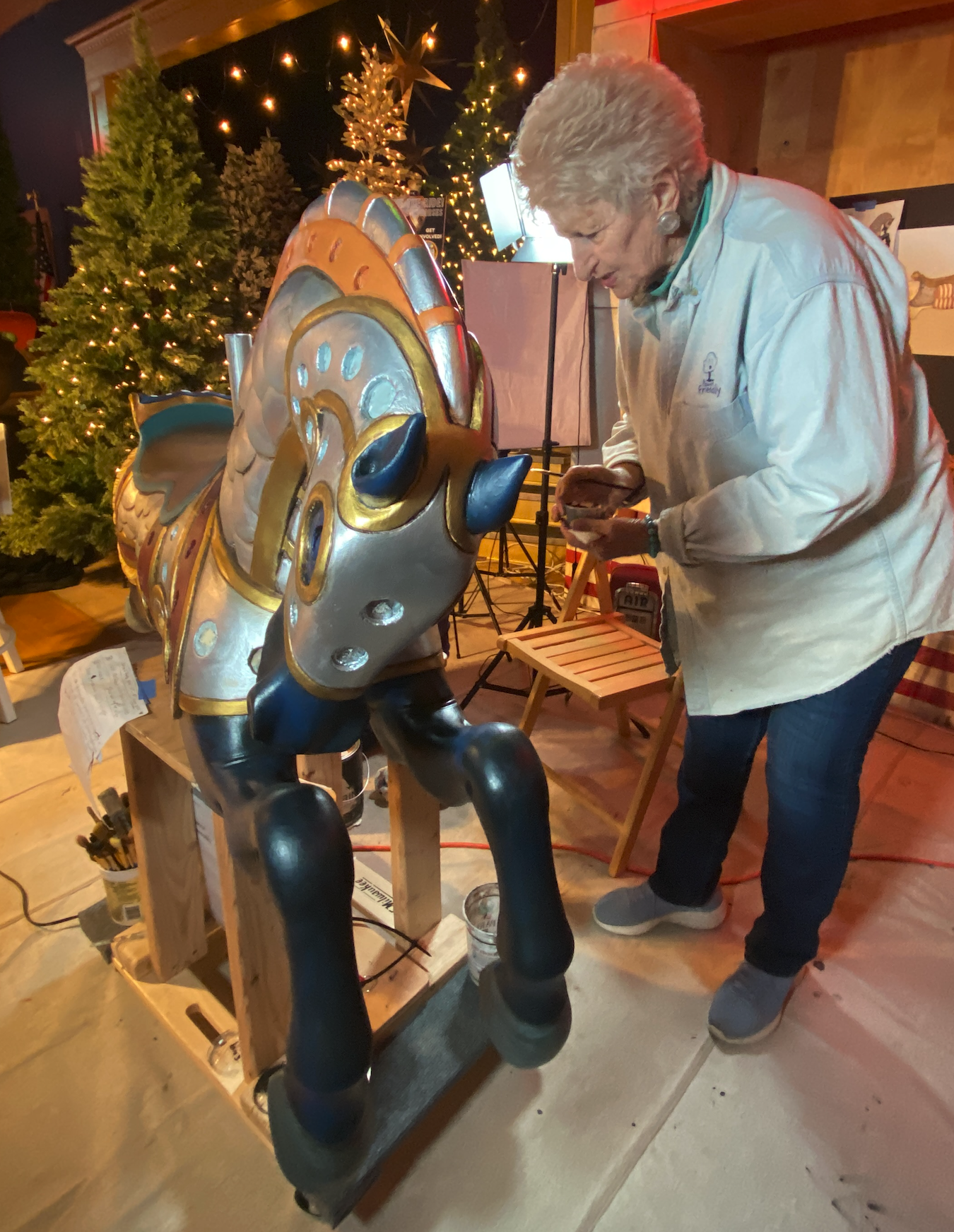
Linda Wilson, a true horse fanatic and huge supporter of Fort Dalles Riders, takes her love to a new level as she works to mix paint colors to get just the exact hue on this armored horse.
Downstairs, in a brightly lit white room, three women worked steadily on other horses stripped to bare wood. For months, volunteers have been filling cracks and sanding surfaces as part of the painstaking restoration process.
“My intent is to preserve these horses for another 100 years,” said volunteer Therese Wunderlich of The Dalles. “We have spent hundreds of hours sanding. We started using wood filler for the cracks, but found that resin works a lot better.”
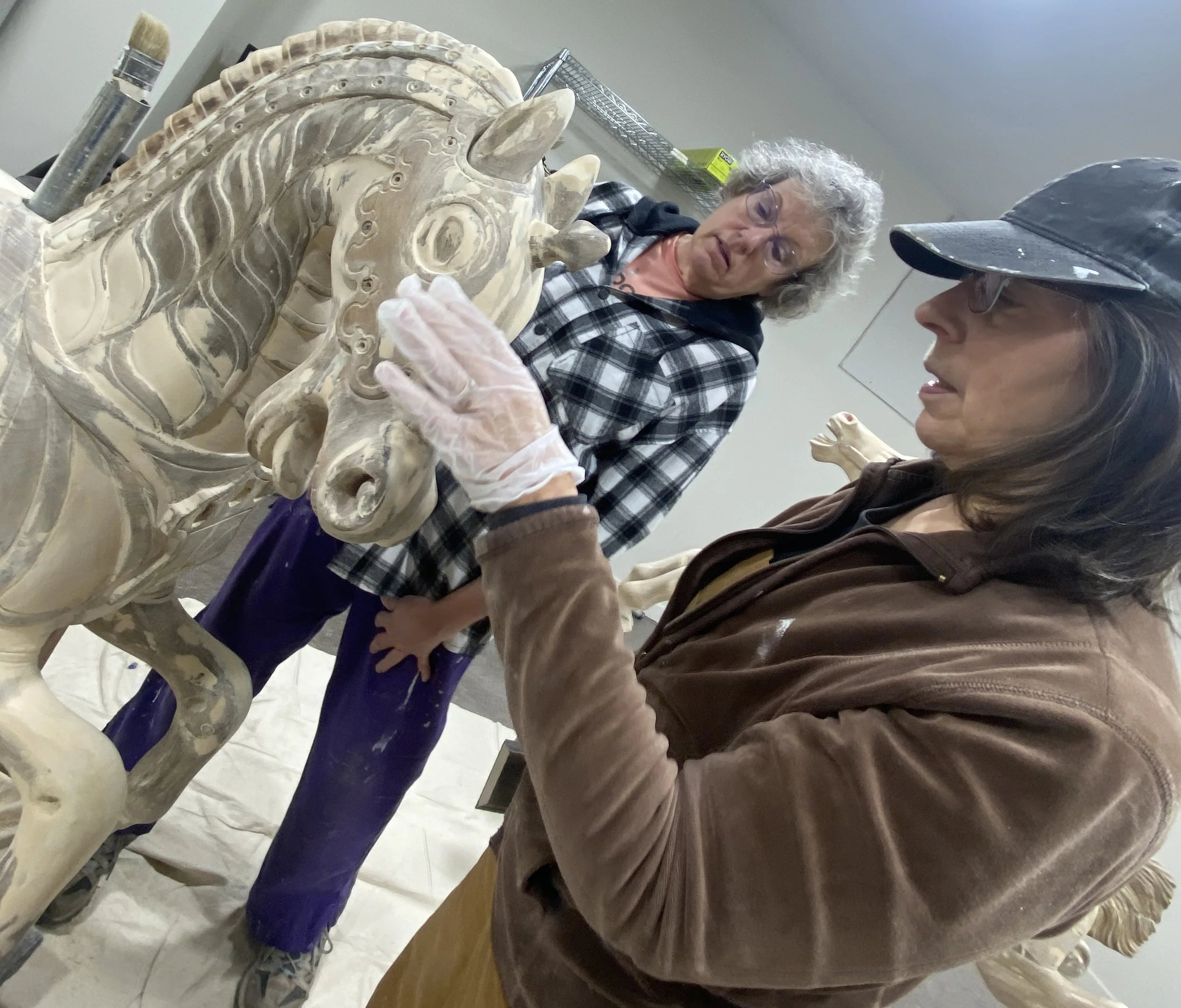
Sally Forster and Therese Wunderlich work on sanding this carved horse after it was stripped of paint and cracks in the wood were filled with resin.
The work underway inside the museum is part of a much larger effort to restore the Jantzen Beach Carousel, a massive attraction built in 1921 and brought to Oregon in 1928. In 2023, stewardship of the carousel was awarded to the Neon Sign Museum following a statewide selection process led by Restore Oregon.
The carousel includes more than 80 carved horses and two chariots and is considered one of the largest traditional carousels in the United States.
Kirsten, David and Simon Benko have made the carousel’s revival a family effort. The Benkos said their roles span stewardship, planning, documentation and community outreach, with each contributing to the long-term goal of returning the historic ride to public use while preserving its artistic and historical integrity.
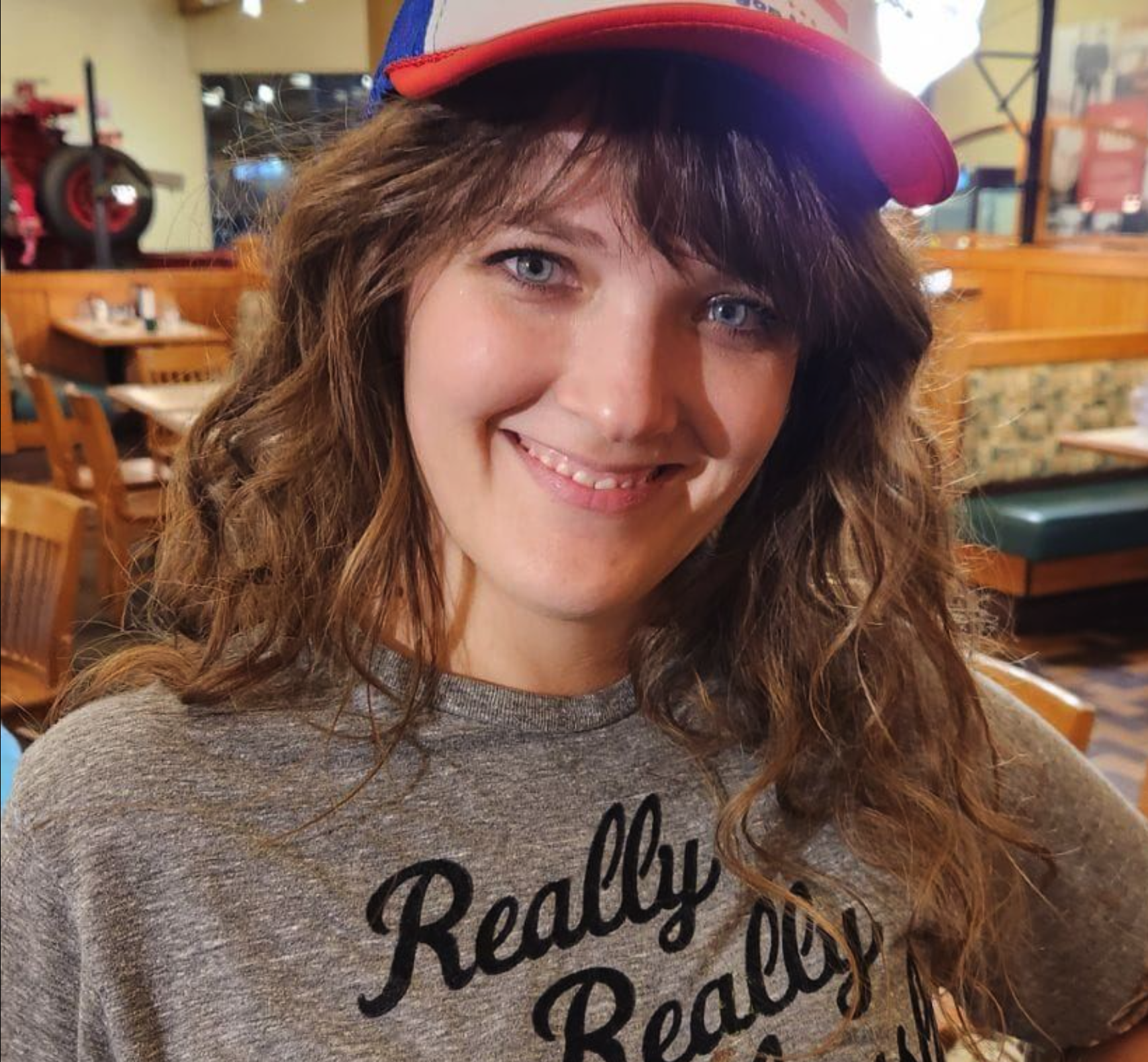
Denae Manion
Local artist Denae Manion has spearheaded much of the hands-on restoration, helping organize volunteer efforts and guide painting and surface-finishing techniques. According to the Benkos, Manion’s experience and steady leadership have been central to maintaining consistency and quality across the restoration process as work continues on multiple horses.
Son, Simon Benko said the first year of the project focused largely on research, planning and relationship-building before visible restoration began.
“This is not about rushing,” Simon Benko said. “We’re just stewards of these horses. Our responsibility is to do it right so the next generation has something documented and preserved.”
According to the Benkos, restoration work is being done in “families” of four horses at a time, grouped by style and position on the carousel. More than a dozen horses are currently in progress, with teams handling woodworking, painting and surface preparation.
Shortly after the museum was selected as steward, David Benko attended the 50th annual convention of the National Carousel Association in New England, visiting more than two dozen carousels in several days and building relationships with operators, artists and restorers.
“One woman in her 90s could barely walk off the bus,” David Benko said, recounting his experience during the tour. “Then she saw her horse, recognized it, and suddenly she was running toward it. That’s what this does.”
“That was the moment it really became real,” he said. “You realize not just what you have, but what it can mean to a community.”
Restoration is being done in groups of four horses at a time — often referred to as “families” — based on their placement and design on the carousel. More than a dozen horses are currently in various stages of restoration, with volunteers specializing in woodworking, painting, surface preparation and documentation.
The Benkos said documentation is a central focus of the project, noting that earlier restoration efforts decades ago left little written record. Today’s work is being carefully recorded so future caretakers understand the materials and methods used.
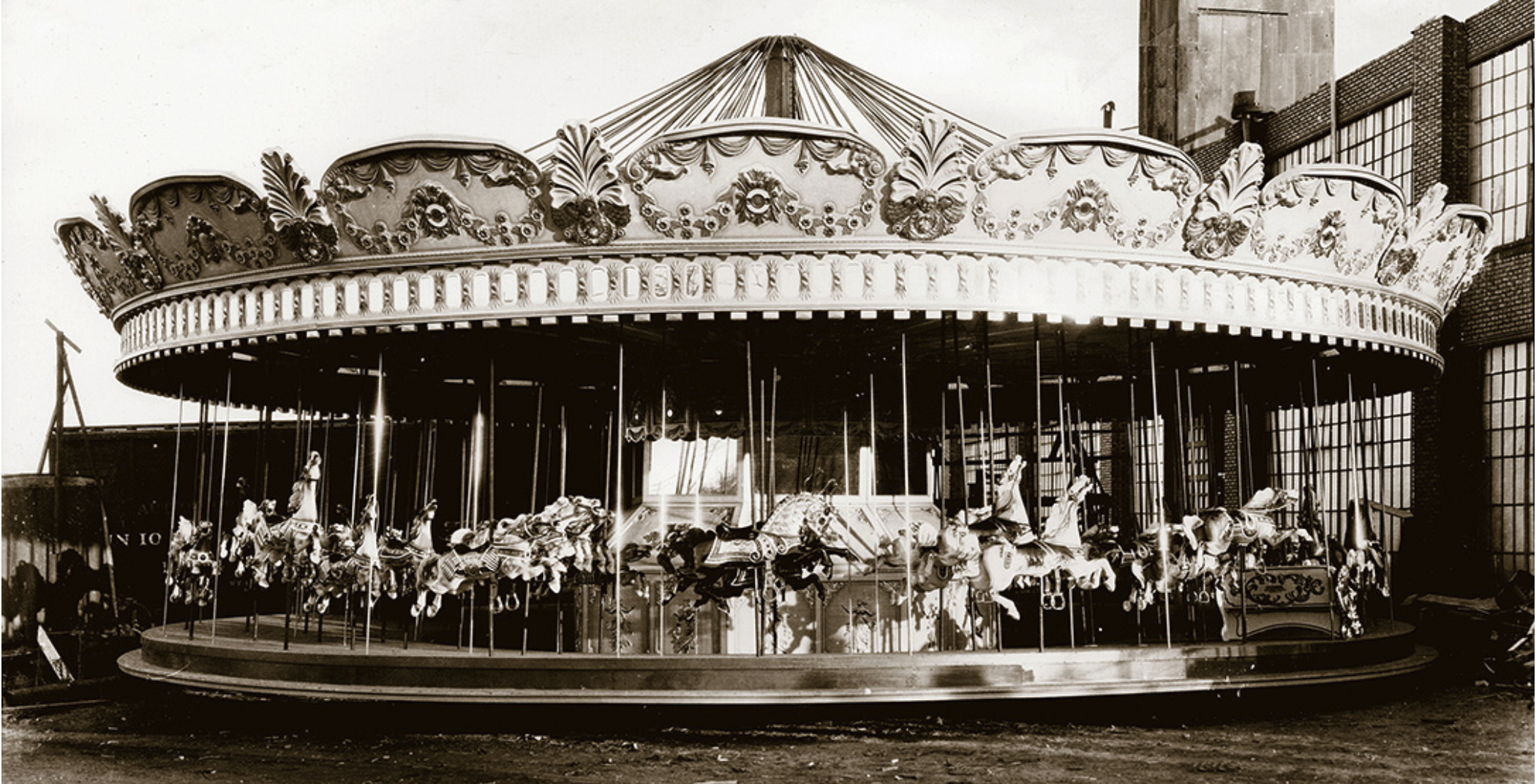
From the Oregon Historical Society: The Jantzen Beach Carousel is a four-abreast, C.W. Parker “Superior Park” model machine. Measuring over 66 feet in diameter, it was specifically designed for permanent installation versus traveling use and is one of only a handful of such elaborate, oversized park-model carousels ever built. Commissioned in 1921 to add sparkle to the pier in Venice, California, the Jantzen Beach Carousel made its Oregon debut in 1928. C.W. Parker Archives, Barbara Fahs Charles Collection.
Beyond the technical work, the Benkos said the carousel’s power lies in its ability to connect people across generations, often evoking strong emotional responses tied to memory, art and place.
The restoration is taking place inside the museum, allowing the public to observe the process firsthand. The museum is completing its lower-level Argon Education Center, which will include classrooms, a working neon shop and a dedicated carousel restoration area with live demonstrations.
The museum is also producing a documentary chronicling the carousel’s history and revival. More than 25 interviews have already been recorded as part of the project, according to the Benkos.
Long-term plans call for construction of a dedicated carousel pavilion adjacent to the museum. Early concepts include a fully enclosed structure designed to protect the carousel while making it visible to the public.
Long-term plans call for construction of a dedicated carousel pavilion adjacent to the museum. Early concepts include a fully enclosed structure designed to protect the carousel while making it visible to the public.
The museum hopes to have a significant portion of the carousel restored by 2028, marking 100 years since it arrived in Oregon.
The Benkos said the project is moving forward deliberately, with an emphasis on craftsmanship, education and community involvement.
Volunteers, donations and grant funding continue to be sought as restoration progresses. More information is available at JantzenBeachCarousel.org and through the museum’s social media channels.