
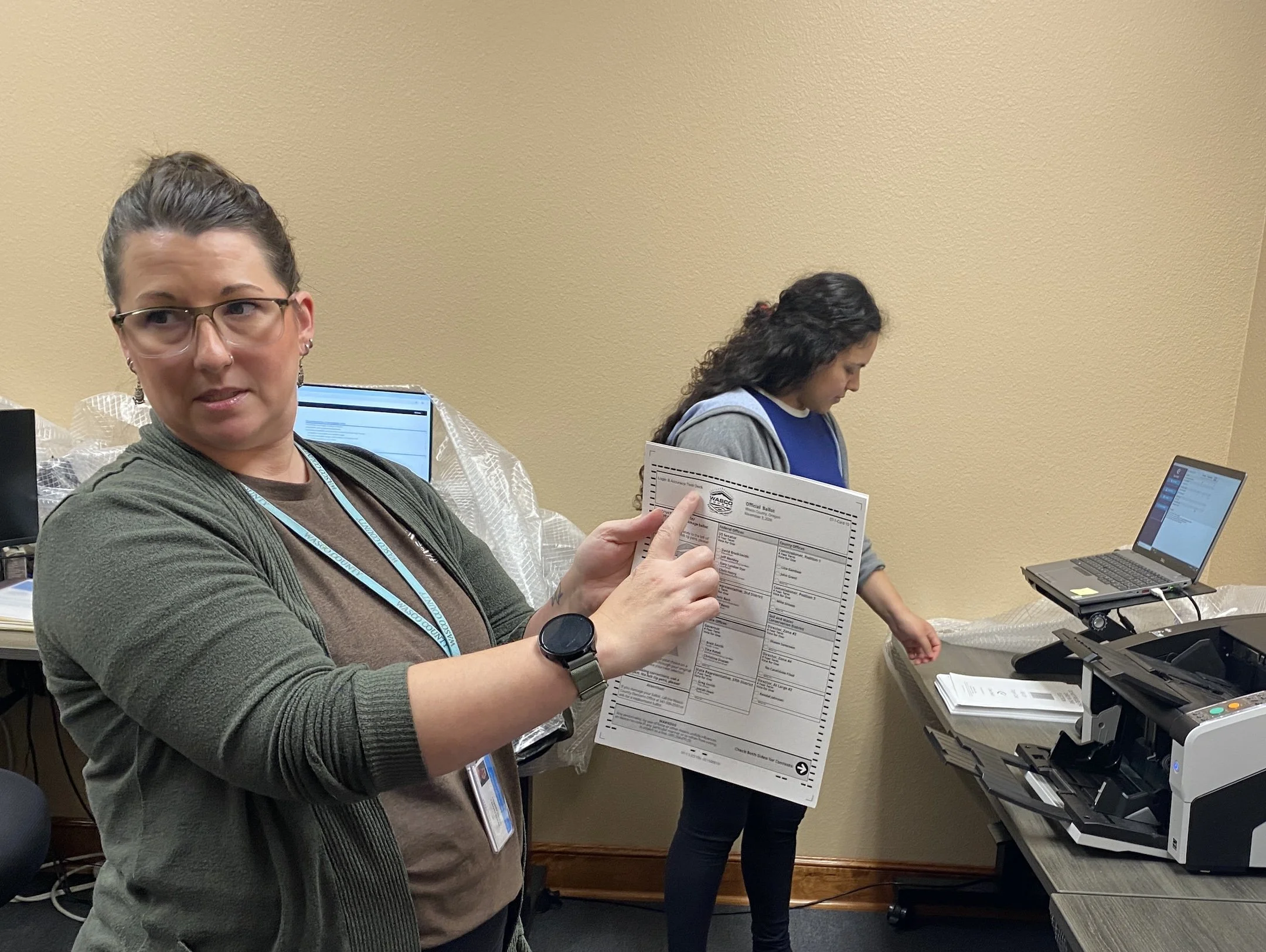
Wasco County Clerk Chrissy Zaugg displays a test ballot during a demonstration of the ballot tabulation process on Tuesday, Oct. 27. More than 20 citizens have already signed up to observe the opening of the ballots, which started on Oct. 29, and continued today and will resume on Nov. 2 and 3.
By Tom Peterson
The Dalles, Ore., Oct. 30, 2026 — From the moment a ballot is mailed or deposited in a drop box to the eventual release of election results, Wasco County has a series of checks designed to ensure every ballot is accounted for and every vote is properly counted. Click here for a quick detailed graphic on the process.
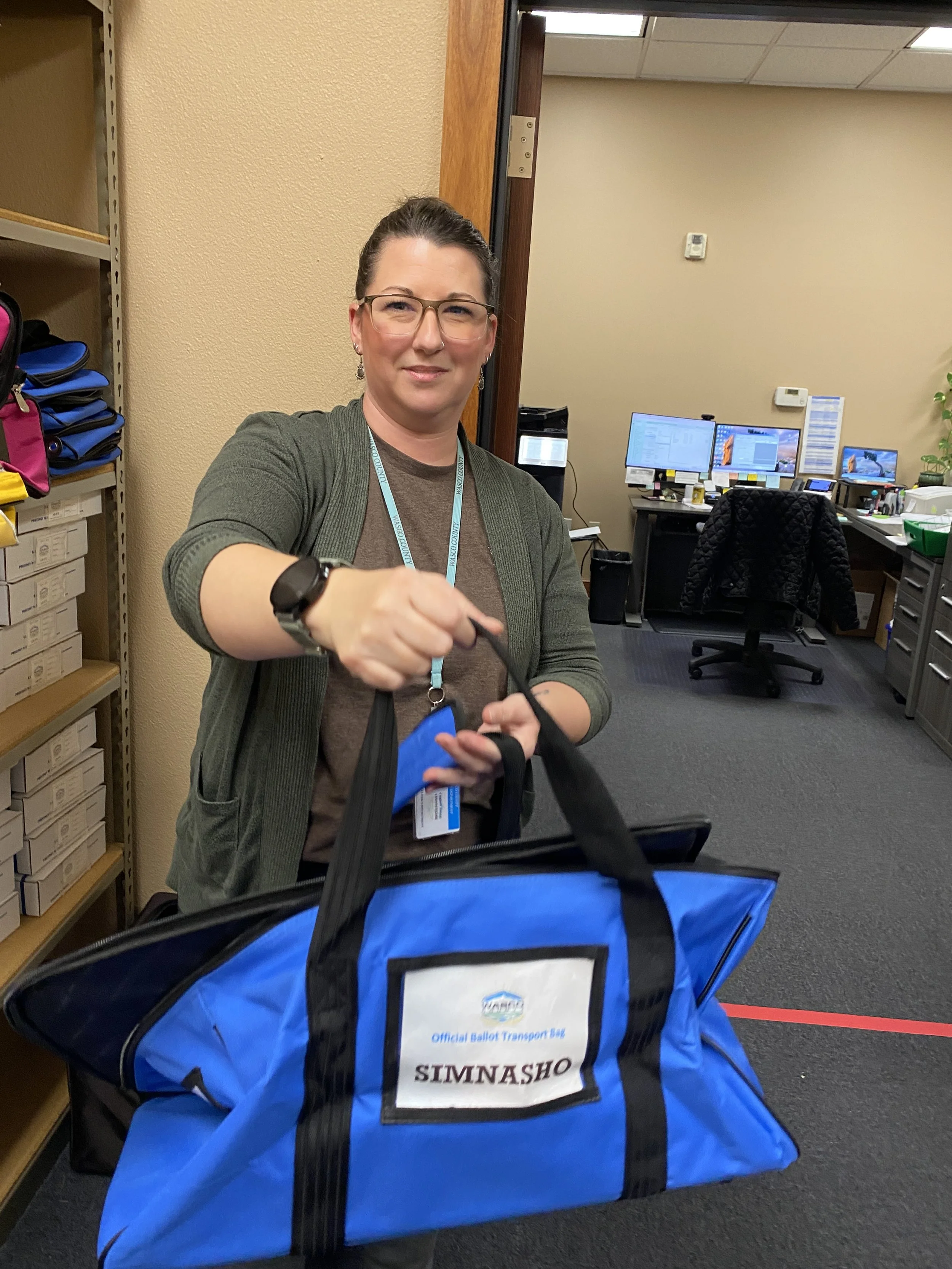
Each drop box gets its own collection bag.
Wasco County Clerk Chrissy Zaugg demonstrated that process Oct. 27, walking four local residents through the steps involved in collecting, verifying, opening and tabulating ballots for the Nov. 3 General Election.
The demonstration offered a look at a system built around two important principles: security and transparency. Ballots are tracked and counted multiple times, equipment is tested, and members of the public are invited to observe much of the process.
One measure of that transparency is the public's involvement in the opening of ballots. Zaugg said on Tuesday that 23 citizens were already signed up to observe the opening-board process for this election. As of Tuesday, Fifteen were set to watch remotely through Zoom, while eight will observe in person.
The opening boards are scheduled to work on Oct. 29, 30 and again Monday, Nov. 2, and Tuesday, Nov. 3.
From the drop box to the clerk's office
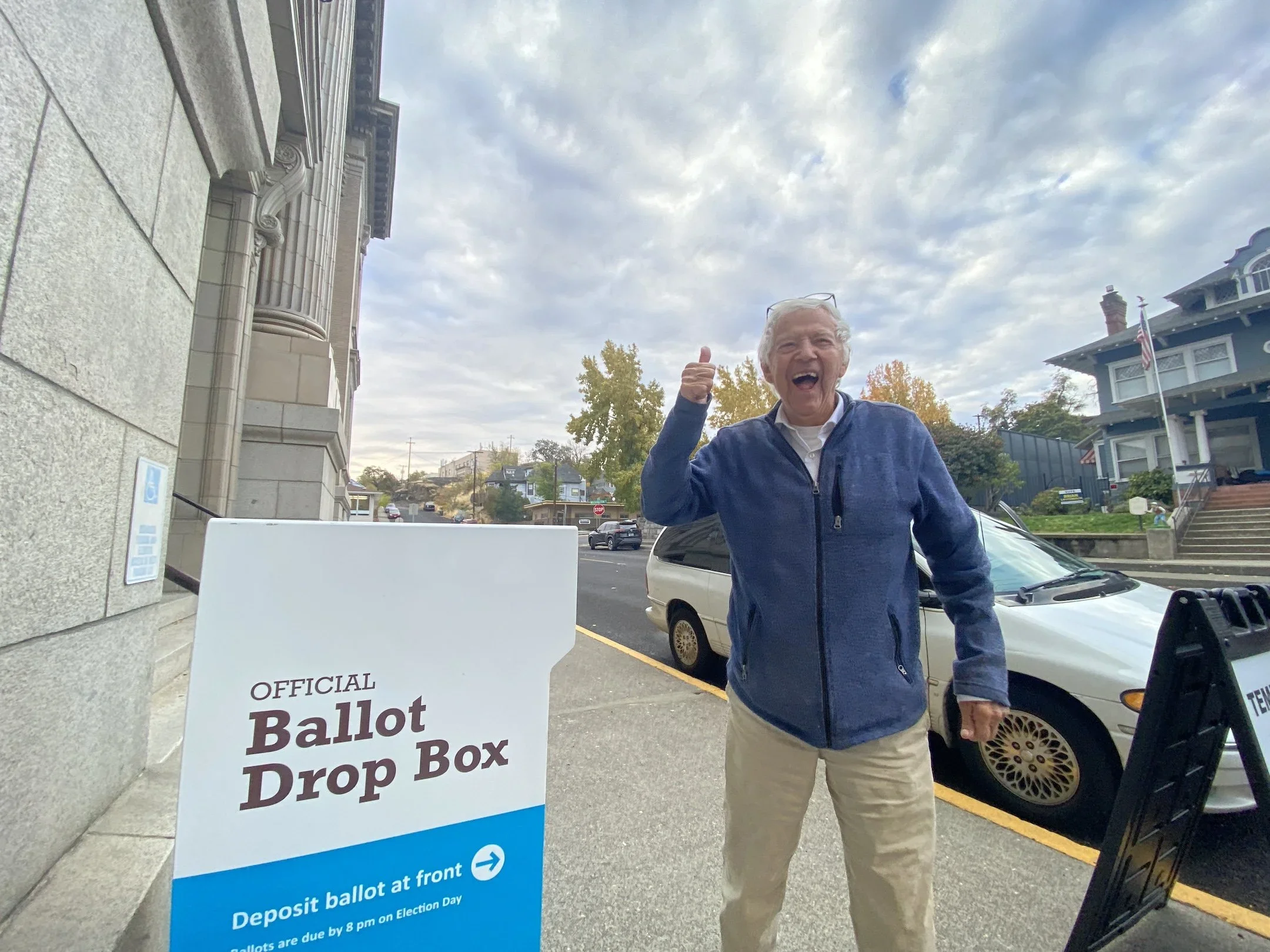
Retired Grocer Ken Dehart throws a thumbs up after dropping his ballot at the Wasco County Courthouse in 2024.
Wasco County has seven 24-hour ballot drop boxes spread throughout the county, serving residents in The Dalles, Dufur, Maupin, Mosier, Simnasho and Tygh Valley. The Tygh School Community Center in Tygh Valley is a new drop-box location this year.
County employees collect ballots in pairs. When a box is emptied, employees document the location, date and time of collection and identify the people responsible. Ballots are transported in designated bags, with accompanying paperwork that follows them back to the clerk's office.
The two-person collection process and accompanying documentation establish a record of where ballots came from and when they were transferred.
Once at the elections office, ballot envelopes are scanned to record their receipt. That allows the county to look up an individual voter and determine whether a ballot has been received and accepted.
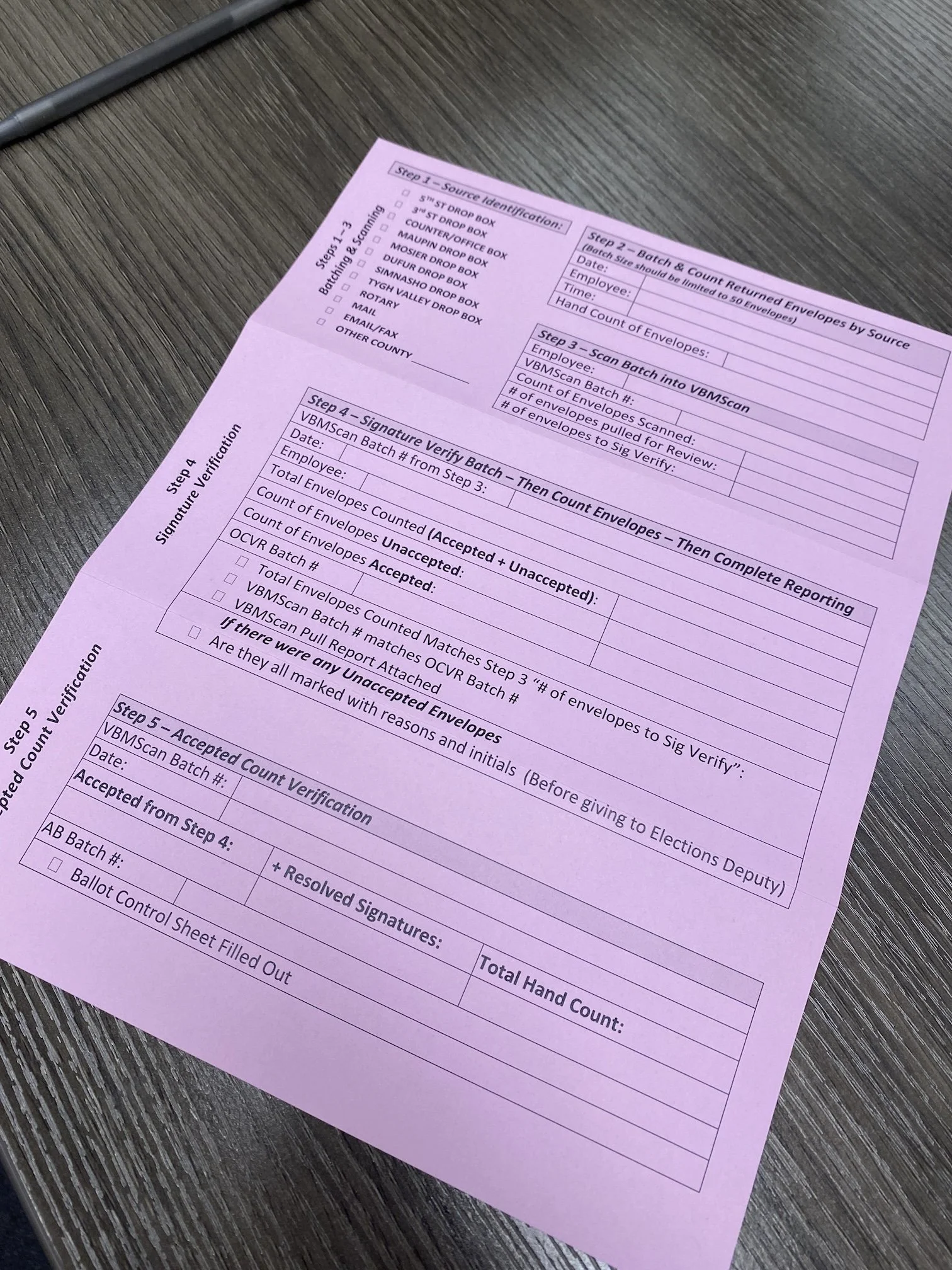
Here is the official 5-step verification sheet that the Wasco County Clerk’s office uses to document the handling and counting of envelopes, signatures and ballots.
The next step is signature verification.
Election staff compare the signature on each returned ballot envelope with the signature on file for that voter. If a signature is questionable, additional employees may review it. Zaugg explained that the county can conduct multiple reviews, including a third check, before deciding that a signature cannot be verified.
Voters whose signatures are missing or challenged are notified and given an opportunity to correct the problem through a process called curing. They have until 5 p.m. on the 21st day after the election to resolve the issue. Ballots that are not properly cured by the deadline are not counted.
After signature verification, envelopes are organized into batches, generally containing about 100 ballots. The county maintains counts and records as each batch moves through the process.
Opening the ballots
The next stage takes place at the opening boards, where workers remove ballots from their return envelopes.
Workers separate the ballots, flatten the paper and count the individual ballot pages by hand. They do not count the votes or determine which candidates received them.
The number of ballots and individual pages is recorded and reconciled with the counts from earlier stages before the ballots are transferred to the tabulation area.
This is the part of the process that 23 local observers will be watching over the next several days.
Residents can observe in person or remotely through Zoom after completing an observation agreement with the clerk's office. Zaugg said people interested in watching can contact the elections office to make arrangements.
The opportunity to observe is not limited to opening boards. Members of the public can also request to watch signature verification and tabulation when those operations are taking place. Because those activities depend on when ballots are available for processing, scheduling an observation may require some flexibility.
Testing the equipment and protecting results
During the Oct. 27 demonstration, Zaugg showed how the county tests its two ballot scanners and the computer used to administer the tabulation system.
The demonstration used a set of test ballots marked with predetermined selections. The ballots were divided between the two scanners, processed and then compared against the results the county already knew they should produce.
On Tuesday, the two test batches were expected to contain 135 and 138 ballots and two cover sheets describing the batches. The scanners ran the ballots through and came up with the same numbers. 273 ballots and two cover pages that the scanner classified as non-ballots.
The equipment operates on an isolated system.
"Everything in this room ... it's not connected to the internet," Zaugg explained, describing how the scanners and administrative computer communicate with one another without an internet connection.
The county also keeps vote totals disabled while ballots are being processed. That means election officials can scan ballots without being able to see the results.
Zaugg explained that the totals are not enabled until the first authorized release of election results after 8 p.m. on Election Day.
The public test is only one part of the equipment-checking process.
"We do a total of at least six tests," Zaugg said, describing the sequence of programming checks, preliminary tests, the public demonstration and additional tests before actual tabulation and final certification.
The purpose is to verify that the system is working properly at multiple points during the election, not simply at the beginning.
The test ballots also demonstrate how the equipment handles different voting situations. An overvote occurs when a voter marks more candidates than allowed in a particular race. An undervote occurs when a voter does not make a selection. Those situations are identified in the tabulation reports and verified against the ballots.
The process continues after Election Day
Although the Nov. 3 election is the central deadline for voters, the county's work continues afterward.
Oregon accepts ballots postmarked by Election Day if they arrive within the seven-day post-election period. The county must also allow time for voters to resolve challenged signatures before completing its final work.
The county will conduct another equipment test before completing its final tabulation and certification.
For voters, returning a ballot may seem like a simple transaction: mark the choices, sign the envelope and put it in the mail or a drop box.
But the process Zaugg demonstrated shows the many steps in between. Ballots are documented when collected, counted and reconciled as they move through the office, checked for valid signatures, opened under observation and processed through equipment that is tested repeatedly and operates isolated from the internet.