
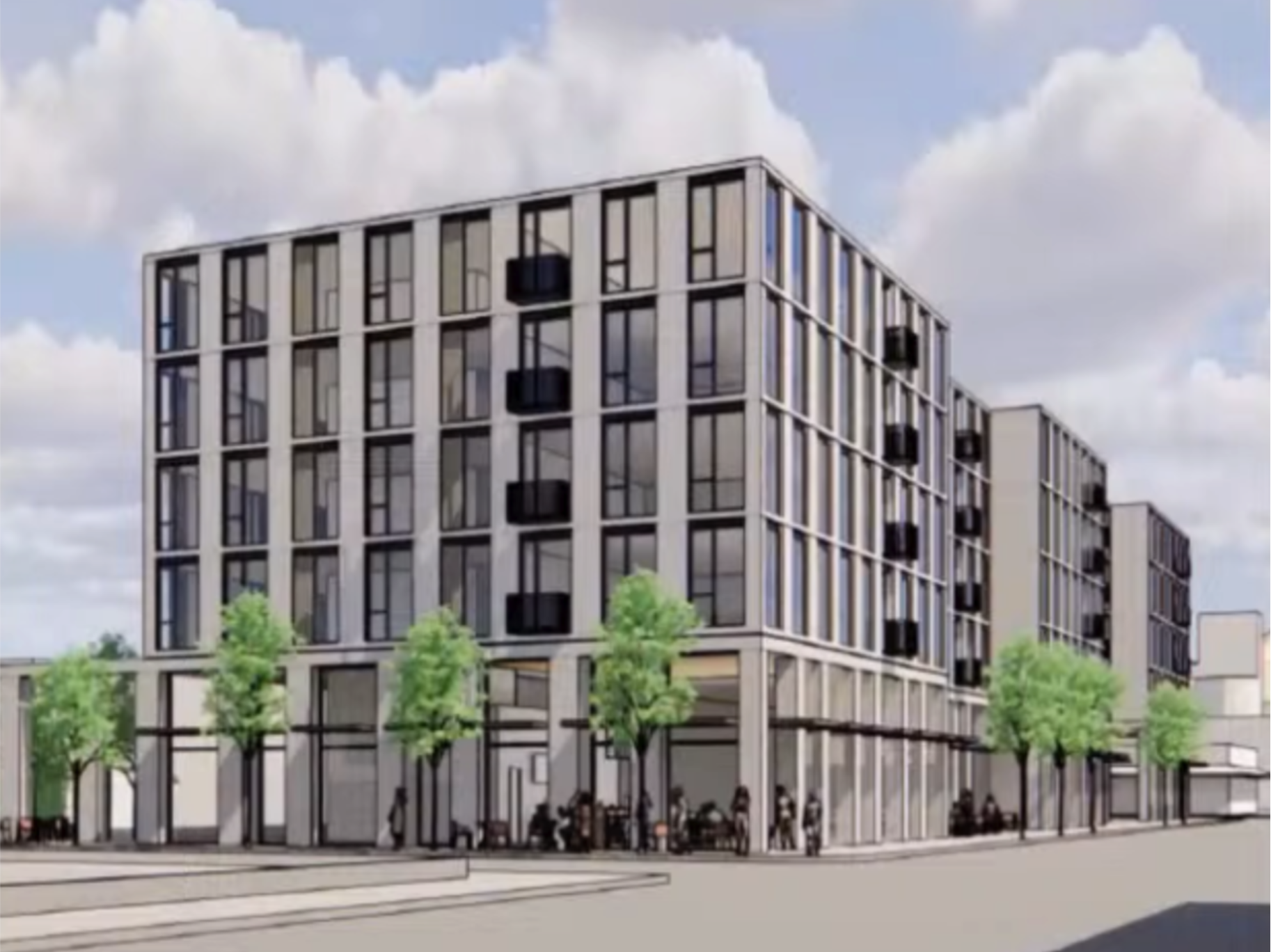
Renderings show the Basalt Commons on the former Griffith Motors site looking east in downtown The Dalles. The Board of Wasco County Commissioners agreed last week to purchase the property for $3 million to help finance the project as housing stocks fall short of the demand in The Dalles.
By Tom Peterson
The Dalles, Ore., April 6, 2026 — Wasco County commissioners approved a $3.08 million land purchase and leaseback agreement Wednesday, April 1, aimed at jumpstarting one of the largest downtown housing projects in decades — a 116-unit development known as Basalt Commons.
The project, estimated at around $31 million to construct, represents a rare opportunity to add large-scale housing downtown — something the city has struggled to achieve for decades — while testing a public-private financing model that could shape future development.
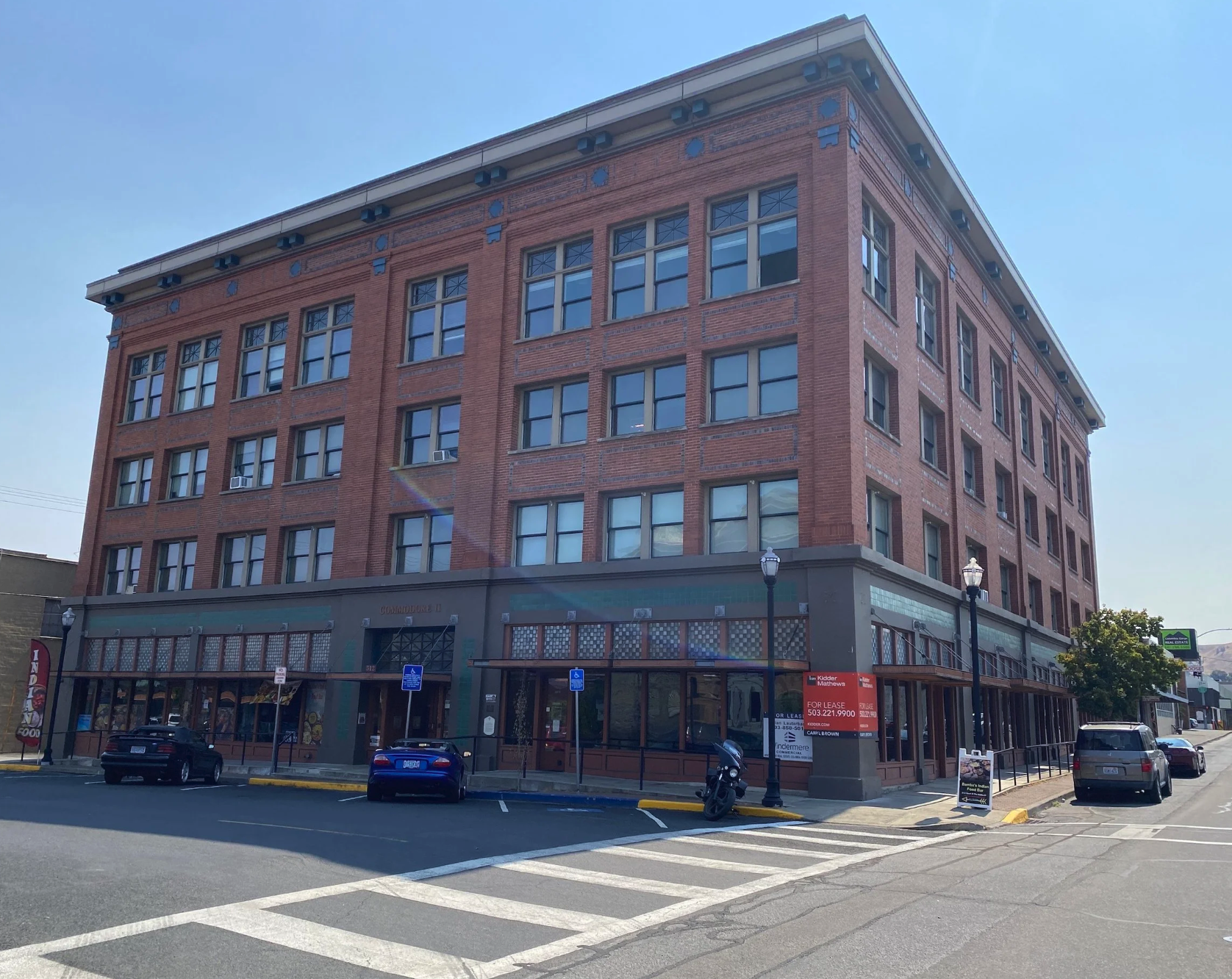
The 64-unit Commodore II at 312 Court Street is about half the size of the Basalt Commons project.
The proposed design for the building, is most similar in height to the Commodore at E. 3rd and Court Streets. The proposed design would anchor the east end of downtown The Dalles with a similar scale to the Commodore and would also have retail space for a brewery on the ground floor.
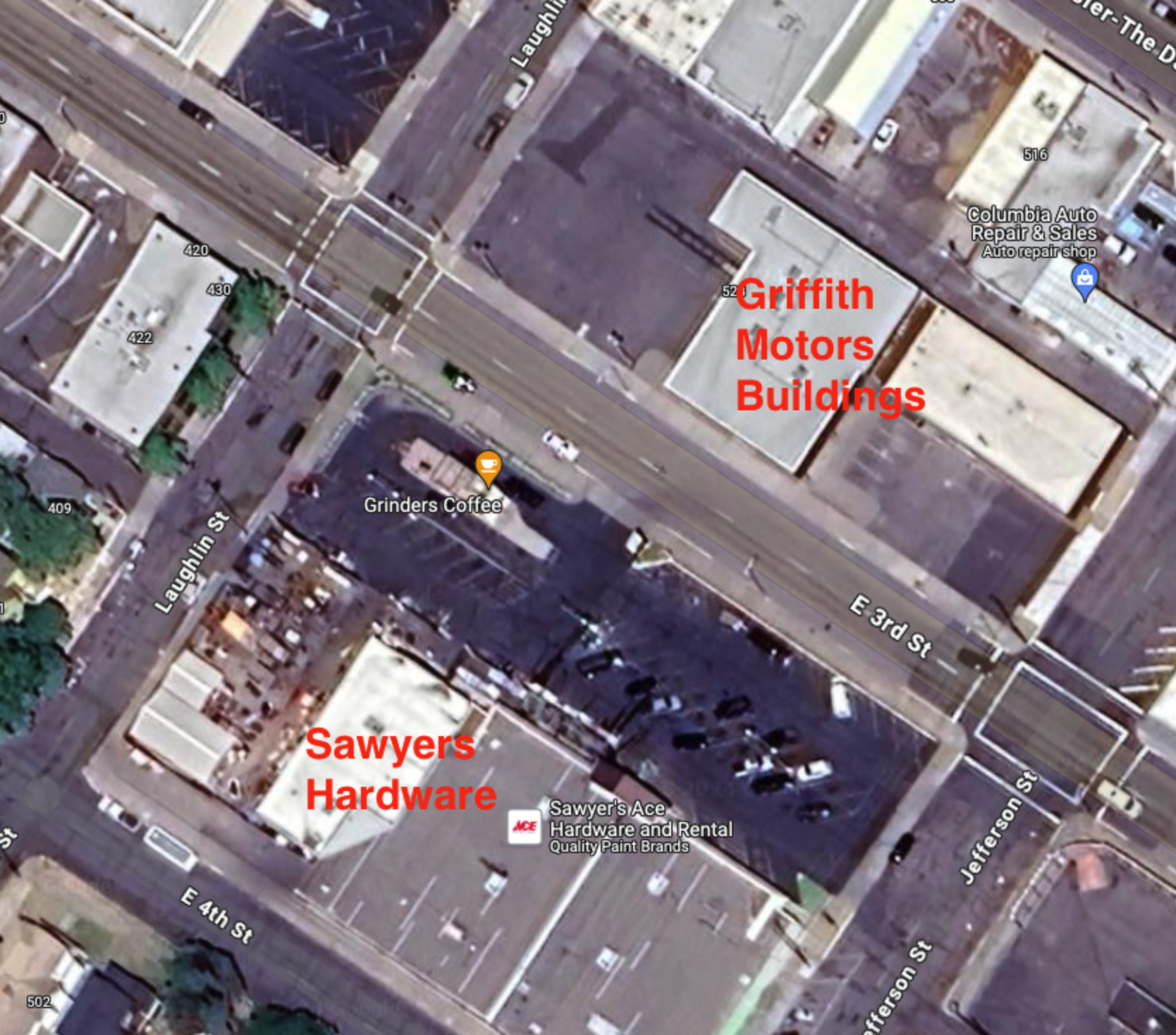
Three lots at the former Griffith Motors building at 523 E. Third Street have been consolidated to to construct the new five-story, multifamily, mixed-use development. on 0.7 acres.
The unanimous vote authorizes the county to purchase the property and lease it back to developer Mary Hanlon’s team, creating a financing structure officials described as critical to making the project feasible amid high construction costs and rising interest rates.
The decision directly targets what multiple speakers described as a worsening housing shortage in The Dalles, where more than half of existing housing is over 50 years old and home prices have doubled in the past decade.
Hanlon, of Hanon Development, told commissioners the project has been years in the making and reflects broader challenges facing housing construction.
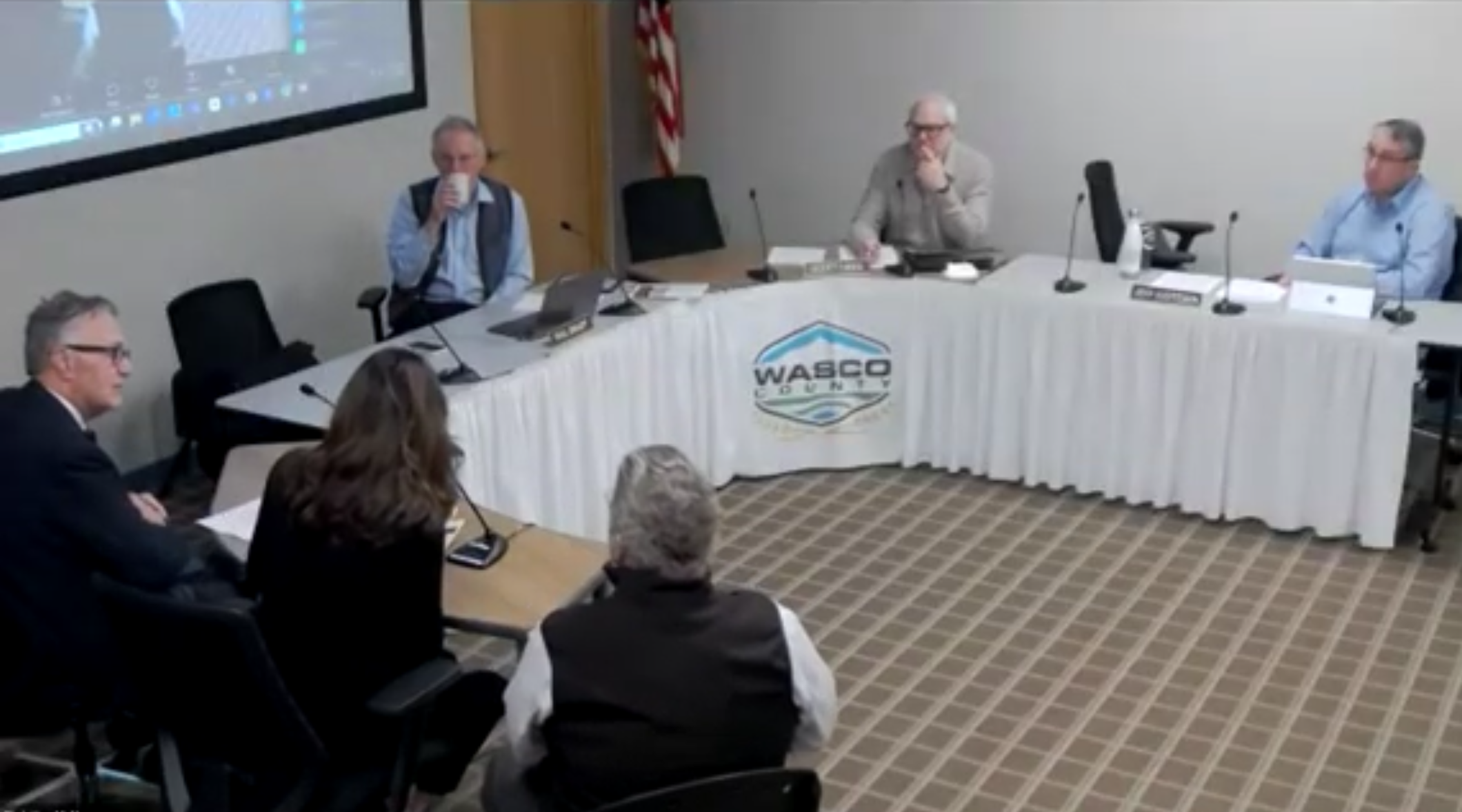
Mary Hanlon speaks to commissioners on Wednesday, April 1.
“This has taken eight years,” she said, citing rising costs and interest rates that have doubled over the past four years.
She told commissioners the development has Urban Renewal Agency funding in place, bank financing lined up and a determination from the Bureau of Labor and Industries that the project is not subject to prevailing wage requirements.
Hanlon said the next steps are critical to locking in the project’s finances.
She said the team is preparing to re-bid the project to confirm construction costs and finalize bank documents before moving forward.
She added that the site itself has sat vacant for at least 20 years and that only one new building has been constructed downtown in roughly the past 50 years — underscoring the significance of the proposal.
How the deal works
Under the agreement, the county will purchase the property for $3.08 million and lease it back to the developer for a 35-year term. The developer has the option to repurchase the land within the first five years for $3,180,000 - a $100,000 profit for the county. .
Lease payments are set at $12,833 per month, or about $154,000 annually, for the first five years, with a 3% annual increase thereafter. That equates to roughly a 5% return for the county — slightly above the current 4.7% rate offered by the state’s Local Government Investment Pool.
If the developer does not exercise the buyback option, the county would ultimately take ownership of the building at the end of the lease term.
County Administrative Officer Tyler Stone framed the deal as both an investment and a housing strategy, noting the return exceeds what the county would earn by parking funds in traditional public accounts.
Special counsel Darien Loiselle said the agreement meets public purpose requirements and includes personal guarantees from the developer to reduce financial risk.
Public investment and broader funding
The project also relies on a mix of public and private financing. The City of The Dalles Urban Renewal Agency is contributing approximately $1.73 million to the project if it is eventually financed and built.
This includes:
A $730,000 direct equity contribution to support project feasibility. The contribution was intended to help address a financing gap caused by elevated interest rates, construction inflation, and general risk associated with a major infill project in the downtown core and;
Up to $1,000,000 to pay residential system development charges. The funds will be paid directly to the City of The Dalles and the Northern Wasco County Parks and Recreation District upon issuance of building permits.
Basalt Commons Consultants emphasized that projects of this type — multi-story urban housing — are far more expensive than typical apartment construction and often require layered funding sources to pencil out.
Support: housing and economic impact
Supporters said the project is essential to addressing both housing shortages and economic growth.
Local Realtor and Planning Commissioner for The Dalles, Cody Cornet told commissioners he has seen repeated failed home searches due to limited inventory and rising costs, calling the 116 units “vital for job growth.”
Mayor Rich Mays described the project as a signal that new construction is possible downtown, adding it could create hundreds of construction jobs and dozens of permanent positions.
Jonathan Zilka, part owner of Shannon’s Ice Cream, also said the project would be a boon to downtown business owners such as himself.
City officials also noted the project aligns with prior approvals on height and historic character, and could include transit incentives such as free bus passes for residents.
Concerns: parking, public cost, and conflicts
Opposition focused on the scale of public investment, parking constraints and governance concerns.
Several downtown business owners argued that more than 100 housing units paired with roughly 30 on-site dedicated parking spaces could strain already limited parking and hurt existing businesses.
Bob Wickwire, owner of Downey Furniture, said the plan’s roughly 30 dedicated parking spaces for more than 100 housing units is insufficient, calling parking a “huge issue” that should be resolved before construction begins.
He said limited parking could hurt existing businesses and questioned whether the project’s design fits the city’s historic character, describing it as “totally out of place.”
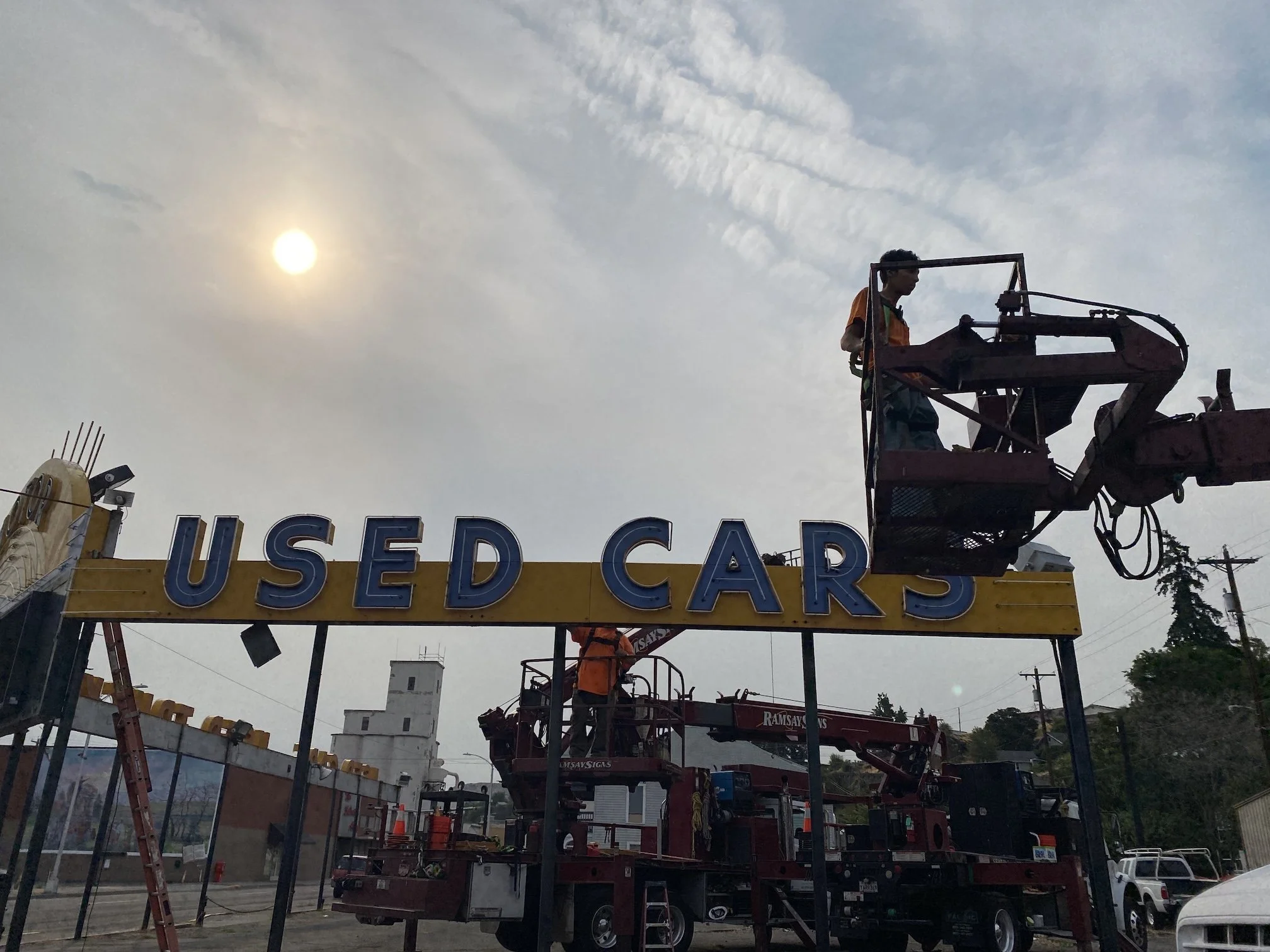
Vintage Used Cars signs have been removed from the property where the City of The Dalles intends to build a new public parking lot, caddy-corner to the Basalt Commons.
Officials with the city and County Commissioner Scott Hege, however, have countered that plenty of parking currently exists in public parking lots on First Street - about a 3 minute walk from the housing development.
Furthermore, the City of The Dalles has already begun investing in additional downtown parking capacity, including the acquisition of properties at 600 E. Third St. for a planned public parking lot. The lot is caddy-corner to the site of the Basalt Commons. While final costs vary depending on redevelopment and construction, the investment is expected to approach $1 million.
The project is intended to help offset long-standing parking constraints in the downtown core — an issue that has surfaced repeatedly in discussions surrounding the Basalt Commons development.
Randy Seufert questioned whether roughly $5 million in combined public support — including county, city and urban renewal contributions — is appropriate for a private development.
Seufert also said the project’s parking approach falls short of past standards, noting that smaller developments in the 1960s were required to include underground parking.
He challenged projections that the development would add only about 50 vehicles downtown and criticized the city’s parking studies as “flawed,” particularly assumptions that residents are willing to walk several blocks.
Concerns were also raised about Commissioner involvement across multiple boards tied to the project, though commissioners said the project had already undergone separate city review processes.
Residents also questioned whether construction costs are fully locked in, given continued volatility in interest rates and building expenses.
Kathy Bayer, a resident and downtown employee, raised concerns about financial certainty and accessibility.
Bayer questioned whether there are written guarantees that construction costs will hold and whether financing is secure given current interest rate volatility.
She also said the project’s parking limitations could be especially difficult for older residents, noting that those downsizing may struggle to carry groceries several blocks.
Bayer added that previous parking assessments may be misleading because they count available spaces without distinguishing between public and private parking.
Board discussion and vote
Commissioners ultimately framed the decision as a calculated but necessary step to address long-term housing needs.
Commissioner Phil Brady described the leaseback structure as an innovative “land trust-style” model that helps reduce development costs while protecting public investment.
Commissioners also pointed to lender involvement and financial vetting as evidence the project is viable.
The board unanimously authorized the purchase, lease and option agreement, contingent on final legal review.