
Wasco County locks $15 million into endowment built on Google-era revenues
By Joshuah Albert
The Dalles, Ore., Sept. 23, 2026 — Wasco County commissioners unanimously approved a plan Wednesday to put $15 million into a long-term endowment, choosing to bank a portion of the county’s extraordinary Google-era revenues for the future rather than spend the money now on infrastructure and other community projects.
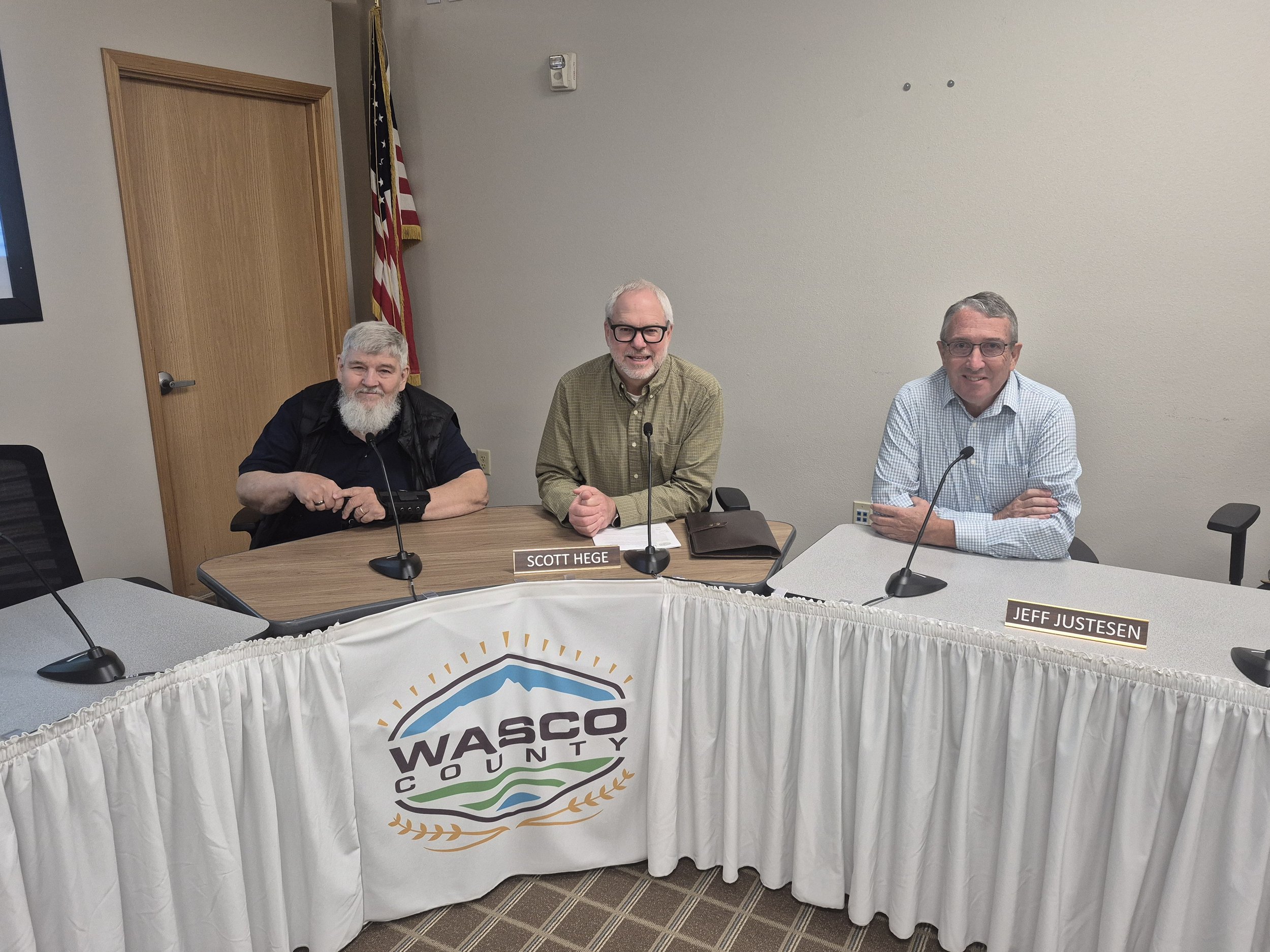
Commissioners Scott Hege, Jeff Justesen and Rodger Nichols voted to approve Ordinance 26-003, creating the Wasco County Community Endowment and Resiliency Fund after three public hearings and weeks of debate over how the county should handle an influx of revenue tied largely to data center development.
The county currently has about $40 million in reserves, Hege said. The plan would place $15 million into the new endowment as an initial investment, leaving roughly $25 million in county reserves.
“The county is not going to be broke if we do this,” Hege said. “After we do this, we're going to have a lot of reserves.”
The ordinance is designed to protect and grow the principal for 15 years, with county officials envisioning investment returns eventually providing a renewable source of money for core county services. County management argued that spending portions of the money now would reduce the power of compounding and could leave the fund too small to generate substantial long-term returns.
The decision came despite a request Wednesday from former Wasco County Commissioner Bill Lennox to postpone the vote and consider splitting the money between the long-term endowment and a second fund that could pay for infrastructure and other projects sooner.
Lennox said he strongly supports an endowment but questioned whether residents should have to wait 15 years to see more tangible benefits from the dramatic expansion of data centers around The Dalles.
“I do think, though, that maybe there's some opportunity here to really look at helping our citizens feel like they're getting a tangible benefit from some of the money that's coming from the data centers,” Lennox said.
Lennox pointed to growing public concern about water and electricity as the data center campus has expanded. He recalled the excitement surrounding the first data center in 2006 and contrasted it with today's much larger development.
“Now we're looking at an incredible campus,” Lennox said, adding that residents are concerned about dependable water supplies and increasing electricity rates.
He proposed dividing future money between the Community Endowment and Resiliency Fund and a separate “Wasco County Infrastructure and Opportunity Fund,” suggesting commissioners consider a split such as 75% for the endowment and 25% for nearer-term projects.
“There are going to be a lot of people that are alive right now that may not be alive in 15 years,” Lennox said.
He asked commissioners to delay adoption and study alternatives.
Commissioners declined.
County management said the strength of the proposal depends on protecting the principal long enough for investment growth to become substantial.
The county's management team has concluded existing revenues are sufficient to operate county government for the next 10 to 20 years, officials said, creating an opportunity to invest the new money rather than build county operations around revenue that may not exist indefinitely.
Hege compared today's data center economy with the aluminum industry that once dominated The Dalles. Aluminum provided jobs and economic activity for decades before largely disappearing.
“Today we have the money flowing, but we don't know about tomorrow,” Hege said.
He said people in the 1960s and 1970s could easily have assumed the aluminum industry would remain in The Dalles indefinitely.
“It isn't,” he said.
Hege said the endowment is intended to give future county governments something to rely on when economic conditions change.
“We're going to make sure that when — because it's probably when, it's not if — in the future there are challenges, that this community, this county and the people in this county are going to have something to rely on,” he said.
Ordinance changed after public comments
County officials did make one significant clarification before Wednesday's vote following concerns raised during earlier hearings about whether creation of the fund could affect money owed to schools, fire districts, libraries and other taxing districts.
The revised ordinance adds a definition of “county-retained revenues” explicitly excluding money that must, by law or agreement, be distributed to local taxing districts.
County counsel said the language makes clear that establishing the endowment “will not in any way alter, impact or divert” money going to those districts.
Officials described the change as a clarification rather than a substantive alteration of the ordinance. Other changes were clerical or involved renumbering sections.
The clarification addresses one of the central concerns raised during the Sept. 2 hearing, when residents generally supported establishing an endowment but questioned what revenues would go into it and whether taxing districts' shares were adequately protected. At that hearing, commissioners delayed final action until Sept. 23.
The county also plans to develop a permanent webpage where residents can follow the endowment's growth, review frequently asked questions and eventually explore what the fund could mean for Wasco County.
Commissioners defend waiting
Justesen said continuing the hearing would not necessarily produce a clearer answer because different attorneys, financial advisers and governments could all recommend different approaches.
“We've had a lot of input,” Justesen said. “I've had input to say move forward, it's a great thing. We've had input to say spend it now, and kind of everything in between.”
He said the county is already seeing benefits from the additional tax revenues through county services and investments including Kramer Field, the Oak Ranch RV project, fairgrounds and park improvements.
“I would love to see some benefits from it today,” Justesen said. “But I think we're already seeing some of the benefits.”
Nichols said the county's fundamental responsibility is maintaining core government services, including law enforcement, roads, public health, land-use planning, veterans services, prosecution, corrections and parole and probation.
He warned against allowing the endowment to gradually become a source for unrelated projects, comparing that possibility to Oregon Lottery revenues, which he said have been divided among an increasing number of uses since voters originally approved the lottery.
Nichols also said he had wrestled with the decision in part because he was appointed rather than elected to the seat formerly held by Phil Brady.
Nichols said he ultimately learned that Brady had supported the endowment concept in three separate votes on the Wasco County Budget Committee on May 7, shortly before Brady died.
“I fully believe in the endowment,” Nichols said.
Nichols was appointed July 15 to serve the remainder of Brady's term after Brady died May 19.
Hege emphasized that Wednesday's ordinance establishes a direction rather than permanently tying the hands of future commissioners.
Future boards will ultimately determine how money is withdrawn and spent once the endowment reaches the point where distributions can begin, he said. The ordinance itself also can be amended.
“The direction is not in stone, and an ordinance is not in stone,” Hege said. “Laws can be changed all the time.”
That flexibility appeared to ease some of Lennox's concerns.
After the vote, Lennox reiterated that he supported creation of the fund and thanked commissioners for making clear that future boards could revisit how the money is allocated.
“This is a big thing for our county,” Hege said after the vote. “Everybody's involvement has been greatly appreciated.”
The unanimous vote ends the series of public hearings and establishes the endowment. County staff's next steps include creating the public-facing website to track the fund, while the $15 million initial investment begins the longer process commissioners hope will turn today's unusual revenues into a permanent financial resource for future generations.
Support Local News!
Available for Everyone; Funded by Readers.