
Wasco County moves $15 million endowment plan forward; second hearing set for Sept. 2
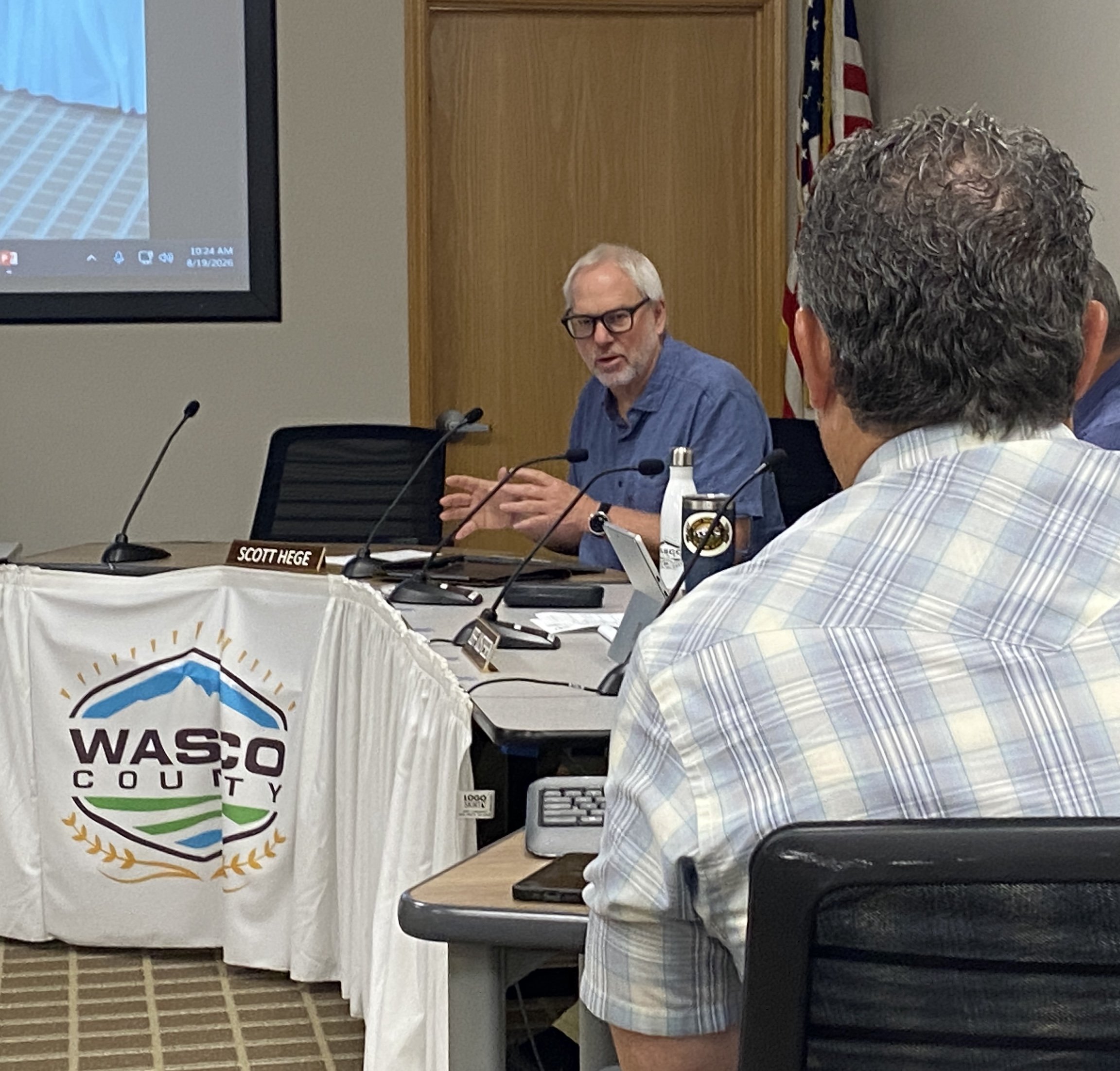
Wasco County Commission Chair Scott Hege discusses a $15 million endowment fund with Wasco County Administrative Officer Tyler Stone on Wednesday morning. The public is encouraged to comment on the ordinance before or during its second public hearing on Sept. 2.
By Tom Peterson
The Dalles, Ore., Aug. 19, 2026 — Wasco County commissioners unanimously moved forward Wednesday with a plan to turn millions of dollars generated by Google tax-abatement agreements into a long-term endowment designed to provide millions of dollars for Wasco County Projects starting in 2041.
The intention is to create a new stream of revenue for future generations as expectations of major jumps in property taxes to the county are expected in the next several years through three Google Data Centers.
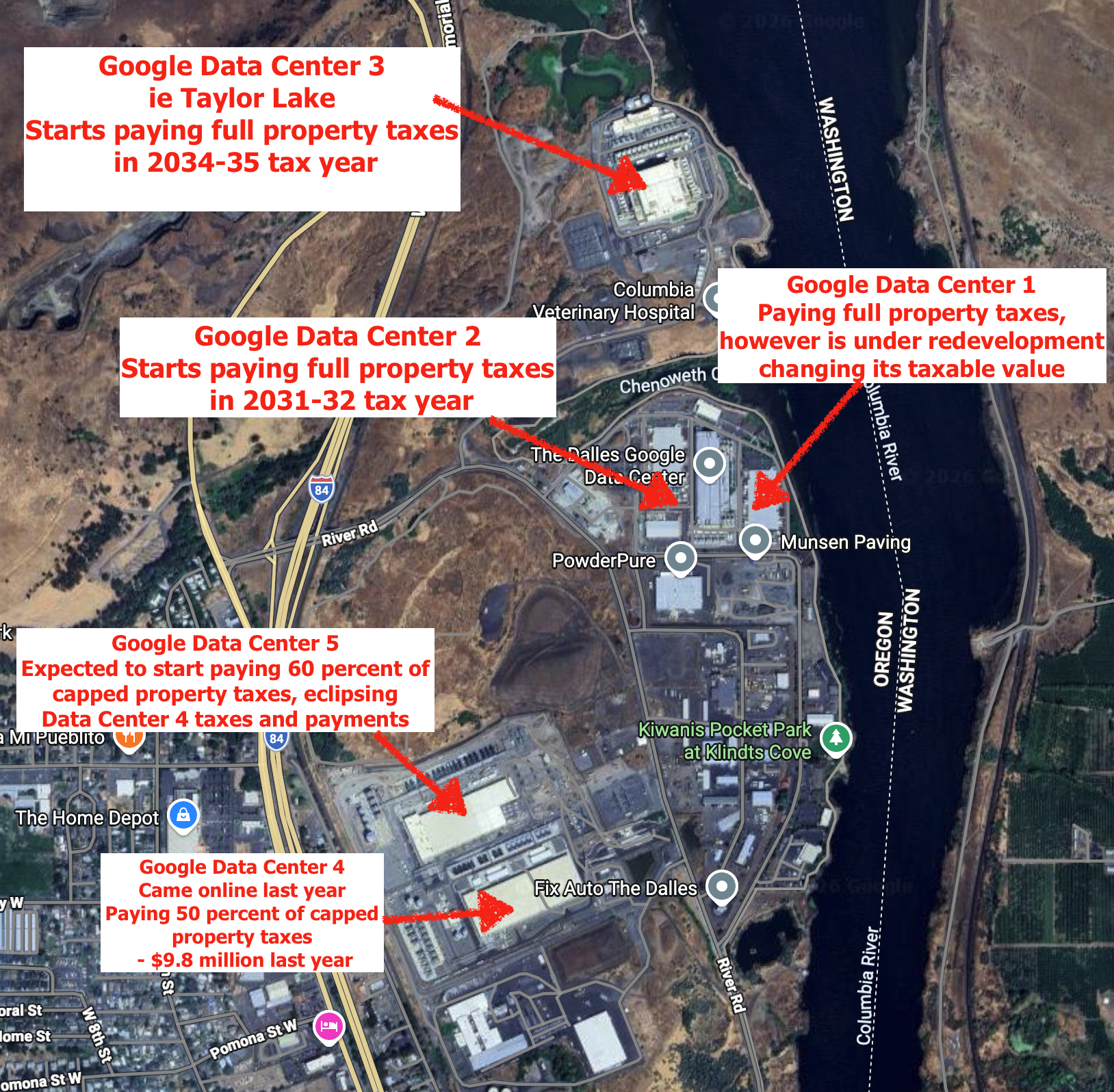
Data Center 1: Paid $4.7 million in property taxes 2025.
Data Center 2: Pays $800,000 annually, split among the City of The Dalles, Wasco County and School District 21. It is scheduled to go on the property tax rolls in 2031-32, paying millions of dollars in revenue to the county.
Data Center 3: Pays $1.81 million annually in fees split between the city and county. It is scheduled to go on the property tax rolls in 2034-35, paying millions of dollars in revenue to the county.
Data Center 4: Paid $9.81 million in fees, payments and property taxes in 2025.
Data Center 5: Still under construction. It is expected to pay more than $9.81 million annually in property taxes after receiving its certificate of occupancy some time in the near future.
Commissioners approved the first reading of ordinance following a public hearing and lengthy discussion of the proposal, which would initially place up to $15 million into the Wasco County Endowment and Resiliency Fund and generally prevent the county from touching the principal for 15 years.
A second public hearing is scheduled for Sept. 2. Commission Chair Scott Hege encouraged residents not to wait until that hearing to weigh in, saying commissioners and county staff are available in the interim to answer questions and hear concerns or suggested changes.
“Please don't wait till September 2nd and then start complaining about how fast we're going,” Hege said. “There's a lot of time between now and then. Please get to us.”
The proposal comes as millions of dollars from Google's data center tax-abatement agreements are accumulating in Wasco County. Under the ordinance, the initial investment would come from money already accumulated in the County Project Fund, with future county-retained payments from qualifying economic development agreements also directed into the endowment.
County officials stressed Wednesday that the proposal does not mean another $15 million would be added every year. The initial investment would be up to $15 million from money already accumulated, while future contributions would vary depending on payments received.
After the initial 15-year maturation period, the county could begin using up to 75% of annual investment earnings while leaving at least 25% invested to help the fund continue growing and keep pace with inflation. The principal would remain protected except under narrowly defined emergency circumstances.
County Administrator Tyler Stone said conservative modeling suggests the endowment could eventually produce roughly $2.5 million to $4.5 million annually after the maturation period, although he emphasized that future investment returns and contributions cannot be known with certainty.
Those earnings could eventually be used for county capital projects, economic development, grant matches, community projects and protection of core county services during difficult financial periods.
Community Development Director Kelly Howsley-Glover pointed to the county's aging bridges as an example of the type of enormous future expense the endowment could help address. Wasco County has identified 17 county-maintained bridges that will eventually need repair or replacement, representing an estimated $71.9 million in current costs. Even with available grant funding, she said, the county could face about $8 million in required matching funds.
Stone said the proposal has unanimous support from the county's management team. He said department heads believe the county can continue providing services over the next 15 years without spending the extraordinary revenue now being generated by tax-abatement agreements.
He described the decision to save rather than spend the money as unusual in government.
“We can do what we do with what we have today,” Stone said, describing the management team's position, “and we think that we should be able to put this money away so that future County is protected and has access to funds that they need.”
Hege made a similar argument, comparing the endowment with the county's shift toward requiring individual departments to live within their budgets and save for major future purchases rather than immediately spending available money.
He acknowledged that some residents believe the county should spend more of the Google-generated revenue now but said the county is attempting to balance current needs against long-term financial stability.
“We can spend every dollar we get every time we get a check or something and not think about the future,” Hege said. Instead, the county is trying to ensure it has “a good balanced financial future.”
Hege also pointed to the financial difficulties facing other Oregon counties as a warning against assuming today's strong financial position will last indefinitely.
“There are very few counties that are in a position of Wasco County's,” Hege said. “We're lucky to be where we're at.”
He said revenue sources can change and pointed to other counties that were once in stronger financial positions but are struggling today.
Investing in your own community
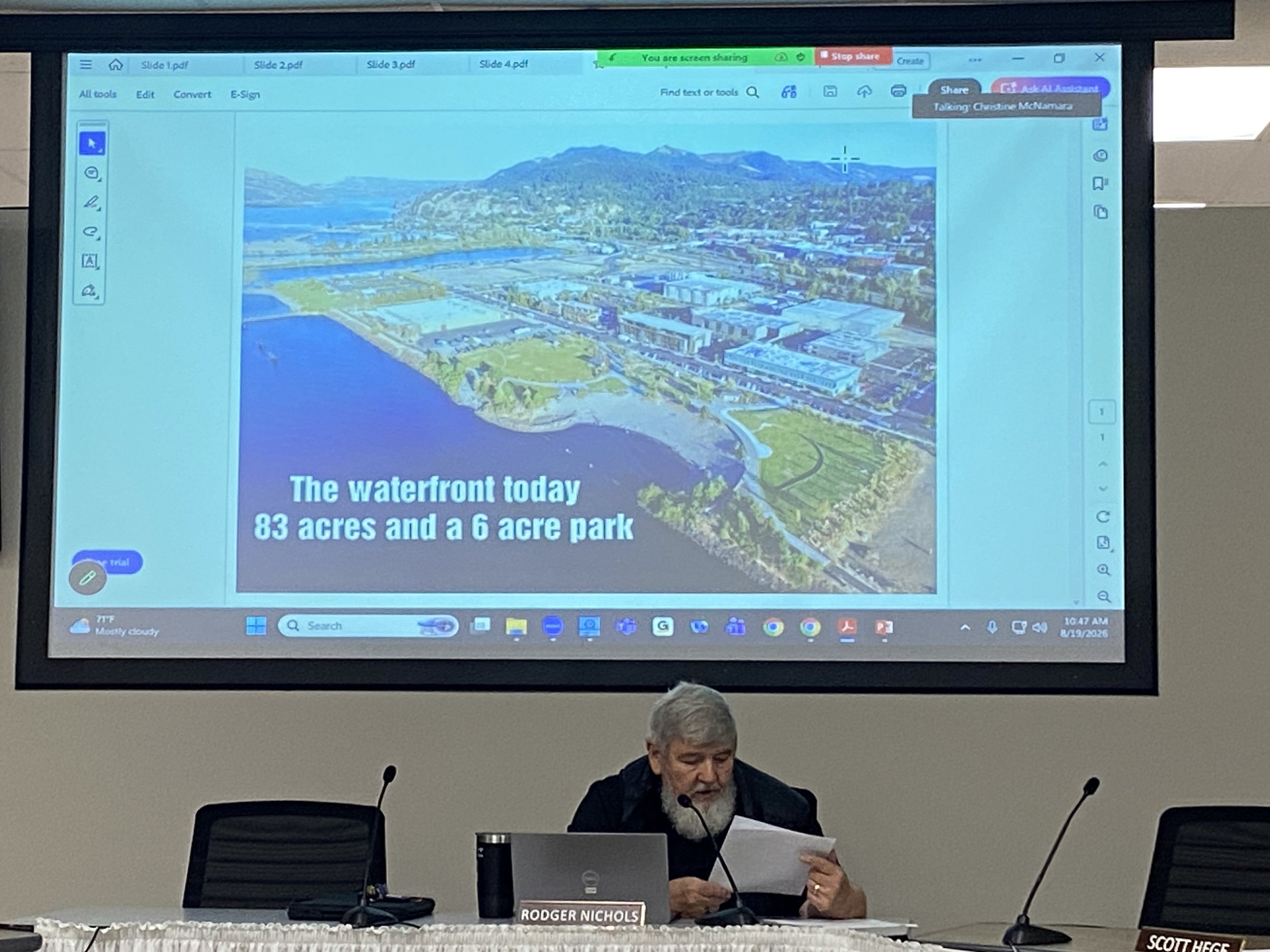
Rodger Nichols used 6 slides on the Port of Hood River to demonstrate the immense potential when a county invests in its own future as he put a vote toward creating a $15 million Wasco County Endowment fund.
Interim Commissioner Rodger Nichols compared the proposed fund to creating an annuity for the county — one that could eventually generate an independent income stream.
“What essentially we're doing is creating an annuity for ourselves that we pay into,” Nichols said. Once it begins paying out, he said, the county would have an income stream “no other government has” and one that belongs solely to Wasco County.
Nichols pointed to the Port of Hood River as an example of what long-term public investment can eventually produce. He traced the waterfront's transformation from essentially a single building — his grandfather's Nichols Boat Works, established in 1941 — to decades of public investment in land, fill and infrastructure that created 83 acres of buildable property, including a 6-acre waterfront park.
Nichols then pointed closer to home. In 1985, Dick Thomas and Al Wynn persuaded the Port of The Dalles board to put a $4.5 million bond measure before voters, he said. Voters approved it, allowing the port to clear land and build streets and infrastructure needed to attract development.
“It seems a better example of what happens when a community invests in itself,” Nichols said.
Today, Nichols said, the developed area supports more than 50 businesses and about 2,000 employees, with more than $1 billion in assessed value — an example he used to illustrate how an investment made by one generation can create economic value decades into the future.
Gambee urges more flexibility
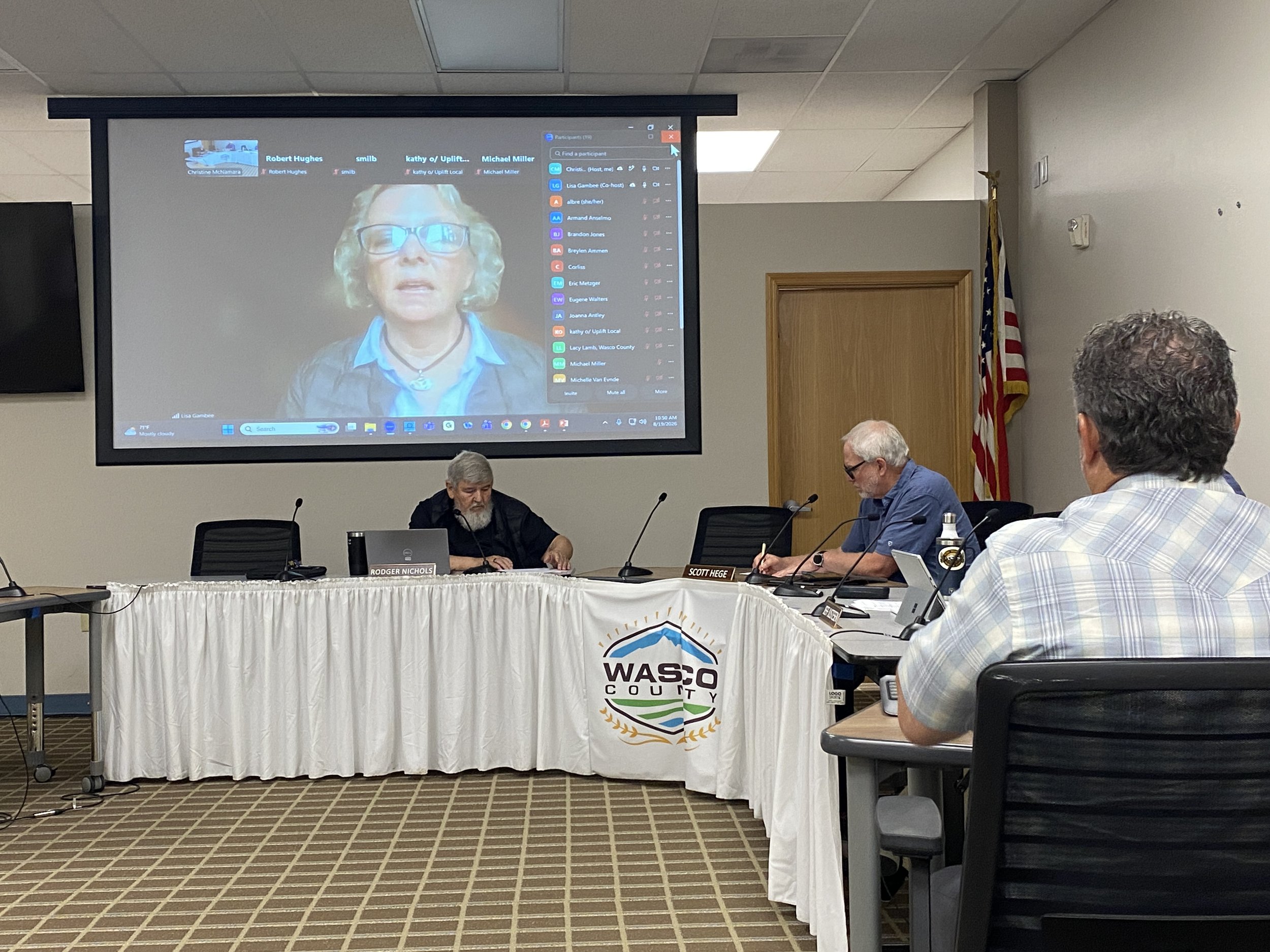
Lisa Gambee suggested the ordinance be less restrictive, allowing for money to be spent on pressing community needs.
The only concern raised during the public hearing came from Tygh Valley resident and county commission candidate Lisa Gambee, who said she supports the concept of saving for the future but questioned whether the proposed ordinance is too restrictive.
Gambee suggested commissioners consider directing some future payments into a separate resiliency fund that could be used sooner for pressing community needs rather than requiring all qualifying future revenue to remain invested for 15 years.
“My concern is that if we wait 15 years, there was a lot of great projects that were out there,” Gambee said, arguing that communities could face needs well before the endowment becomes available.
She pointed to the Grasshopper Fire as an example, questioning what would happen if a community such as Dufur suddenly needed county assistance to protect drinking water or other critical infrastructure.
Gambee also questioned whether the ordinance's catastrophic-emergency provisions are too restrictive and raised concerns about preserving the intent of today's commissioners and administrators as elected officials and county employees change over the next 15 years.
She urged commissioners to consider a “win-win” approach that preserves the long-term investment while allowing greater flexibility to address immediate community needs.
Commissioner Jeff Justesen said he was encouraged that county department heads — who potentially could benefit from having additional money available to their departments today — nevertheless support putting the money away.
Justesen compared the decision with personal investing, saying he wished he had invested differently when he began his career with Wasco County more than 35 years ago.
He also noted that some projects the county could pursue today could consume nearly all of the available money, leaving nothing to generate revenue in the future.
Hege emphasized that the ordinance is not yet set in stone and encouraged the public to read the proposal and provide feedback before Sept. 2.
The county is also developing an online tool that would allow residents to plug in different investment amounts and interest-rate assumptions to see how the proposed endowment could grow over time.
Following the public hearing, Nichols moved to approve the ordinance's first reading. Commissioners approved the motion unanimously, advancing the proposal to its second public hearing Sept. 2.
Who Would Control the Endowment Money?
The endowment would remain under local control, with county officials and citizens providing oversight and direction to Wasco County Finance Director Mike Middleton and the county's investment process. During Wednesday's discussion, county officials said Wasco County already has an investment committee and works with financial professionals to manage public investments.
One of the primary tools available to Oregon local governments is the Oregon Local Government Investment Pool, or LGIP, which allows counties, cities, school districts and other eligible public entities to pool money in the Oregon Short Term Fund managed by the Oregon State Treasury. About 1,000 local governments participate. The state says its investment priorities, in order, are preservation of principal, liquidity and yield. The fund invests primarily in high-quality, short-term fixed-income securities and is not invested in the stock market.
The LGIP is currently paying 4% interest, according to the Oregon State Treasury, although the rate changes with market conditions. The rate was as high as 5.3% in July 2024 before gradually declining to its current level.
That conservative investment approach is central to the county's endowment proposal: Rather than spend the Google-related revenues as they arrive, Wasco County would seek to preserve and grow the money over 15 years through compound earnings before allowing future commissioners to begin drawing from the investment income.