
Getting to the root of STEM: Chenowith kids transform school garden
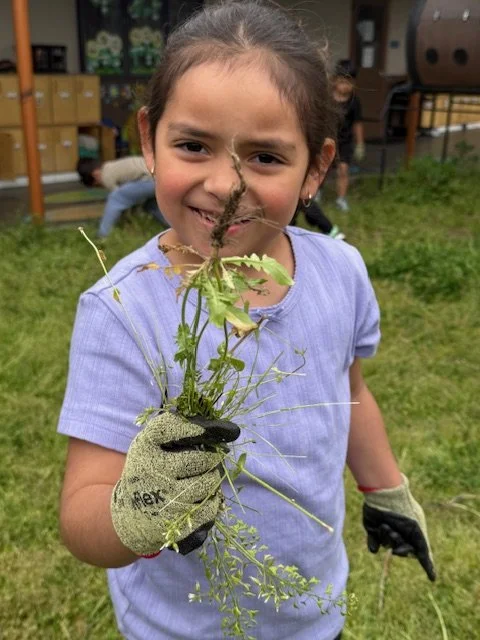
Look at how long this weed root is.
By Dana Greyson
The Dalles, Ore., May 27, 2026 — In an era where electronic devices and AI all-too-often hijack our brains and short-circuit human interaction, Chenowith Elementary School students are solidly bucking that trend.
Hands-on, down-and-dirty problem-solving takes priority as Chenowith’s students work together to revamp their school’s courtyard garden. They’re transforming mats of weeds, an unruly bramble of roses and other abandoned plants into a garden they can be proud of.
Jocelyn Paris spearheaded the Rural Schools Collaborative grant that got the project started. She’s a teacher on special assignment whose focus is to create deeper learning through hands-on projects that encourage students to use critical thinking skills. Her goal is to make the garden into a space for year-round exploration and discovery —for students, their teachers and the community.
The project kicked off on April 23rd, the day after Earth Day.

Because The Dalles is an agricultural, rural community, most students have had some exposure to growing things, though they may have limited access to a place of their own to do it. This garden serves as means of using their local environment as a starting point to a broader community and ultimately world view, while expanding their learning beyond textbooks. The school uses an interdisciplinary approach, blending math, science, social studies and language arts for the projects.
Garden time is a slot or tool that teachers can use to enhance any subject they are teaching. For example, pollinator classes in the garden provide an engaging framework for learning how to identify and describe plants, tools or direct tasks in English and Spanish. Measuring and mapping spaces in the garden lends itself well to math and more broadly offers another way to approach science, technology, engineering and math (STEM) challenges. At a simpler level, students might “spy” garden animals or participate in a scavenger hunt to find objects that measure five inches or start with the sound “guh.”
Before they work in the garden, students are taught a specific lesson in class. Then they build on it, directly applying what they learned by doing. As they identify and solve real-life problems, they develop community stewardship and a sense of their capability to contribute and make change. Clearing the raised beds and adding compost provided was inspired by finding a place to plant the sugar snap peas the students started indoors, observing the seed to sprout cycle.

The garden plan is made up of four distinct garden spaces: pollinator, sensory, local native plant and fire-wise. The sensory garden is being planted now, with textural plants like soft lamb’s ears and spiky ones like agave. They can “pet” the lamb’s ears, while learning to watch out for the agave. Sage, rosemary and sweet peas are there for taste, with lemon balm, verbena, and lavender for scent. As some Chenowith students lost their home to the Rowena fire, the fire-wise garden literally hits home by demonstrating the benefits of fire-resistant plants and materials.
Dirt Huggers, a local compost and soil supplier, generously contributed compost. Mosaic art and ceramic pots created by other Chenowith classes will grace the garden. The school also partnered with Wasco County Master Gardeners Association (WCMGA) as advisors as well as other experts, but the students run the show. Their teachers and advisors provide the general direction—for example making a garden bed ready for plants, and how to use the tools. Then the adults step back and let the students figure out how to do it.
“The students ask us how to do something,” Jocelyn says, “and we’ll reply with, ‘What ideas do you have?’ and they get to work on them. They are more efficient solving problems on their own.”
The students aren’t shy about asking each other for help, and their peers don’t hesitate to take action. “Hey, someone come help me carry this bag of soil! Thanks. You grab this side and I'll get this side,” Jocelyn overheard.

“The students are so eager to work in the dirt,” says Hilary Jensen, Master Gardener and Community Horticulture Coordinator. “We found worms, identified fly larvae. We showed them how to pull weeds, how to prune roses and tree suckers, and more. The kinders were all thrilled every time they got a good root.” She adds “My heart is full! Working directly with the community, providing hands-on education, has always been my favorite part of being a Master Gardener,” she adds. The Master Gardener Program is part of Oregon State University’s Wasco County Extension Services.
Julia Tidwell is a WCMGA volunteer helping out on the project. When her now-grown children went to Chenowith Elementary, they were not allowed to walk on the grass, much less tear it out for a garden, or go to town with a pair of rose pruners.
“We showed them how to use shovels to get out the grass that goes for miles… And they got excited about seeing the worms in the soil, “Julia chuckles. “The students are enthusiastic about everything.”
Garden bugs like roly-polies (known as also pillbugs) delight them. One class raised monarch butterflies…and the gardeners found two on the rosebush in the garden They met with bee experts and loved spotting bees on flowers in the garden. When a spider was discovered, a student leapt its to “Don’t kill it!” the student insisted. “It’s good. Make sure that spider is safe.”
Jack Alsheimer is a dual language kindergartener who works on the garden. His mom Kelsey, a Master Gardener, helped bring WCMGA aboard. She’s already noticed Jack shows a much clearer understanding of the whole process of how plants grow and is more engaged and excited about gardening. He planted marigold seeds on Earth Day, which hold special cultural meaning for Latino holidays like Día de Muertos. The marigolds are now growing in their family’s garden.
“The students are awesome about taking ownership to clean up that space. They’re doing the hard work first, Hilary says. “Digging out weeds. Hauling dirt and moving rocks. Laying down cardboard mulch. They’re excited about who can pull out the longest root. They were pulling out grass runners that were taller than they were. Seven students worked together on it. Some held back the landscape fabric, while others were pulling the long tendrils out. Watching their teamwork is inspiring.”
Week after week students come back and build on what they learned. They can tell the difference between weeds and plants and know their names. They remember that weeds like vetch…’will hurt your skin if you rub against it.’ They remember how to use their shovels safely.
”A lot of schools create projects that they don’t get to see though…such as vegetable gardens that don’t get harvested while the students are still in school,” Hilary explains. “This is a pilot project for us and for Chenowith. It’s a multi-year project, and more of a marathon than a sprint. We’re slowly helping them learn how to develop this into a year-round garden. They learn from start to finish what it takes to get a garden space ready; their teachers are learning alongside. It’s a perfect fit with our community education goal—we’re advisors. We aren’t there to do maintenance, but we’re happy to get down in the dirt with the students.”
Chenowith’s garden is intended to be an ongoing program, however the Rural Schools Collaborative grant was a small grant for this year only. The school is seeking additional sources of funding and partnerships to continue to evolve the program as there was a pond the school hoped to revamp, but it was determined to be structurally unsound and would require expensive engineering to be usable. Other desired projects in search of funding include a water feature for the fire wise garden and a calm seating area that anyone in the school could use as a place to take time to connect with nature. Longer term still, Chenowith would like to add a community garden with a greenhouse.
“The kids love it,” agrees Jocelyn. “Working in the garden is their favorite time of the week. We remind them it’s a learning space, and they are welcome to use it as such.”