
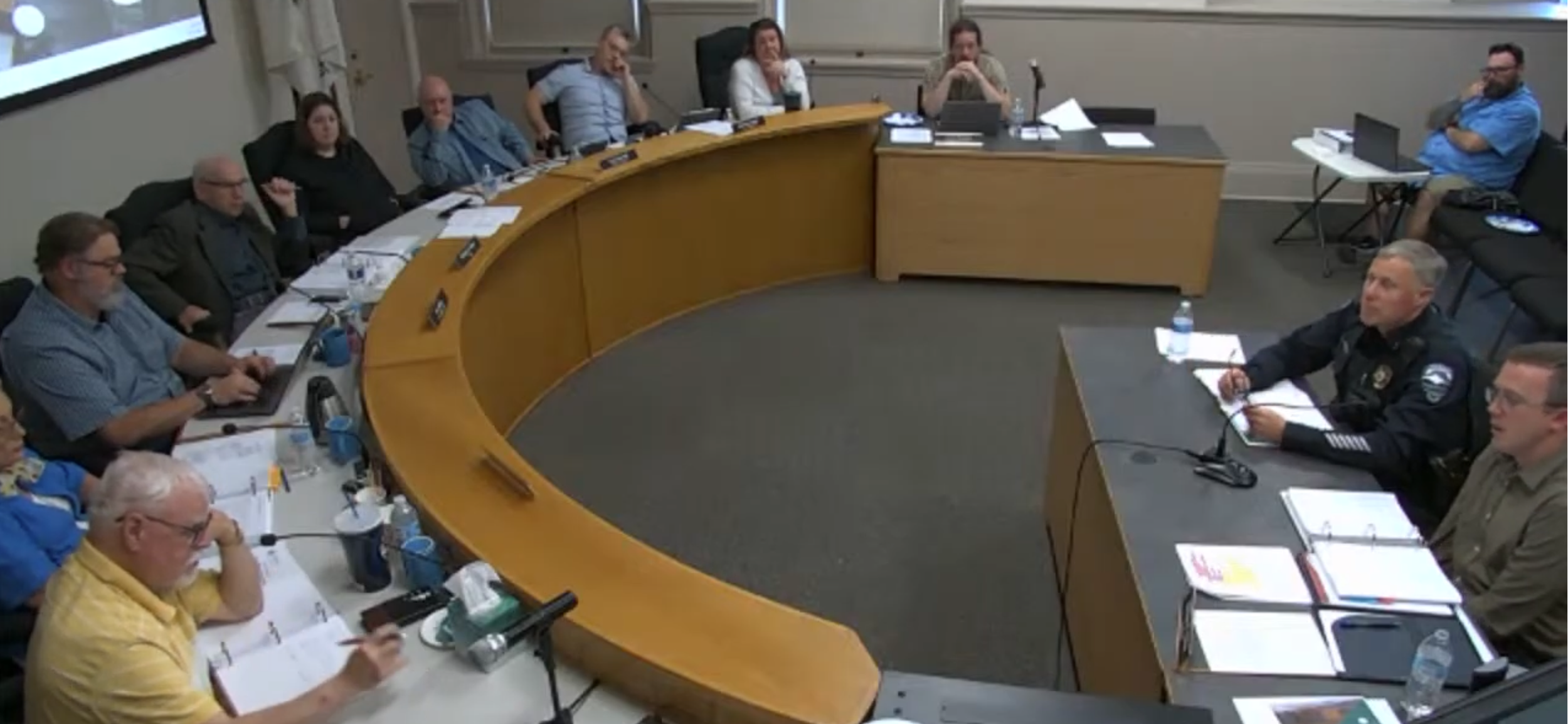
City of The Dalles Budget Committee members hear from Police Chief Tom Worthy and City Manager Matthew Klebes on Tuesday, May 12, as the committee reviewed the police budget and discussed setting aside funds to protect the city during a potential economic downturn.
The Dalles, Ore., May 15, 2026 — City of The Dalles Budget Committee members dove into police spending as well as a proposed $2.75 million rainy day fund for the city during the second and final day of reviewing the projected 2026-27 fiscal year budget before ultimately agreeing to send the proposal to the City Council for final approval in June.
The proposed budget — which includes roughly $20.8 million in General Fund expenditures and approximately $69 million across all city funds — will shape everything from police staffing and emergency preparedness to street maintenance, water infrastructure, parks, tourism promotion and long-term capital projects. Budget decisions made during the process determine which projects move forward, which services are maintained and where the city believes future risks and opportunities lie.
Committee members voted Tuesday, May 12, to recommend approval of the proposed budget, approve the city’s permanent property tax rate of $3.0155 per $1,000 of assessed value and forward the package to the City Council for formal adoption before the new fiscal year begins July 1.
Much of Tuesday’s discussion focused on the police department budget and the city’s efforts to modernize aging public safety technology.

The Dalles Police Chief Tom Worthy
Police Chief Tom Worthy told the committee the department responded to 18,264 calls for service last year while continuing to focus on staffing stability, traffic enforcement and community policing.
“How many of those is it okay for us to get wrong?” Worthy asked the committee while discussing the pressure officers face responding to emergencies. “None. We can’t get any wrong.”
Worthy said the department is currently fully staffed — something he described as increasingly difficult in modern law enforcement because certified officers can often move quickly between agencies offering higher pay or better equipment.
“If you’re a certified law enforcement officer in Oregon, you can go to work wherever you want,” Worthy said.
A major portion of Tuesday’s discussion centered around the city’s long-planned CAD/RMS modernization project — shorthand for the police department’s computer-aided dispatch and records management system.
Worthy described the city’s current software as severely outdated.
“Our current CAD system looks like we’re playing Oregon Trail,” Worthy said.
The project is expected to modernize police reporting, dispatch coordination, evidence management and electronic ticketing systems throughout the department.
Worthy acknowledged the project has experienced delays after issues with the vendor’s original project management team, but said city and county partners remain committed to launching the new system later this year.
“We could have forced forward and gone live at the end of June,” Worthy said. “But that would have been at the detriment of the project.”
The police budget also includes funding for:
body camera leases,
radio infrastructure maintenance,
electronic ticketing systems,
tactical response equipment,
officer wellness programs,
regional drug enforcement participation,
and ongoing accreditation reviews.

City Manager Matthew Klebes
Earlier in the meeting, City Manager Matthew Klebes outlined the reasoning behind a proposed new “service continuity fund” — effectively a city emergency reserve account intended to help stabilize operations during major economic disruptions such as recessions, pandemics or major industry downturns.
For example, Google is now the largest property taxpayer in Wasco County and to the City, as it is working toward a bringing a fifth data center online. If that industry were to cycle downward it would have major impacts on local tax revenue.
The proposal would transfer $2.75 million from the city’s beginning General Fund balance into the reserve during the upcoming fiscal year.
Klebes said the reserve is designed to protect city services if major revenue losses occur unexpectedly, particularly as the city becomes increasingly reliant on revenue connected to large industrial employers and data centers.
“This service continuity fund will allow us to remain stable while we evaluate and make choices in response to that qualifying event,” Klebes said.
Committee members questioned whether the reserve could eventually be used to offset known funding shortages in areas such as transportation, but Klebes said the fund is intended specifically for unexpected emergencies rather than ongoing structural budget problems.
“This is truly looking at having a source of resources for those truly unexpected situations,” Klebes said.
Finance Director Brita Meyer also reviewed the city’s primary revenue sources, noting that franchise fees and property taxes continue to form the backbone of the General Fund, while recent growth has been heavily influenced by Google data center development and related agreements.
City officials emphasized during the meeting that the proposed budget does not include an increase to the city’s permanent property tax rate.