
By Ken Polehn
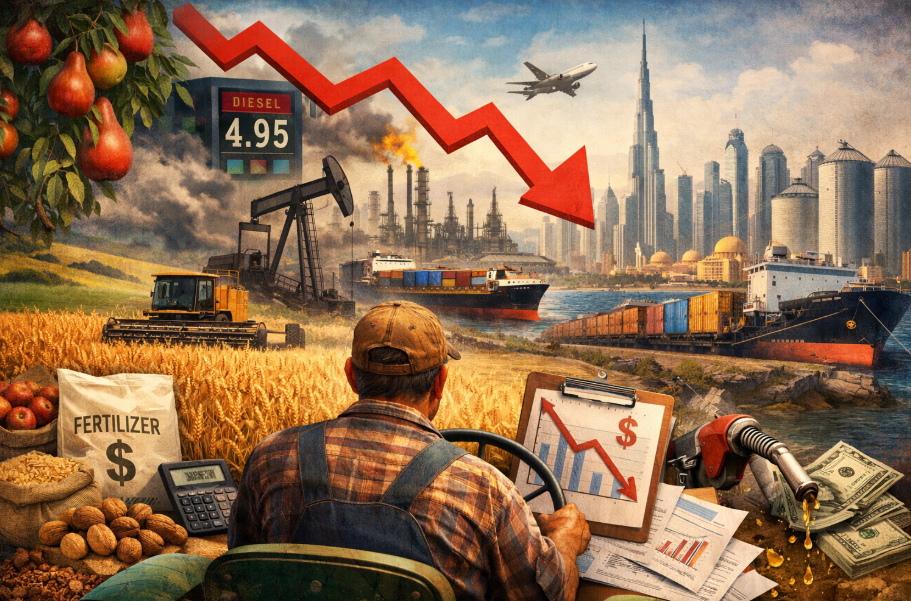
The Dalles, Ore., March 14, 2026 — From the tractor seat, agriculture often comes down to a very simple equation: costs on one side, returns on the other. For many farmers today, that equation is becoming harder and harder to balance.
Across the Pacific Northwest, the cost of producing food continues to rise while farm-gate returns — the price farmers actually receive — remain unpredictable and, in many cases, historically low. Adjusted for inflation, the prices farmers receive at the farm gate remain historically low even as grocery prices continue to climb. That widening gap is creating real pressure on farms that have operated successfully for generations. The story is local. But much of it is global.
In many cases, farmers are producing more food with better technology than ever before — yet earning less real income from that work than previous generations.
Modern agriculture depends on energy, fertilizer, and transportation systems that stretch around the world. Diesel fuels tractors and harvest equipment. Fertilizer production depends heavily on natural gas. Packaging materials, machinery parts, and even some crop protection tools move through international supply chains.
When those systems tighten — because of war, energy disruptions, or shipping instability — costs move quickly upward.
Farmers notice it almost immediately.
At the same time, the crops we grow here in the Pacific Northwest are deeply tied to global markets. Wheat from eastern Oregon and Washington moves down the Columbia River to export terminals. Apples, pears, cherries, and nuts from the Northwest are packed, cooled, and shipped across oceans to consumers in other countries.
For decades, those international relationships have helped sustain Northwest agriculture.
Markets in the Middle East — including the United Arab Emirates and places like Dubai — have long been important destinations for Northwest fruit and agricultural products. Pears, apples, wheat, nuts, and other crops from our region have found strong demand there. Those markets helped diversify sales beyond North America and allowed growers to reach consumers who value the quality of Northwest production.
But international trade only works when transportation, energy, and global stability allow food to move freely.
When shipping costs rise, when fuel becomes more expensive, or when geopolitical tensions disrupt trade lanes, those markets can become more difficult to reach. Even small disruptions can ripple through the agricultural system.
For wheat growers, the global grain market can shift quickly depending on production and political stability around the world. For fruit growers, timing is everything. A delayed shipment or disrupted export channel can mean lost opportunities in markets that depend on fresh product arriving at just the right moment.
Meanwhile, the costs of producing those crops continue to climb.
Fuel, fertilizer, labor, equipment, transportation, regulatory compliance — every part of the farming system has grown more expensive. Yet the share of the food dollar that returns to the farm often remains surprisingly small.
Consumers see rising prices at the grocery store, and understandably they assume farmers must be benefiting. The reality on most farms looks very different.
Agriculture has always required resilience. Farmers adapt constantly to weather, markets, and new technology. But when costs rise faster than returns for extended periods of time, even the most efficient operations begin to feel the strain.
The Pacific Northwest remains one of the most productive agricultural regions in the world. Our wheat feeds global markets. Our fruit is known for its quality. Our farms have built relationships across continents.
But those systems depend on stable trade, stable transportation, and economic conditions that allow farmers to keep producing.
From the tractor seat, the numbers are impossible to ignore. Costs continue to climb. Markets remain uncertain. And the global systems that agriculture depends on are under more strain than they have been in decades.
Food security ultimately depends on more than just the ability to grow food. It also depends on whether farmers can continue to make the economics work.
Because when the math stops working on the farm, the consequences eventually reach far beyond it.
From the tractor seat, the math is becoming harder to ignore. Northwest farmers continue to grow some of the most abundant food in the world, but the system that supports that abundance — fuel, fertilizer, transportation, and global trade — is under increasing strain. If that balance continues to shift, the consequences will eventually reach far beyond the farm.

Support Local News!
Available for Everyone; Funded by Readers.