
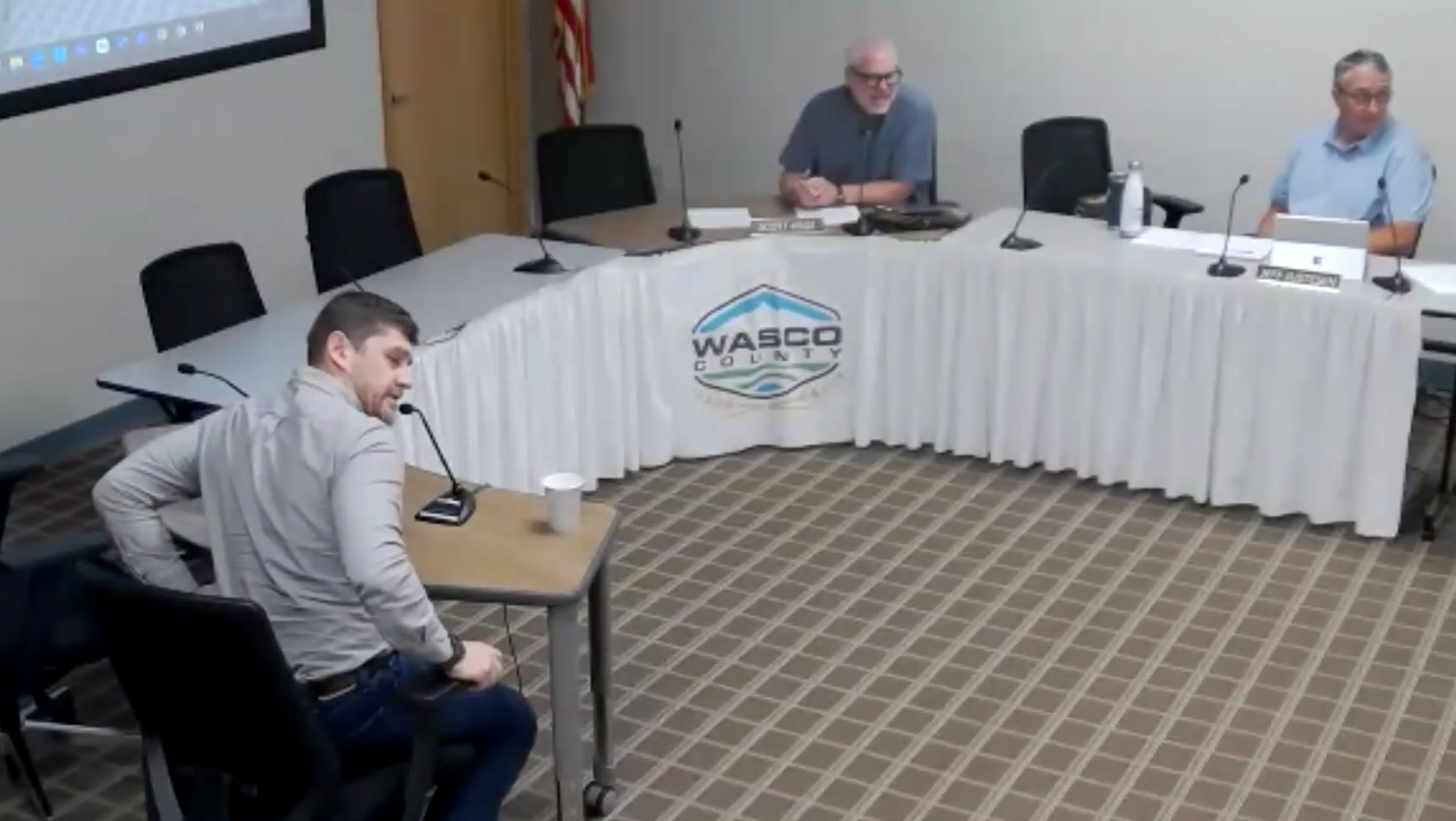
Wasco County Planning Director Daniel Dougherty told Commissioners Scott Hege and Jeff Justesen about rural roads - many were created decades ago without a long-term plan for ownership or maintenance. The work is being done to improve evacuation routes in emergency situations.
The Dalles, Ore., July 17, 2026 — Wasco County has completed a sweeping assessment of more than 120 miles of rural roads that could become critical evacuation routes or firefighting corridors during wildfires, giving emergency officials their first countywide tool for identifying where access problems and heavy vegetation pose the greatest risks.
The Public Access Road Inventory and Fire Risk Assessment examined publicly dedicated roads that are not maintained by the county, including narrow and unimproved routes serving rural subdivisions and isolated communities. Planning Division Director Daniel Dougherty said many of the roads were created decades ago without a long-term plan for ownership or maintenance.
The project used vehicle-mounted, 360-degree cameras to document road conditions and surrounding vegetation. Staff then scored each road based on its surface, width, shoulder condition, firebreaks and nearby population density.
Road segments were classified as needing no improvements, minor improvements or significant improvements. The resulting interactive map can show whether a road itself is in poor condition, whether vegetation creates an elevated fire risk, or both.
The assessment is not a legal road map or professional engineering survey, Dougherty said. Instead, it is intended to help fire districts, emergency managers and policymakers prioritize evacuation planning, vegetation work and future grant applications.
“If we don’t know what the conditions of these roads are, it’s hard to plan for evacuations,” Dougherty told commissioners. He said some roads also could be used as strategic fuel breaks during wildfires.
The county received approximately $78,000 from the Oregon Department of Emergency Management for the project and finished below that amount. Staff said the map is still being refined with zoning, property and other information before it is more widely distributed.
Rural fire districts and the Oregon Department of Forestry participated in the review, comparing the preliminary rankings with conditions crews have encountered on the ground. County officials said discussions about using the information to pursue road and fuel-reduction funding are already underway.
Emergency communications upgrades approved
Commissioners also approved two agreements intended to modernize the county’s emergency dispatch system and reduce delays when agencies from different jurisdictions respond to the same incident.
The county will join the Portland Dispatch Center Consortium, commonly called PDX, allowing its new computer-aided dispatch system to electronically exchange calls and updates with other participating dispatch centers.
Wasco County 911 Manager Krista Silver said dispatchers currently must telephone neighboring agencies when requesting ambulances, fire crews or law enforcement assistance. Under the new system, incident details can be transmitted directly from one dispatch system to another.
Silver cited Mosier as an example. Mosier Fire can respond to an emergency, but an ambulance may need to come from Hood River. The new connection would allow Wasco County dispatchers to send the call electronically to Hood River instead of making a separate telephone call and having another dispatcher re-enter the information.
Fifteen Oregon counties were participating in the system at the time of the meeting, Silver said. The total regional package is expected to cost about $30,000 annually, divided among Wasco County, the city of The Dalles, The Dalles Police Department and Mid-Columbia Fire & Rescue. Wasco County’s initial share was described as just under $5,500.
Commissioners unanimously approved the five-year agreement.
The board separately approved up to $97,500 for Adcomm Engineering to continue managing implementation of the county’s new computer-aided dispatch and law-enforcement records system.
Chief Deputy Scott Williams said the consulting company has helped manage the project, track vendor commitments and coordinate numerous technical connections, including state crime databases and crash-reporting systems. Without the consultant, Williams said the county would likely need a full-time employee dedicated to the project.
The new system is expected to go live in October. The expense is shared by Wasco County, the city of The Dalles and Mid-Columbia Fire & Rescue and is included in their budgets.
The board also accepted a $32,363.87 Oregon Department of Emergency Management Homeland Security grant to equip a backup mobile dispatch vehicle with digital radios, a Starlink connection and networking equipment.
County radio technician Stephen Lloyd said the tri-band radios will allow the mobile dispatch center to communicate with numerous agencies and radio systems during an emergency.
Regional energy plan targets outages and disaster preparedness
Commissioners unanimously adopted a regional energy resilience plan developed with Hood River, Sherman, Gilliam and Wasco counties.
The roughly 400-page plan identifies energy infrastructure, natural hazards, vulnerable populations and critical facilities that could benefit from backup power, weatherization or other improvements. It also includes 17 community profiles, county-specific emergency fuel plans, maps and potential projects that local governments and organizations can use when seeking grants.
Community outreach found that most residents would prefer to remain at home during a disaster, making home weatherization and the ability to maintain safe indoor temperatures important resilience strategies. Residents identified municipal buildings and schools as preferred places to seek shelter or assistance when remaining at home is no longer possible.
Wildfires were the top concern identified during public outreach, followed by winter storms. Aging infrastructure, including roads and bridges, and gaps in emergency communications were also identified as major barriers.
The plan highlights the Gloria Center in The Dalles as a local example. The center received Oregon Department of Energy funding for solar panels, battery storage and a natural-gas generator intended to keep the facility operating during a power outage.
County Emergency Manager Sheridan McClellan said the plan will be shared with local agencies and posted online. Its findings can be used to strengthen grant applications for projects such as backup power systems, community shelters and home weatherization.
Public-record requests prompt software upgrade
County officials are also preparing to purchase Granicus software to manage a growing volume of public-record requests.
The county currently handles requests manually, with procedures varying among departments. The new online system would route requests to the proper department, track legal deadlines, send automatic reminders, handle communications and invoices, and allow county counsel to monitor requests across the organization.
The Sheriff’s Office alone received 495 public-record requests during the past fiscal year, Finance Manager Shayla Maki said.
The one-year agreement will cost just under $15,000, followed by an anticipated 5% annual increase. Commissioners were briefed on the purchase but were not required to vote because it can be approved administratively. County department directors and information-technology staff supported moving forward with the system.
Insurance savings and county finances
The county’s insurance representatives reported that risk-management efforts produced about $40,000 in workers’ compensation savings this year. Approximately $32,000 resulted from the county’s claims-experience rating, while another $8,000 came from an improved insurance tier.
Representatives said the county’s use of a higher liability deductible has saved approximately $178,000 in premiums over the past decade. The county also renewed $3 million in internal cyber coverage and $2 million in errors-and-omissions coverage for technology work performed for outside agencies. Its annual cyber premium is approximately $36,000.
Finance Director Mike Middleton reported that county investment earnings reached approximately $2.83 million for the fiscal year, about 4.6% more than the previous year and 134% of the budgeted amount.
Public Works moved $125,000 from its road reserve to cover petroleum costs that came in higher than budgeted. Middleton also said the Rowena wildfire debris-removal project is expected to finish slightly below the county’s approximately $3.5 million grant award.
The figures remain unaudited and could change as the county records final revenue and expense accruals.