
Critics Question Google Tax Breaks as New Data Center Delivers $9.8M Locally

The new data center at River Road chipped in $9.8 million in Wasco County in 2025 in taxes and fees, boosting local services and creating an economic development nest egg for city and county officials.
By Tom Peterson
The Dalles, Ore., March 6, 2026 — Property tax revenues and negotiated fees from Google’s newest data center at 3500 River Road in the Port of The Dalles have nearly doubled early projections, according to Wasco County tax records.
The facility, which became operational in 2025, generated about $9.8 million in taxes and fees in its first year — far exceeding estimates made when city and county officials negotiated tax agreements with the company in 2021.
Those revenues are flowing into local taxing districts, boosting funding for schools, libraries, fire protection, parks and other public services.
If all Google properties in Wasco County are combined, the company paid nearly $13 million in taxes and fees in 2025, making it the county’s largest taxpayer.
Early Estimates
Back in 2021, officials theorized the new data center would carry an assessed value of roughly $600 million when negotiations began under Oregon’s Strategic Investment Program, a state incentive designed to attract large industrial investments. It is a number that Google has repeated about data centers in multiple locations in the United States.
At that valuation, projections suggested the facility would generate about $5.45 million annually in taxes and fees.

Wasco County Tax Assessor Jill Amery
Wasco County Tax Assessor Jill Amery said those early projections were based on the best information available at the time.
“When people were forecasting numbers four or five years ago, they were actually a little conservative. We didn’t know what the future held at that point,” Amery said.
“It would have been irresponsible for us to say it was going to be something higher when we didn’t have that information yet.”
Instead, the project’s total real market value — including buildings, machinery, equipment and business personal property — reached roughly $1.2 billion once construction was complete.
“The real market value went over a billion once the building, machinery, equipment and business personal property were included,” Amery said.
Understanding this Latest Google Deal
Property tax — Under Oregon’s Strategic Investment Program, projects exceeding $1 billion in investment have their taxable assessed value capped at $100 million for 15 years, even if the total project value is significantly higher.
A. Even though the data center’s total value is about $1.2 billion, the taxable value is capped at $100 million under the Strategic Investment Program.
B. Based on that capped value, the project generated $1.55 million in property taxes in 2025.
C. The Community Service Fee is set at 25 percent of the property tax savings created by the tax abatement and is capped at $2.5 million annually. Because the calculated amount exceeds the cap, the Community Service Fee is $2.5 million.
D. The remaining portion of the negotiated payment becomes the Guaranteed Annual Payment (GAP), which ensures the company pays a minimum 50 percent of its taxes through the combination of taxes and fees. For the 2025 tax year, the GAP totaled $5.76 million and it is split equally between the city and county.
Conclusion:
$1.55 million Property Taxes
$2.5 million Community Service Fee
$5.75 million Guaranteed Annual Payment
= $9.8 million in total annual taxes and fees generated by the one new data center.
According to Amery, both the Community Service Fee and the Guaranteed Annual Payment for the data center were paid Dec. 31, 2025.
Together, those two payments accounted for about $8.2 million of the $9.8 million generated by the facility in 2025.
Breaking Down the Community Service Fee
The Community Service Fee alone generated $2.5 million, which was distributed among local taxing districts.
The distribution formula was established through a 2022 intergovernmental agreement among 11 taxing districts after the City of The Dalles, Wasco County and Google finalized the Strategic Investment Program agreement.
Local districts agreed to divide that payment using a fixed percentage formula and made the decision to help local schools. North Wasco County School District 21, which was not entitled to the money under state law, was cut in by the other districts to receive the largest share.
The $2.5 million Community Service Fee generated in 2025 was distributed as follows:
• North Wasco County School District 21 — $752,500 (30.1%)
• Wasco County — $610,000 (24.4%)
• City of The Dalles — $432,500 (17.3%)
• Mid-Columbia Fire & Rescue — $302,500 (12.1%)
• Wasco County Library District — $97,500 (3.9%)
• North Wasco County Parks & Recreation — $97,500 (3.9%)
• Wasco County Education Service District — $67,500 (2.7%)
• Columbia Gorge Community College — $40,000 (1.6%)
• Wasco County 4-H and Extension — $35,000 (1.4%)
• Wasco County Soil and Water Conservation District — $35,000 (1.4%)
• Port of The Dalles — $30,000 (1.2%)
Google Goes # 1
The combined payments have reshaped the county’s list of top taxpayers.
Google — whose local holdings appear under multiple entities including Design LLC — now ranks as Wasco County’s largest taxpayer, paying about $4.7 million in property taxes alone.
That total is roughly $3.6 million more than the county’s second-largest taxpayer, Northern Wasco County PUD, which paid about $1.14 million.
Criticism of World’s Third Wealthiest Company
The Strategic Investment Program agreements have also drawn criticism from some residents who argue that one of the world’s largest companies should pay property taxes on the full value of its facilities.
Local leaders say the program, administered through Business Oregon, is designed specifically to attract large industrial investments that might otherwise locate in other states.
Their argument is that even with the tax cap, the projects generate millions of dollars in new annual revenue that did not previously exist for local governments and taxing districts.
Stability
Amery said counties that host data centers often experience more stable government finances as a result.
“When you look at counties around the state, some of them are doing layoffs,” Amery said. “When you look at our revenue, we’re healthy.”
Where should all those GAP dollars go?
Even as the first new data center begins generating millions in annual revenue, local officials are still working out how some of that money will ultimately be spent.
Much of the discussion centers on the Guaranteed Annual Payment, or GAP, which generated about $5.75 million in 2025 and is split evenly between Wasco County and the City of The Dalles.
Those funds were negotiated as part of the Strategic Investment Program agreement to ensure local governments receive a predictable level of revenue while the project receives partial property tax abatements.
However, local officials have not finalized long-term plans for how those funds should be used, and discussions about priorities continue at both the city and county levels.
More on the Way
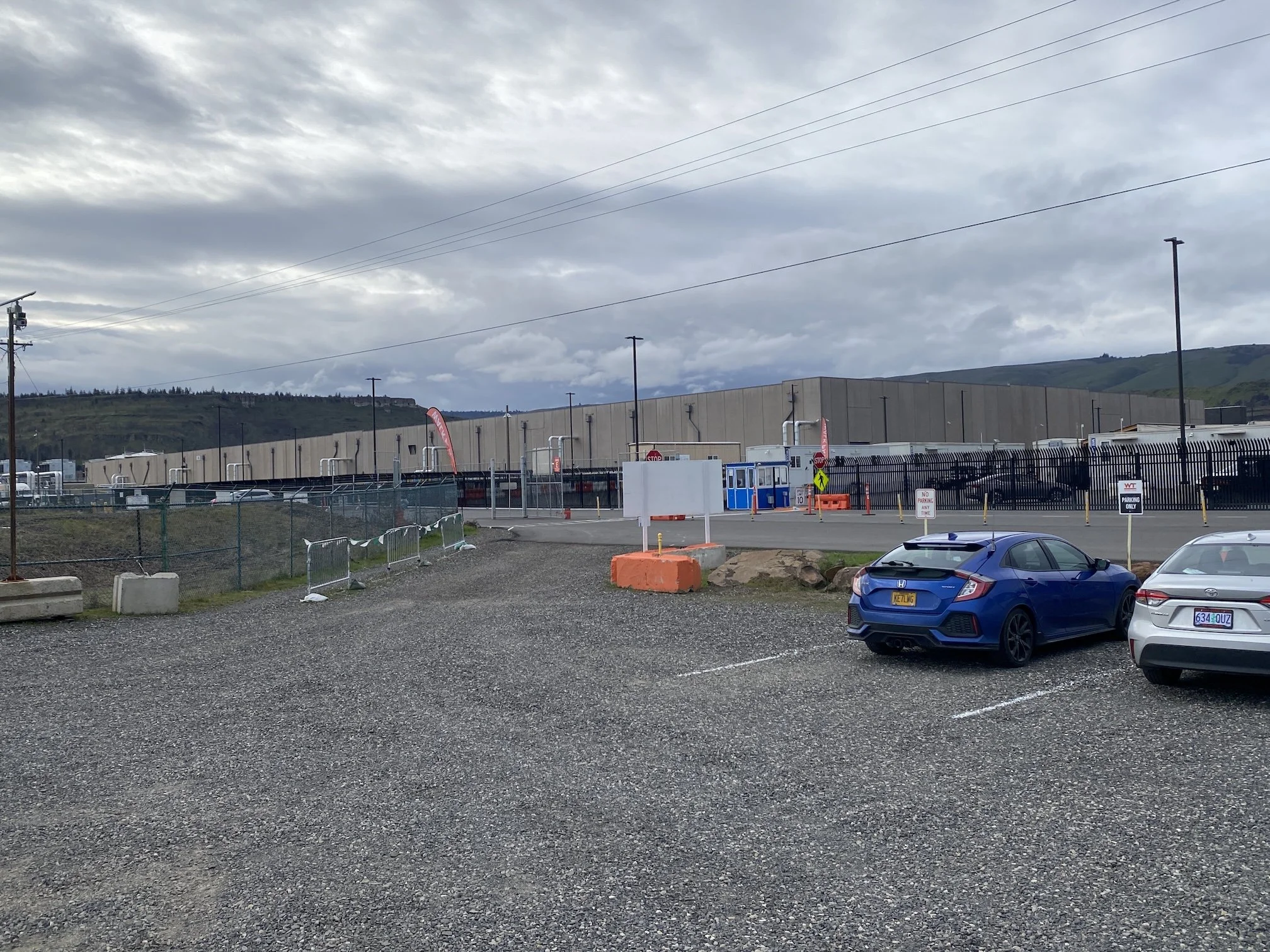
Operable new Google data center at 3500 River Road on March 6, 2026. There is another one on the way right next door.
Meanwhile, Google is already well into construction of a second data center on the former aluminum plant property in the Port of The Dalles.
The second facility is expected to be roughly the same size as the data center that began operating in 2025 and falls under the same Strategic Investment Program agreement negotiated in 2021.
There is one key difference.
While the first data center was structured to pay the equivalent of about 50 percent of its property taxes through a combination of property taxes, community service fees and guaranteed payments, the second project is required to pay about 60 percent of its property taxes through those same mechanisms.
If the investment reaches a similar valuation as the first project, the second data center could generate even more annual revenue for local governments and taxing districts.
Construction is already underway, and once completed — likely within the next year or two — the facility could add more than $9.8 million annually in taxes and fees to local budgets.