
Thoughts from the Tractor Seat: Two Lines, One Story
Thoughts from the Tractor Seat By Ken Polehn
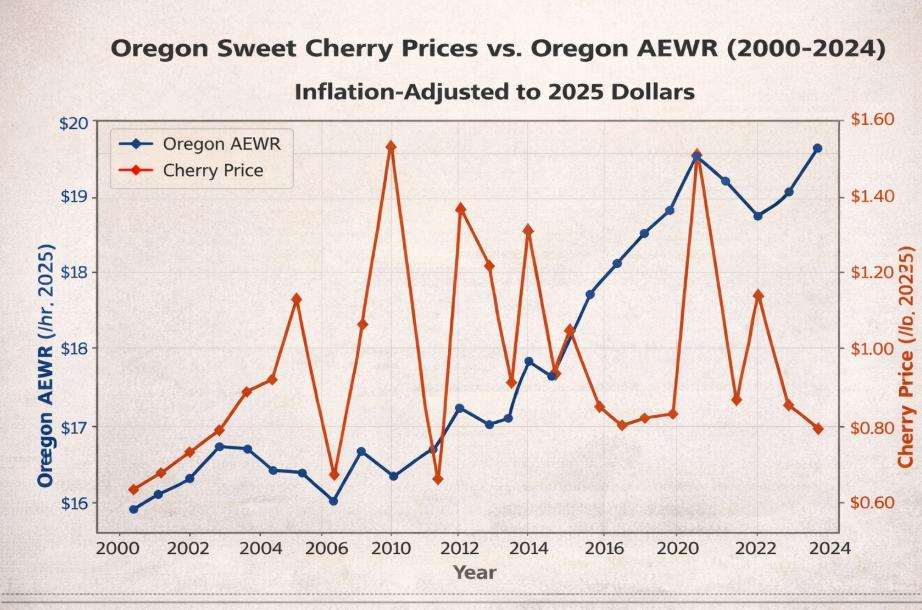
The Dalles, Ore., March 7, 2026 — I was looking at a simple chart the other day. Two lines. Twenty-five years. Oregon data.
Ken Polehn
One line shows the required wage rate for agricultural workers hired through the federal H-2A program. The other shows the inflation-adjusted price of Oregon sweet cherries over the same period.
The wage line moves steadily upward.
The cherry price line rises and falls — sometimes sharply — but over time, it stays mostly flat.
You don’t need to understand farm policy to understand what that means.
The blue line — the wage line — represents the Adverse Effect Wage Rate. It’s the minimum hourly wage farms must pay seasonal guest workers. It was designed to protect domestic workers by ensuring foreign labor does not drive wages down.
Over the past twenty-five years, adjusted for inflation, that wage has climbed from roughly the mid-teens per hour to nearly twenty dollars per hour in Oregon. Especially in the past decade, it has risen steadily and predictably.
The red line — cherry prices — tells a different story. Some years are strong. Some are weak. Weather, export demand, global supply, and consumer buying patterns all affect the price. But over the long stretch, adjusted for inflation, the average price per pound hasn’t steadily increased.
One line climbs. The other wobbles.
That gap is where farms live.
Most consumers understandably assume that if costs go up, businesses simply raise prices. That works for a restaurant or a contractor. It doesn’t work that way for most farmers. We don’t set the national price of cherries. We harvest when the fruit is ready and accept the market that exists.
Labor is the single largest cost in many specialty crops. Cherries must be picked by hand. Pears must be picked by hand. They are delicate and perishable. You can’t run them through a combine like wheat.
When the largest expense in your business rises steadily, but the price you receive for your product does not rise at the same pace, the margin narrows. Quietly at first. Then structurally.
This isn’t about resisting fair wages. Skilled agricultural labor is demanding work. Experienced crews matter deeply to quality and food safety. A stable workforce benefits everyone.
But the graph isn’t making a moral argument. It’s showing arithmetic.
If required wages increase every year regardless of market conditions, and fruit prices continue to swing up and down without long-term growth, the pressure doesn’t disappear. It forces adjustment.
Sometimes that adjustment looks like fewer acres planted. Sometimes it looks like older orchards are not being replaced. Sometimes it looks like consolidation into larger operations that can absorb thinner margins. Sometimes it looks like more imported fruit filling the gap.
From a grocery aisle, none of this is obvious. Shelves still appear stocked. The system feels abundant. But abundance rests on margins that have to work season after season.
That simple chart is not dramatic. There are no political slogans attached to it. Just two lines moving in different directions.
One rising steadily.
One drifting sideways.
At some point, every farm family looks at a graph like that and asks a practical question: can we continue to grow this crop here under these conditions?
That question matters beyond the farm. It affects rural jobs, local economies, regional food production, and long-term resilience.
Two lines on a page may seem abstract. But behind them are real decisions — about planting, hiring, investing, and whether the next generation will keep farming at all.
The chart doesn’t tell us what policy should be. It doesn’t argue for or against any single solution.
It simply shows where the pressure lives.
And in farming, ignoring pressure rarely makes it go away.
About the Author
I was born in 1961 into a second-generation farm family in The Dalles. I grew up on a tractor seat, moving irrigation pipe with my sisters before school, and spent my summers picking cherries alongside the children of migrant families who returned year after year. My wife, children, and parents have all worked the same land. I’ve served as county Farm Bureau president, sat on the county fair board, and continue to support 4-H and FFA. I’ve seen firsthand what happens when farmers are squeezed out—not just of business, but of the conversation.
Support Local News!
Available for Everyone; Funded by Readers.