‘Once In A lifetime’ Endowment gets more time for review; Commissioners set to pull trigger
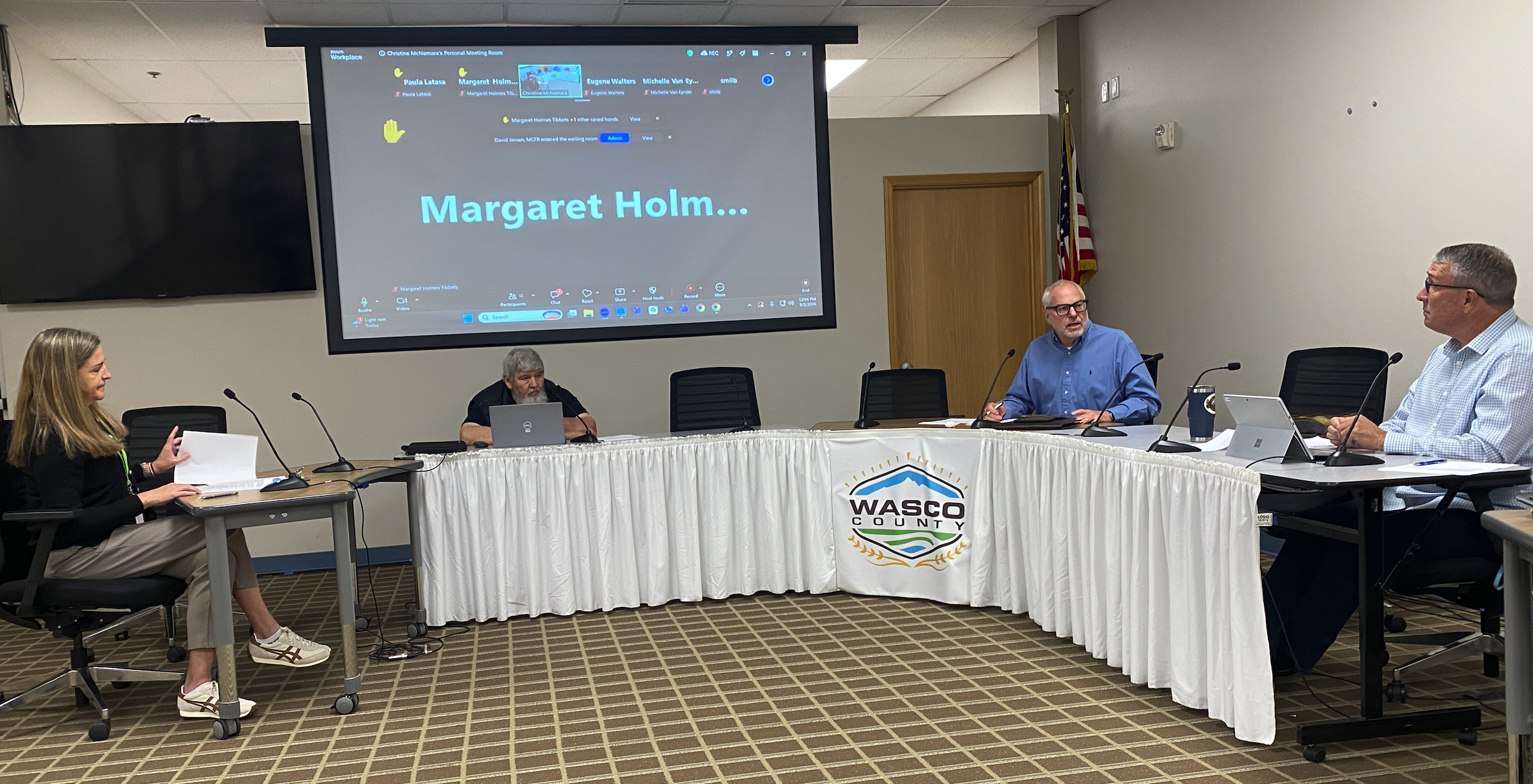
Commissioners Rodger Nichols, Scott Hege and Jeff Justesen agree to extend the hearing on a Wasco County endowment fund on Wednesday morning. The fund could be worth up to $150 million after 15 years and provide annual revenue to the county between $2.5 million to $ 5.5 million.
By Tom Peterson
The Dalles, Ore., Sept. 2, 2026 — Wasco County commissioners and residents found plenty to agree on Wednesday: Investing millions of dollars in extraordinary economic-development revenues to create a permanent endowment for future generations is a good idea.
Now they're ironing out the details as commissioners are leaning heavily toward a formal approval at its next meeting, Sept. 23.
Not one person who testified during Wednesday's lengthy public hearing spoke against creating an endowment. Instead, questions centered on how much money could eventually flow into the fund, what revenues would qualify, whether some money should remain available for nearer-term infrastructure projects and how clearly the ordinance distinguishes county-retained revenues from money belonging to other taxing districts.
If approved, Wasco County would launch the endowment with up to $15 million in Google-related fees, then continue adding the county’s share of qualifying fee payments over the next 14 years while reinvesting the earnings. After 15 years, county projections estimate the fund’s principle amount could be $80 million and could generate roughly $2.5 million to $5.5 million a year in spendable investment earnings while leaving the principal intact to continue producing revenue.
Commissioners also left little doubt about where they stand.
Commissioner Jeff Justesen said he was willing to make a motion to approve the endowment Wednesday. Commissioner Rodger Nichols, appointed to the board just six weeks ago, said he had learned about the proposal only a little more than six weeks earlier but had become "very convinced this is something we absolutely have to do."
Nichols nevertheless favored waiting.
"I want everybody to have a chance to think about it," Nichols said, suggesting the county wait three weeks, make any necessary adjustments and then vote.
Commission Chair Scott Hege agreed.
Rather than adopt Ordinance 26-003 Wednesday, commissioners unanimously continued the hearing until Sept. 23 at 9:30 a.m., allowing county staff to make nonsubstantive clarifications to the language and giving residents more time to digest the numbers behind what could become one of Wasco County's most consequential long-term financial decisions.
"I think there's some minor tweaks that we can make and maybe make more clear what's in there," Hege said. "I think that would be helpful, and I think people would appreciate that."
The delay was not a retreat from the endowment proposal.
Hege called it "a great idea," said he was "super proud" of county staff for bringing it forward and said he wanted to "get this done sooner than later."
General support for an endowment ran through the public testimony on Wednesday.
Wasco County taxpayer Shelly Dean put it plainly.
"I think the endowment fund should absolutely happen," Dean said. "It's a great idea. No questions about it."
But she said she had only recently learned about the proposal and wanted additional time to understand the ordinance and the numbers behind it.
"We have the chance to eliminate the flaws before we move forth," she said.
That combination — support for an endowment coupled with requests for more explanation and precision — defined much of Wednesday's hearing.
South Wasco seeks assurances
Those questions were particularly evident among residents from South Wasco County, where renewable-energy development could generate substantial future tax revenue.
Jaron Wright told commissioners he had spoken with numerous people about the proposal and found support for the concept.
"The good news is this: No one that I've spoken to has an issue with the endowment fund, with the concept of the endowment fund," he said.
His concern was ensuring that taxes generated by projects in South Wasco County would not be pulled wholesale from school, fire and other taxing districts and placed into a county fund for 15 years.
Mark Radabaugh of The Dalles said county officials' explanations during Wednesday's hearing had largely reassured him.
"I'm encouraged from the discussions that we've had today from county representatives where they state that that isn't going to be the case," he said.
But he argued that the ordinance should make that distinction clearer.
"The main concern I think that you're going to hear from the constituents in this room today is to take a pause on the ordinance as it stands today because it's too ambiguous," he said.
County counsel told commissioners that the language could easily be clarified to further define "county-retained" funds and explicitly reiterate that revenues belonging to other taxing districts are not included.
That distinction was also addressed in detail by Wasco County Assessor and Tax Collector Jill Amery.
Amery said that under the county's current Strategic Investment Program agreement with Google, taxing districts first receive their share of taxes and a community service fee. Only the county's negotiated guaranteed annual payment is being considered for the endowment.
'My head is really spinning'
Another resident captured a different challenge facing the county: The financial mechanics are difficult for people who don't work with SIPs, abatements, valuations and investment models every day.
"To be perfectly honest, my head is really spinning," Kim Mead of Maupin told commissioners. "This is your guys' daily lingo. This is not my daily lingo."
She said the public needed more opportunities to understand the proposal and suggested town halls or other outreach.
"I do totally support investing in the future, don't get me wrong," she said. "I just request that citizens of Wasco County have opportunity to be educated on this procedure and ask for a little bit more time."
Margaret Holmes-Tibbetts also asked commissioners to slow down.
"I think it's great that Wasco County is thinking about the future," she said, but added that moving from the first hearing Aug. 19 to a potential vote Sept. 2 felt fast.
"We do need some time to process this," she said.
She also urged commissioners not to view Google's data centers as the county's only major future economic opportunity, pointing to energy development in South Wasco County.
"It sounded like this was a very The Dalles-centric discussion," she said, arguing that commissioners should consider the entire county and future industries that may emerge outside The Dalles.
Commissioner Hege later addressed that comment, noting information from staff about industrial space running out, was clearly directed at available space in the City of The Dalles. He, staff and other commissioners were fully aware of other opportunities such as wind and solar projects in south Wasco County.
How much money are we talking about?
The biggest numbers Wednesday came from Tygh Valley resident Lisa Gambee, who supports creating an endowment but has proposed dividing some future revenues between the long-term fund and a separate fund available for nearer-term projects.
"I want an endowment fund," Gambee told commissioners. "I think the idea is just getting an understanding — what kind of numbers are we talking about, and what's left for investment in other things?"
Gambee said her calculations were based on county figures and were intended to show that the discussion involves more than the initial $15 million.
"It's not $75 million right now," she said, noting it would be by the time all the money was put into the fund at the end of 15 years.
Gambee questioned whether some future revenue should remain available for infrastructure, particularly roads and bridges.
"Do we want to wait 15 years to do bridge projects?" she asked.
Amery pushed back on some of those projections.
She said future SIP payments cannot simply be multiplied by 15 because they are tied to annual property valuations that can rise or fall as equipment changes.
"That number was multiplied by 15, and that's the number that is being put out there, and that is inaccurate," Amery said. "You cannot straight-line that."
Amery said county officials and Oregon Department of Revenue specialists have made their best estimates but acknowledged that data center equipment and valuations are difficult to project 15 years into the future.
"We don't really know," she said, pointing out that annual valuations change, as equipment at data centers are depreciated and upgraded.
The power of compounding
County staff's argument for investing as much as possible now comes down largely to compound investment returns.
Community Development Director Kelly Howsley-Glover said the county has seen claims that it currently possesses $75 million that could instead be spent on community projects.
"We don't have $75 million in hand right now," Howsley-Glover said.
What the county knows, she said, is that it has up to $15 million available for the initial investment. Future Google fees in the form of Guaranteed Annual payments would then be added and investment earnings reinvested.
"We're hoping after 15 years that the principal will look like something like that because that will give us that $2.5 to $5.5 million annual interest that we can spend," she said.
Howsley-Glover showed commissioners modeling comparing larger and smaller initial investments. One projection beginning with about $13 million showed the fund potentially reaching roughly $80 million and producing an initial payout of about $2.82 million. Starting with roughly half as much produced considerably smaller returns.
"The magic" of the proposal, she said, is compound interest.
Hege went further during commissioner deliberations, saying he believes the fund could ultimately exceed current staff projections.
"I think we'll have over $150 million in the endowment at the end," Hege said, immediately acknowledging that staff would caution him against making such a projection.
His larger point was that compounding could turn one-time revenue into what he called "forever money" — principal capable of generating millions of dollars year after year.
"We will probably double the amount of money that we put in," Hege said.
'Once-in-a-lifetime opportunity'
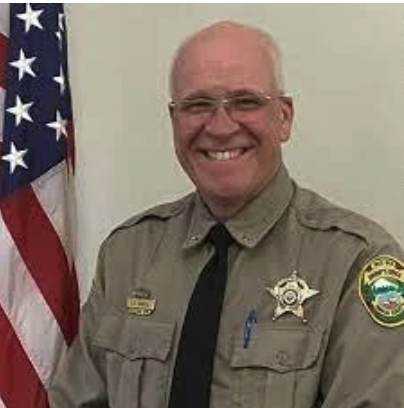
Wasco County Sheriff Lane Magill
Perhaps the strongest argument for the endowment came from Wasco County Sheriff Lane Magill, who drew on nearly 25 years working for the county.
Magill recalled the county's financial difficulties around 2004 and 2005, when he was among deputies facing layoffs.
"I was the guy off the bottom," Magill said.
He had tested with Oregon State Police and was preparing to leave when the county found a way to preserve the positions. He stayed because Wasco County was his home.
Magill said it took the county more than a decade to achieve the financial stability it enjoys today.
He argued that investing the windfall is an extension of the long-term budgeting practices that evolved six years ago helped the county get there.
"I can tell you this: The opportunity to invest this money in an endowment fund for future generations based on our strategic plan is a once-in-a-lifetime opportunity," Magill said.
The lesson from past downturns is that today's revenue cannot be assumed to last forever.
"We have to be good stewards of what we've got and be able to pass that on to the next generation," he said.
His message to commissioners was straightforward.
"Let's not kick the can down the road," Magill said. "Let's get this thing done."
Budgeting the Long Game
Wasco County officials said the county has become a model frequently pointed to by the Association of Oregon Counties for its long-term financial management, but it was not always that way.
County Administrator Tylor Stone recalled the painful budget years of the early 2006. Department directors described budget season then as essentially a zero-sum game: One department's gain could mean another's loss, while major maintenance, equipment replacement and future upgrades often went unfunded because there was little ability to plan ahead, as money left unspent was swept and rationed.
The meetings could become so emotional that tissues were routinely kept on hand for employees and department heads facing cuts. In the years since, the county has moved toward long-range department budgeting, built reserves and invested millions in PERS side accounts to control future retirement costs.
The proposed endowment is the next step in that evolution — using today's Google-related windfall to create a permanent internal revenue stream that could help sustain county services through future recessions, business closures, wildfires, floods or other crises without returning to the financial bloodletting county employees remember from two decades ago.
County says it can afford the investment
County officials also stressed that investing up to $15 million would not empty Wasco County's reserves or prevent it from helping communities during the next 15 years.
Finance Director Mike Middleton said the county would retain more than $20 million in unrestricted reserve accounts after making the initial investment. Restricted reserves for 911 and Public Works would remain untouched.
Hege emphasized the same point during deliberations.
"It's not like if we put the $15 million in there, we're strapped for the next 15 years and we can't help anybody or do anything," Hege said. "We will have a significant amount of resources to do other things."
He said the county would continue helping fund community projects while attempting to transform extraordinary one-time payments into a permanent revenue source.
"We will continue to be very healthy and have the ability to do a lot of things into the future, as well as have the one-time money convert into what I call forever money," Hege said.
Another commissioner said the county's financial position was a key reason for supporting the investment, noting that Wasco County does not depend on Google's extraordinary payments to keep its basic departments operating.
"We could carry on with all the activities in all 17 departments for two solid years without a dime of extra tax money," he said.
Why wait?
By the end of the hearing, there appeared to be little question about whether commissioners favored an endowment.
The question was whether to approve it Wednesday or give residents and staff a few more weeks.
Justesen was ready to act.
Nichols wanted to wait.
Hege, while strongly supporting the proposal, sided with giving people additional time.
Commissioners then unanimously continued the hearing until Sept. 23 and authorized staff to make nonsubstantive clarification changes to the ordinance.
The three-week pause leaves the fundamental proposal intact: Take an unusual influx of revenue that county officials say may never be repeated, invest it rather than spend it, and give compound interest time to transform today's windfall into a revenue source for future generations.